Nassar Rania M A, Kamel Hedaya A, Ghoniem Ahmed E, Alarcón Juan José, Sekara Agnieszka, Ulrichs Christian, Abdelhamid Magdi T
Agricultural Botany Department, Faculty of Agriculture, Cairo University, Giza 12613, Egypt.
Radioisotopes Department, Atomic Energy Authority, Dokki, Giza 12311, Egypt.
Plants (Basel). 2020 Feb 12;9(2):237. doi: 10.3390/plants9020237.
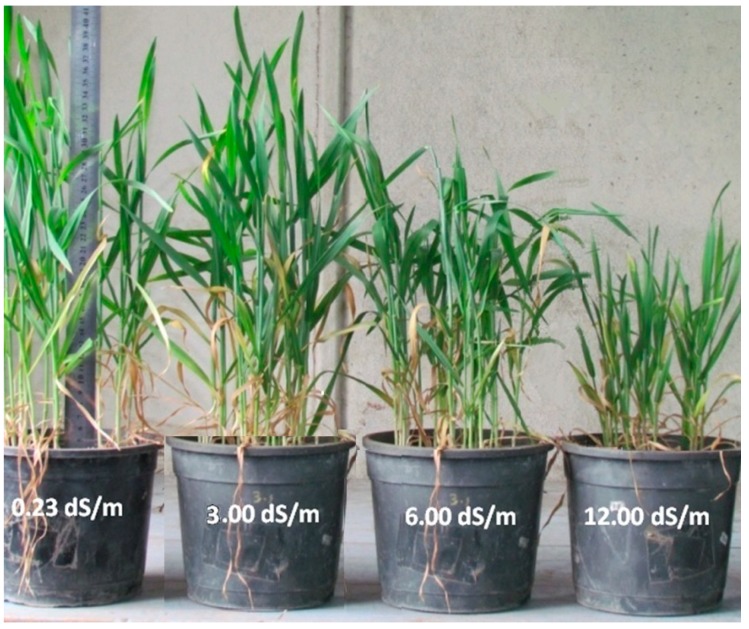
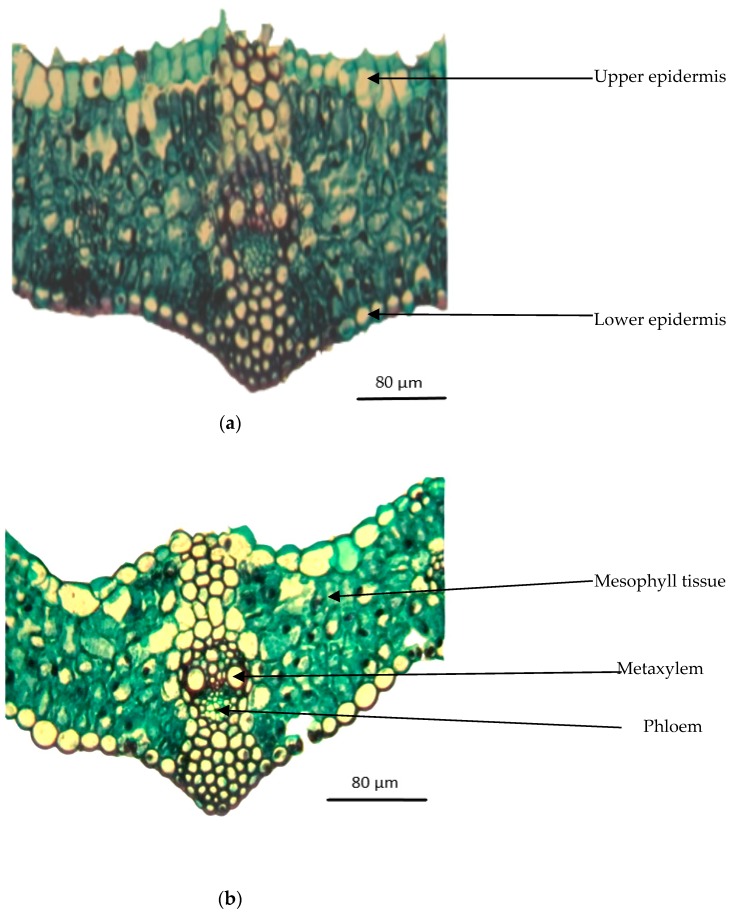
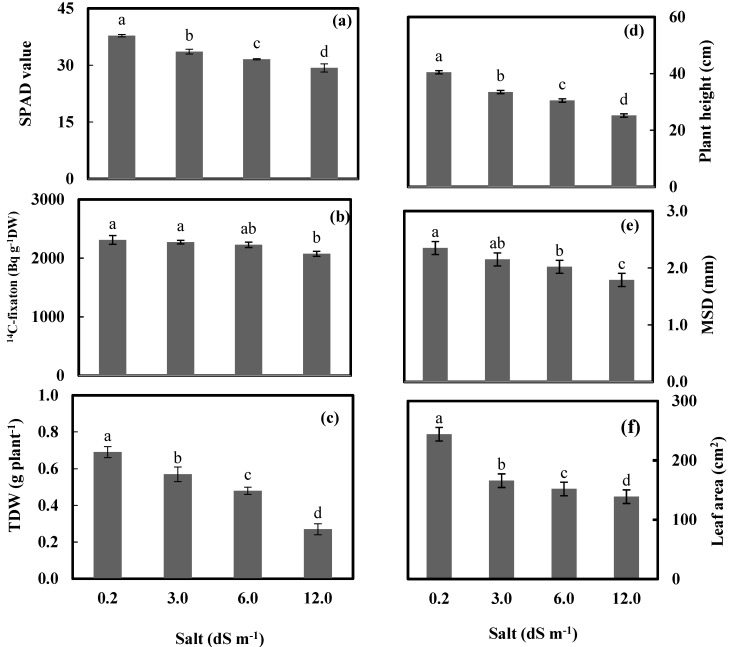
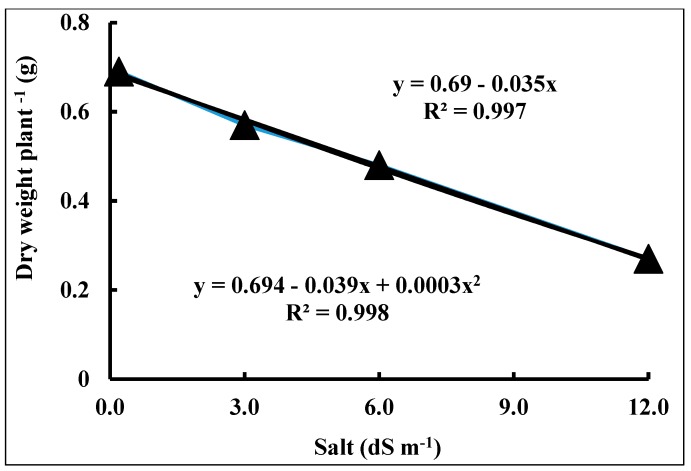
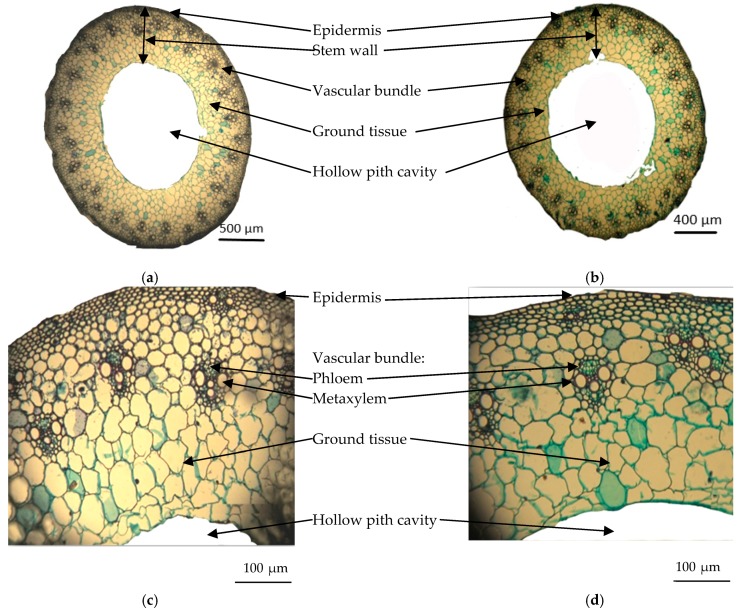
Two pot experiments were conducted in a greenhouse to examine C fixation and its distribution in biochemical leaf components, as well as the physiological and anatomical adaptability responses of wheat ( L.) grown with seawater diluted to 0.2, 3.0, 6.0, and 12.0 dS m. The results showed significant reductions in chlorophyll content, C fixation (photosynthesis), plant height, main stem diameter, total leaf area per plant, and total dry weight at 3.0, 6.0, and 12.0 dS m seawater salt stress. The C loss was very high at 12.0 ds m after 120 h. C in lipids (ether extract) showed significant changes at 12.0 dS m at 96 and 120 h. The findings indicated the leaf and stem anatomical feature change of wheat plants resulting from adaptation to salinity stress. A reduction in the anatomical traits of stem and leaf diameter, wall thickness, diameter of the hollow pith cavity, total number of vascular bundles, number of large and small vascular bundles, bundle length and width, thickness of phloem tissue, and diameter of the metaxylem vessel of wheat plants was found. In conclusion, salt stress induces both anatomical and physiological changes in the stem and leaf cells of wheat, as well as the tissues and organs, and these changes in turn make it possible for the plants to adapt successfully to a saline environment.
在温室中进行了两项盆栽试验,以研究碳固定及其在叶片生化成分中的分布,以及在稀释至0.2、3.0、6.0和12.0 dS m的海水中生长的小麦(L.)的生理和解剖适应性反应。结果表明,在3.0、6.0和12.0 dS m的海水盐胁迫下,叶绿素含量、碳固定(光合作用)、株高、主茎直径、单株总叶面积和总干重均显著降低。在12.0 dS m处理120小时后,碳损失非常高。在96和120小时时,12.0 dS m处理下脂质(乙醚提取物)中的碳显示出显著变化。研究结果表明,小麦植株因适应盐胁迫而发生叶和茎的解剖特征变化。发现小麦植株的茎和叶直径、壁厚、空心髓腔直径、维管束总数、大、小维管束数量、束长和宽度、韧皮部组织厚度以及后生木质部导管直径等解剖特征均有所降低。总之,盐胁迫诱导了小麦茎和叶细胞以及组织和器官的解剖和生理变化,而这些变化反过来又使植物能够成功适应盐碱环境。