Department of Cellular and Molecular Physiology, The Pennsylvania State University College of Medicine, 500 University Dr., Hershey, PA 17033, USA.
Inserm U1069 Nutrition, Croissance et Cancer, Université de Tours, 10 Boulevard Tonnellé, 37032 Tours, France.
Cells. 2020 Feb 12;9(2):432. doi: 10.3390/cells9020432.
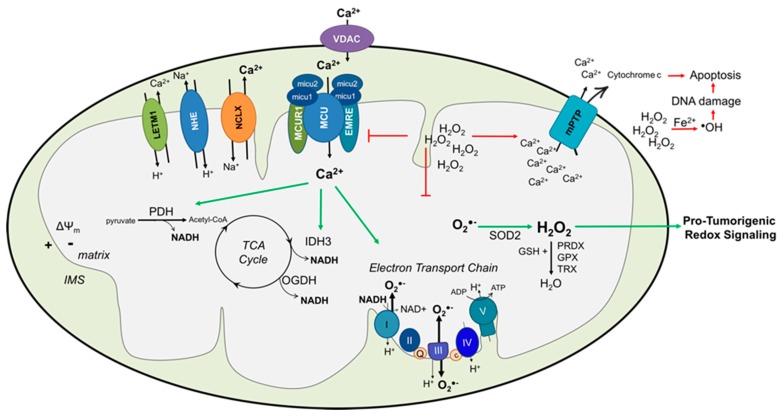
Calcium (Ca) uptake into the mitochondria shapes cellular Ca signals and acts as a key effector for ATP generation. In addition, mitochondria-derived reactive oxygen species (mROS), produced as a consequence of ATP synthesis at the electron transport chain (ETC), modulate cellular signaling pathways that contribute to many cellular processes. Cancer cells modulate mitochondrial Ca ([Ca]m) homeostasis by altering the expression and function of mitochondrial Ca channels and transporters required for the uptake and extrusion of mitochondrial Ca. Regulated elevations in [Ca]m are required for the activity of several mitochondrial enzymes, and this in turn regulates metabolic flux, mitochondrial ETC function and mROS generation. Alterations in both [Ca]m and mROS are hallmarks of many tumors, and elevated mROS is a known driver of pro-tumorigenic redox signaling, resulting in the activation of pathways implicated in cellular proliferation, metabolic alterations and stress-adaptations. In this review, we highlight recent studies that demonstrate the interplay between [Ca]m and mROS signaling in cancer.
钙(Ca)进入线粒体摄取会影响细胞内 Ca 信号转导,并作为生成 ATP 的关键效应因子。此外,线粒体来源的活性氧(mROS)是电子传递链(ETC)合成 ATP 的结果,它可以调节细胞信号通路,促进许多细胞过程。癌细胞通过改变摄取和排出线粒体 Ca 所需的线粒体 Ca 通道和转运蛋白的表达和功能来调节线粒体 Ca([Ca]m)稳态。[Ca]m 的调节性升高对于几种线粒体酶的活性是必需的,这反过来又调节代谢通量、线粒体 ETC 功能和 mROS 的产生。[Ca]m 和 mROS 的改变是许多肿瘤的特征,而升高的 mROS 是促进促肿瘤发生的氧化还原信号的已知驱动因素,导致与细胞增殖、代谢改变和应激适应相关的途径被激活。在这篇综述中,我们强调了最近的研究,这些研究表明 Ca 摄取与癌症中的 mROS 信号之间存在相互作用。