College of Medicine and Health, University of Exeter, Exeter, UK.
Plymouth University, Plymouth, UK.
BMC Fam Pract. 2020 Feb 14;21(1):35. doi: 10.1186/s12875-020-01106-z.
NICE guidelines for the management of emotional concerns in primary care emphasise the importance of communication and a trusting relationship, which is difficult to operationalise in practice. Current pressures in the NHS mean that it is important to understand care from a patient perspective. This study aimed to explore patients' experiences of primary care consultations for emotional concerns and what patients valued when seeking care from their GP.
Eighteen adults with experience of consulting a GP for emotional concerns participated in 4 focus groups. Data were analysed thematically.
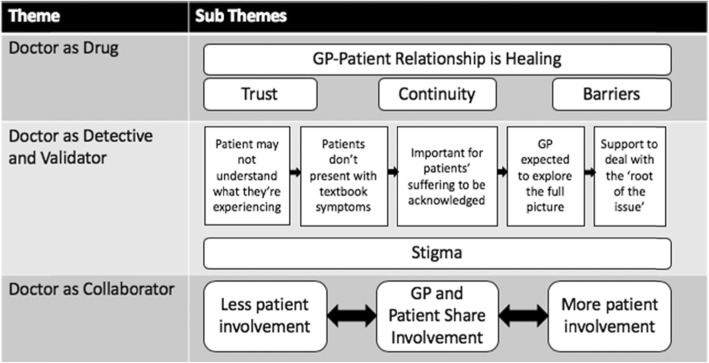
(1) Doctor as Drug: Patients' relationship with their GP was considered therapeutic with continuity particularly valued. (2) Doctor as Detective and Validator: Patients were often puzzled by their symptoms, not recognising their emotional concerns. GPs needed to play the role of detective by exploring not just symptoms, but the person and their life circumstances. GPs were crucial in helping patients understand and validate their emotional concerns. (3) Doctor as Collaborator: Patients prefer a collaborative partnership, but often need to relinquish involvement because they are too unwell, or take a more active role because they feel GPs are ill-equipped or under too much pressure to help. Patients valued: GPs booking their follow up appointments; acknowledgement of stressful life circumstances; not relying solely on medication.
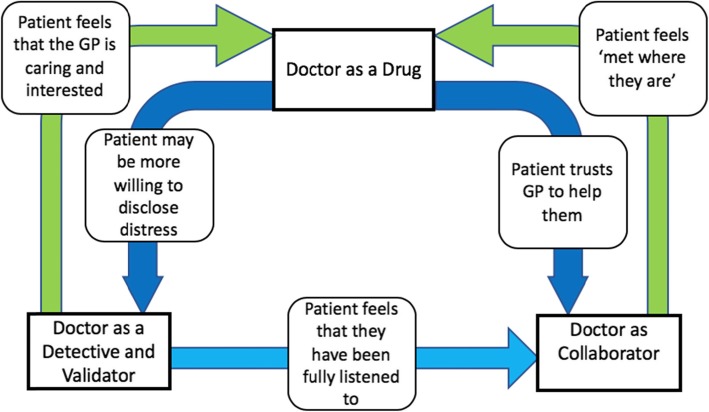
Seeking help for emotional concerns is challenging due to stigma and unfamiliar symptoms. GPs can support disclosure and understanding of emotional concerns by fully exploring and validating patients' concerns, taking into account patients' life contexts. This process of exploration and validation forms the foundation of a curative, trusting GP-patient relationship. A trusting relationship, with an emphasis on empathy and understanding, can make patients more able to share involvement in their care with GPs. This process is cyclical, as patients feel that their GP is caring, interested, and treating them as a person, further strengthening their relationship. NICE guidance should acknowledge the importance of empathy and validation when building an effective GP-patient partnership, and the role this has in supporting patients' involvement in their care.
NICE 指南强调了初级保健中情感问题管理中沟通和信任关系的重要性,但在实践中很难实施。目前英国国家医疗服务体系的压力意味着,从患者的角度了解护理服务非常重要。本研究旨在探讨患者在寻求全科医生治疗情感问题时的就诊体验,以及患者在寻求全科医生治疗时看重的因素。
18 名有过因情绪问题咨询全科医生经历的成年人参加了 4 次焦点小组。对数据进行了主题分析。
(1)医生如药物:患者与全科医生的关系被认为具有治疗作用,连续性尤其受到重视。(2)医生如侦探和验证者:患者经常对自己的症状感到困惑,无法识别自己的情绪问题。医生需要通过探索症状、个人和生活环境来扮演侦探的角色。医生在帮助患者理解和验证他们的情绪问题方面起着至关重要的作用。(3)医生如合作者:患者更喜欢合作的伙伴关系,但由于身体不适,往往需要放弃参与,或者因为觉得医生没有能力或压力过大而更积极地参与。患者看重:全科医生预约复诊;承认生活压力大;不只是依赖药物。
由于污名化和不熟悉的症状,寻求情感问题的帮助具有挑战性。全科医生可以通过充分探索和验证患者的担忧,考虑到患者的生活背景,来支持对情绪问题的披露和理解。这一探索和验证过程是建立一种治疗性、信任性的医患关系的基础。信任关系,强调同理心和理解,可以使患者更愿意与全科医生共同参与他们的治疗。这个过程是循环的,因为患者感到他们的医生关心、感兴趣,把他们当作一个人来对待,进一步加强了他们的关系。NICE 指南应承认同理心和验证在建立有效的医患伙伴关系中的重要性,以及在支持患者参与他们的治疗中所起的作用。