Programme in Emerging Infectious Diseases, Duke-National University of Singapore Medical School, Singapore, 169857, Singapore.
Centre for BioImaging Sciences, Department of Biological Sciences, National University of Singapore, Singapore, 117557, Singapore.
Nat Commun. 2020 Feb 14;11(1):895. doi: 10.1038/s41467-020-14647-9.
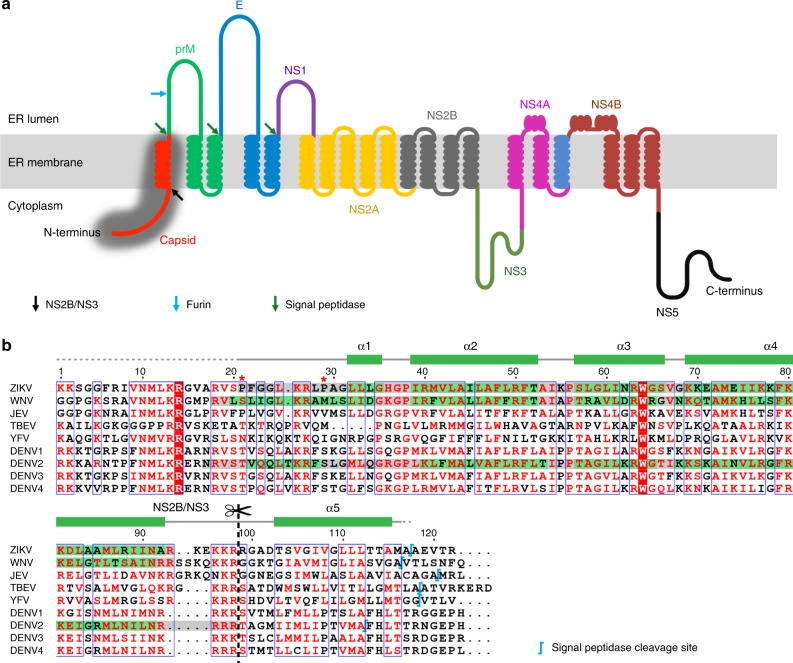
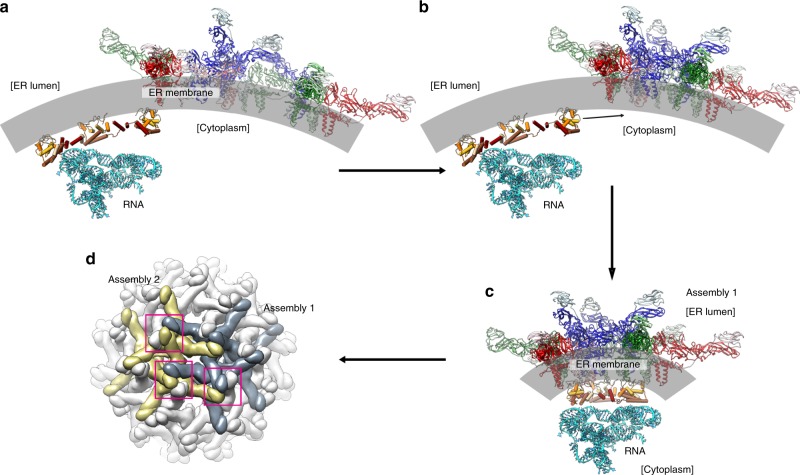
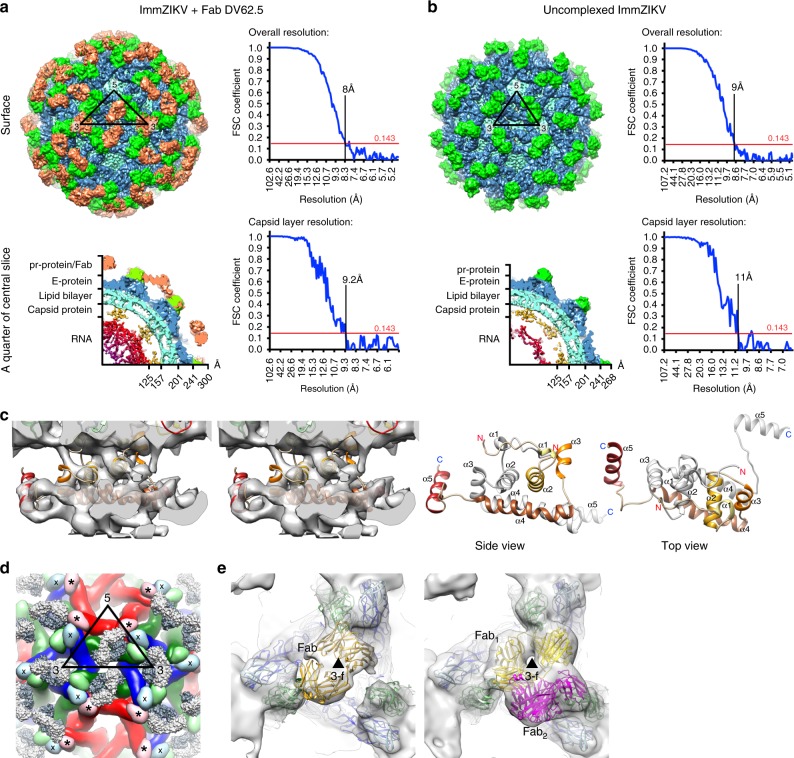
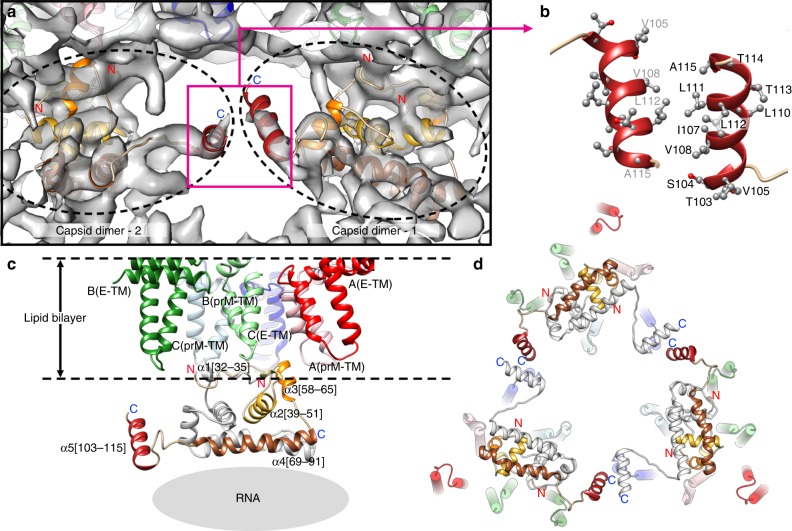
Structures of flavivirus (dengue virus and Zika virus) particles are known to near-atomic resolution and show detailed structure and arrangement of their surface proteins (E and prM in immature virus or M in mature virus). By contrast, the arrangement of the capsid proteins:RNA complex, which forms the core of the particle, is poorly understood, likely due to inherent dynamics. Here, we stabilize immature Zika virus via an antibody that binds across the E and prM proteins, resulting in a subnanometer resolution structure of capsid proteins within the virus particle. Fitting of the capsid protein into densities shows the presence of a helix previously thought to be removed via proteolysis. This structure illuminates capsid protein quaternary organization, including its orientation relative to the lipid membrane and the genomic RNA, and its interactions with the transmembrane regions of the surface proteins. Results show the capsid protein plays a central role in the flavivirus assembly process.
结构的黄病毒(登革热病毒和 Zika 病毒)粒子已知接近原子分辨率,并显示其表面蛋白(E 和 prM 在不成熟的病毒或 M 在成熟的病毒)的详细结构和排列。相比之下,衣壳蛋白的排列:RNA 复合物,它形成粒子的核心,是了解甚少,可能是由于内在的动态。在这里,我们通过一种抗体稳定不成熟的 Zika 病毒,该抗体横跨 E 和 prM 蛋白结合,导致衣壳蛋白在病毒粒子内的亚纳米分辨率结构。衣壳蛋白的密度拟合表明存在以前认为通过蛋白水解去除的螺旋。该结构阐明了衣壳蛋白的四级组织,包括其相对于脂质膜和基因组 RNA 的取向,以及与表面蛋白的跨膜区的相互作用。结果表明,衣壳蛋白在黄病毒组装过程中起着核心作用。