Division of Epidemiology, Department of Health Informatics and Public Health, Tohoku University School of Public Health, Graduate School of Medicine, 2-1 Seiryo-machi, Aoba-ku, Sendai, Miyagi, 980-8575, Japan.
Eur J Epidemiol. 2020 Sep;35(9):851-860. doi: 10.1007/s10654-020-00612-9. Epub 2020 Feb 15.
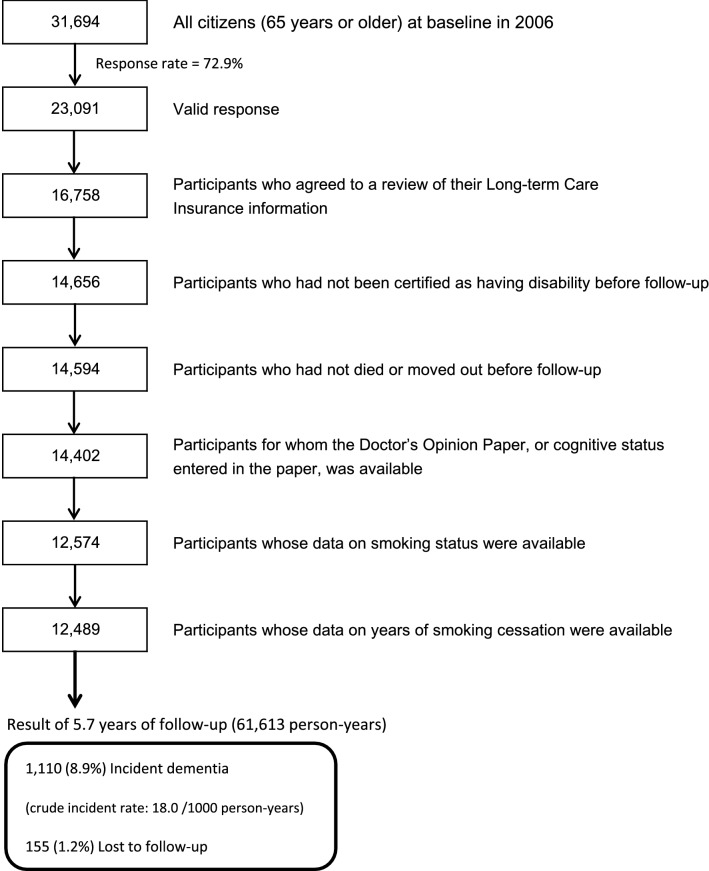
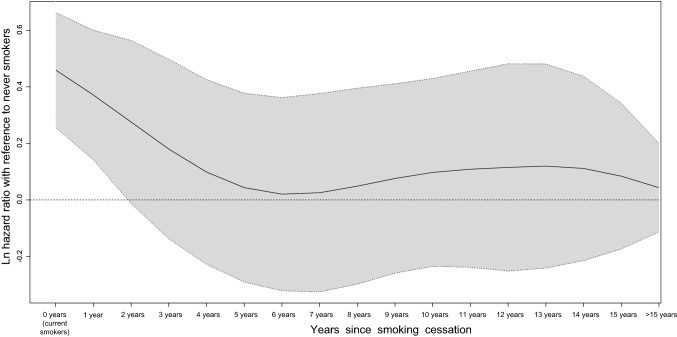
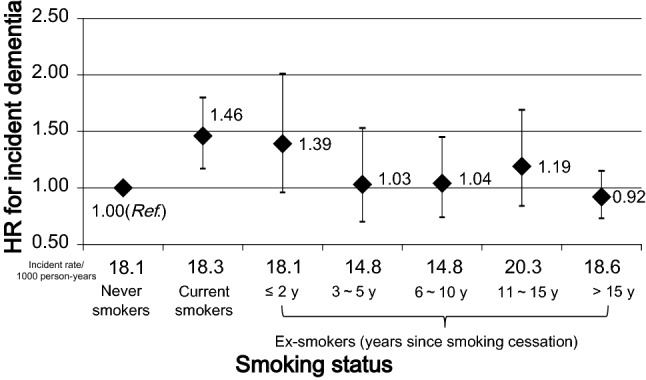
To investigate the association of smoking status and years since smoking cessation with the risk of incident dementia among elderly Japanese. We conducted a longitudinal analysis of smoking status and smoking cessation with dementia in prospective cohort study of 12,489 Japanese individuals aged ≥ 65 years who were followed up for 5.7 years. Information on smoking status and other lifestyle factors was collected via a questionnaire in 2006. Data on incident dementia were retrieved from the public Long-term Care Insurance Database. The Cox proportional hazards model was used to estimate the multivariable-adjusted hazard ratios (HRs) and 95% confidence intervals (95% CIs) for incident dementia. During 61,613 person-years of follow-up, 1110 cases (8.9%) of incident dementia were documented. Compared with individuals who had never smoked, current smokers showed a higher risk of dementia (HR 1.46, 95% CI 1.17, 1.80). Among ex-smokers, the risk for those who had stopped smoking for ≤ 2 years was still high (HR 1.39, 95% CI 0.96, 2.01), however, quitting smoking for 3 years or longer mitigated the increased risk incurred by smokers; the multivariable HRs (95% CIs) were 1.03 (0.70, 1.53) for those who had stopped smoking for 3-5 years, 1.04 (0.74, 1.45) for 6-10 years, 1.19 (0.84, 1.69) for 11-15 years, and 0.92 (0.73, 1.15) for > 15 years. Our study suggests that the risk of incident dementia among ex-smokers becomes the same level as that of never smokers if they maintain abstinence from smoking for at least 3 years.
为了探究吸烟状况和戒烟年限与日本老年人发生痴呆风险之间的关联,我们对 12489 名年龄≥65 岁的日本老年人进行了一项前瞻性队列研究,这些老年人参与了一项关于吸烟状况和戒烟与痴呆关系的研究。通过问卷调查收集了参与者的吸烟状况和其他生活方式因素的信息,调查时间为 2006 年。从公共长期护理保险数据库中获取了痴呆发病的相关数据。使用 Cox 比例风险模型估计了多变量调整后的风险比(HR)及其 95%置信区间(95%CI),以评估痴呆的发病风险。在 61613 人年的随访期间,有 1110 例(8.9%)发生了痴呆。与从不吸烟者相比,当前吸烟者发生痴呆的风险更高(HR 1.46,95%CI 1.17,1.80)。在戒烟者中,戒烟时间≤2 年者的风险仍然较高(HR 1.39,95%CI 0.96,2.01),但戒烟 3 年以上可降低吸烟者的发病风险;多变量 HR(95%CI)分别为戒烟 3-5 年者为 1.03(0.70,1.53)、戒烟 6-10 年者为 1.04(0.74,1.45)、戒烟 11-15 年者为 1.19(0.84,1.69)和戒烟>15 年者为 0.92(0.73,1.15)。我们的研究表明,戒烟者如果能保持至少 3 年的不吸烟状态,其发生痴呆的风险与从不吸烟者相同。