Wu Dongyuan, Li Xinyuan, Zhang Xiaohan, Han Fang, Lu Xin, Liu Lei, Zhang Junsheng, Dong Mei, Yang Huanjie, Li Hui
Department of Biochemistry and Molecular Biology, Basic Medical Science College, Harbin Medical University, Harbin, China.
Department of Pharmacy, Harbin Medical University Cancer Hospital, Harbin, China.
Front Oncol. 2020 Jan 29;9:1524. doi: 10.3389/fonc.2019.01524. eCollection 2019.
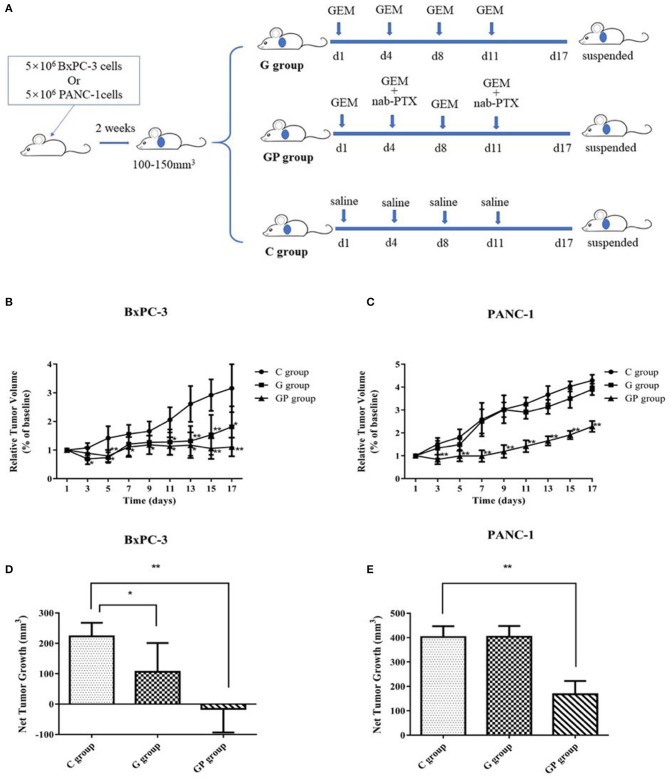
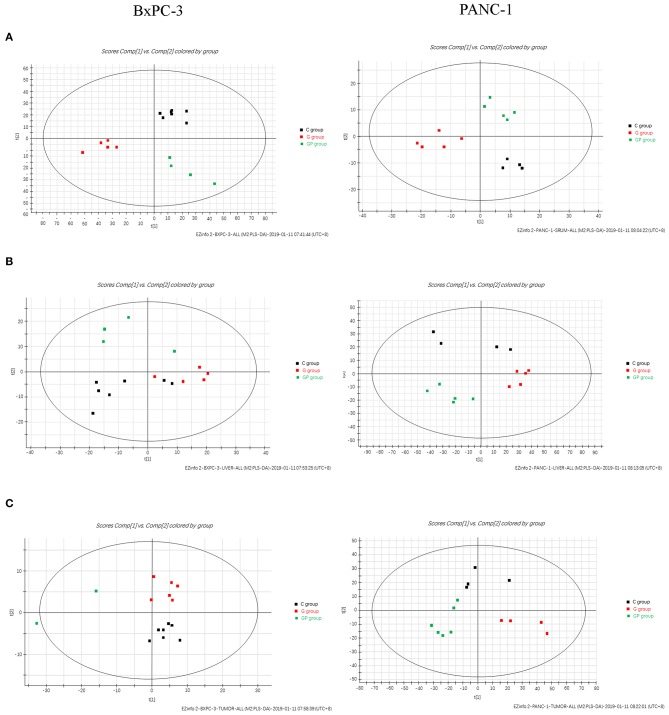
Gemcitabine (GEM)-based chemotherapy is the standard regimen for the treatment of pancreatic cancer (PC). However, chemoresistance is a major challenge in PC treatment. Reliable biomarkers are urgently needed to predict the response to GEM-based therapies. GEM-sensitive (GEM-S) and GEM-resistant (GEM-R) pancreatic carcinoma xenograft models were established, and GEM monotherapy and GEM plus nanoparticle albumin-bound paclitaxel (nab-PTX) doublet therapy were administered to GEM-S/R tumor-bearing mice. Metabolomic mass spectrometry (MS) analysis of serum, liver, and tumor samples was performed using an ultraperformance liquid chromatography-quadrupole time-of-flight mass spectrometer. The results showed that both GEM monotherapy and combination therapy significantly inhibited the tumor growth in GEM-S subgroup. However, in the GEM-R subgroup, tumor growth was not significantly inhibited by GEM monotherapy, but was significantly suppressed by GEM combination therapy. Metabolic profiling analysis by hierarchical cluster analysis and partial least squares discriminant analysis showed that the differences in metabolites were most significant in serum of three types of samples in the GEM-S/R subgroups, regardless of the administration of GEM monotherapy or combination therapy. The differential metabolite analysis of serum samples revealed 38 and 26 differential metabolites between the GEM-R and GEM-S subgroups treated with GEM monotherapy or combination therapy, and four common discriminating metabolites were investigated: 3-hydroxyadipic acid, d-galactose, lysophosphatidylcholine (LysoPC) (P-16:0), and tetradecenoyl-l-carnitine. The relative amounts of the four metabolites changed significantly and consistently after GEM monotherapy or combination therapy. The levels of these four metabolites were significantly different in the GEM-S and GEM-R pancreatic carcinoma xenograft models; thus, these metabolites could be effective predictive indicators of the efficacy of chemotherapy in PC patients, regardless of the administration of GEM alone or GEM plus nab-PTX.
吉西他滨(GEM)为基础的化疗是治疗胰腺癌(PC)的标准方案。然而,化疗耐药是PC治疗中的一个主要挑战。迫切需要可靠的生物标志物来预测对基于GEM疗法的反应。建立了GEM敏感(GEM-S)和GEM耐药(GEM-R)胰腺癌异种移植模型,并对荷GEM-S/R肿瘤的小鼠进行GEM单药治疗以及GEM联合纳米白蛋白结合型紫杉醇(nab-PTX)的双联疗法。使用超高效液相色谱-四极杆飞行时间质谱仪对血清、肝脏和肿瘤样本进行代谢组质谱(MS)分析。结果显示,GEM单药治疗和联合治疗均显著抑制了GEM-S亚组中的肿瘤生长。然而,在GEM-R亚组中,GEM单药治疗未显著抑制肿瘤生长,但GEM联合治疗显著抑制了肿瘤生长。通过层次聚类分析和偏最小二乘判别分析进行的代谢谱分析表明,无论给予GEM单药治疗还是联合治疗,GEM-S/R亚组中三种类型样本的血清中代谢物差异最为显著。血清样本的差异代谢物分析显示,接受GEM单药治疗或联合治疗的GEM-R和GEM-S亚组之间分别有38种和26种差异代谢物,并对四种共同的鉴别代谢物进行了研究:3-羟基己二酸、d-半乳糖、溶血磷脂酰胆碱(LysoPC)(P-16:0)和十四碳烯酰-L-肉碱。GEM单药治疗或联合治疗后,这四种代谢物的相对含量发生了显著且一致的变化。这四种代谢物的水平在GEM-S和GEM-R胰腺癌异种移植模型中存在显著差异;因此,无论单独给予GEM还是GEM加nab-PTX,这些代谢物都可能是PC患者化疗疗效的有效预测指标。