Liu Lixing, Gong Yang, Zhang Qinglin, Cai Panpan, Feng Li
Department of Chinese Medicine, National Cancer Center, National Clinical Research Center for Cancer/Cancer Hospital, Chinese Academy of Medical Sciences and Peking Union Medical College, Beijing, China.
The General Hospital of Shenyang Military Region, Shenyang, China.
Front Oncol. 2020 Jan 29;9:1557. doi: 10.3389/fonc.2019.01557. eCollection 2019.
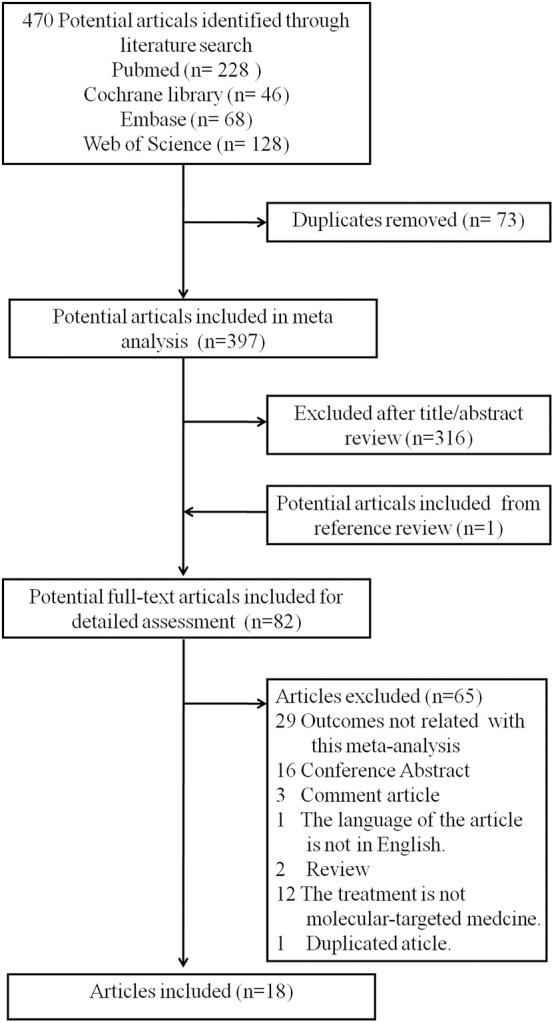
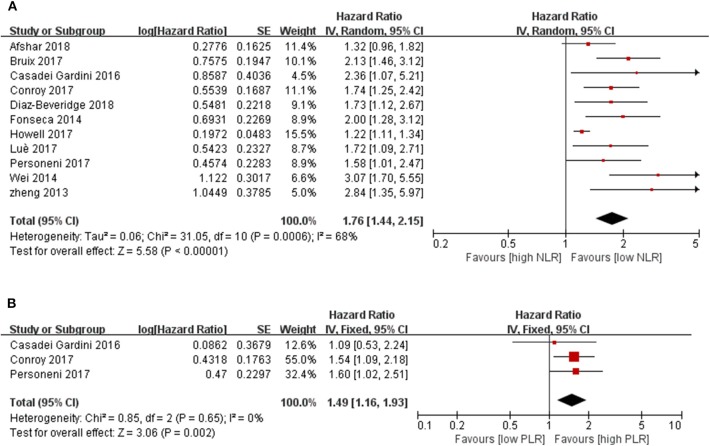
The purpose of this meta-analysis is to investigate the effectiveness of the prognostic roles of blood inflammatory markers in hepatocellular carcinoma (HCC) patients receiving sorafenib. We carried out a comprehensive literature search in four databases. Study endpoints, hazard ratios (HRs) and the associated 95% confidence intervals (CI) for clinical outcomes, which were to assess therapeutic efficacy, were extracted. This meta-analysis was conducted by Review Manager 5.3. We summarized the available evidence from 18 studies with a total of 2,745 cases. The pooled results showed that the synthesized HR favored patients with low pretreatment NLR (neutrophil-to-lymphocyte ratio), which also indicated that HCC patients with a lower baseline NLR may have a better response to sorafenib than those with higher NLR (HR = 1.76, 95% CI [1.44, 2.15], < 0.00001, = 68%). Significance was also observed for the prognostic function of the PLR (platelet-to-lymphocyte ratio) of HCC patients treated with sorafenib (HR = 1.49, 95% CI [1.16, 1.93], = 0.002, = 0%, = 0.65). The subgroup analysis revealed that different gene backgrounds play a prominent role in the source of heterogeneity. Interestingly, the predictive effect on OS (overall survival) was more pronounced as the NLR cutoff value increased. Notably, a significant predictive effect of NLR on the clinical outcome was detected in HCC patients treated with sorafenib compared to those treated with tivantinib. In conclusion, the present study reported promising predictive biomarkers for HCC patients and notably indicated that HCC patients with a lower baseline NLR and PLR may have a better response to sorafenib than those with higher ones. Further large-scale prospective studies are required to determine the optimal NLR and PLR cutoff values, which are important for identifying the dominant populations for sorafenib treatment.
本荟萃分析的目的是研究血液炎症标志物在接受索拉非尼治疗的肝细胞癌(HCC)患者中的预后作用的有效性。我们在四个数据库中进行了全面的文献检索。提取了用于评估治疗效果的研究终点、风险比(HRs)以及临床结局的相关95%置信区间(CI)。本荟萃分析由Review Manager 5.3进行。我们总结了18项研究中的现有证据,共计2745例病例。汇总结果显示,综合HR有利于预处理时中性粒细胞与淋巴细胞比值(NLR)低的患者,这也表明基线NLR较低的HCC患者对索拉非尼的反应可能优于NLR较高的患者(HR = 1.76,95% CI [1.44, 2.15],< 0.00001,I² = 68%)。对于接受索拉非尼治疗的HCC患者的血小板与淋巴细胞比值(PLR)的预后功能也观察到了显著性(HR = 1.49,95% CI [1.16, 1.93],P = 0.002,I² = 0%,τ² = 0.65)。亚组分析显示,不同的基因背景在异质性来源中起显著作用。有趣的是,随着NLR临界值的增加,对总生存期(OS)的预测效果更明显。值得注意的是,与接受替凡替尼治疗的HCC患者相比,在接受索拉非尼治疗的HCC患者中检测到NLR对临床结局有显著的预测作用。总之,本研究报告了HCC患者有前景的预测生物标志物,并特别指出基线NLR和PLR较低的HCC患者对索拉非尼的反应可能优于较高的患者。需要进一步的大规模前瞻性研究来确定最佳的NLR和PLR临界值,这对于识别索拉非尼治疗的优势人群很重要。