Institute of Psychiatry, Psychology & Neuroscience, King's College London, UK; ESRC Centre for Society and Mental Health, King's College London, UK.
Institute of Psychiatry, Psychology & Neuroscience, King's College London, UK; ESRC Centre for Society and Mental Health, King's College London, UK; Department of Public Mental Health, Central Institute of Mental Health, Medical Faculty Mannheim, University of Heidelberg, Mannheim, Germany.
J Psychiatr Res. 2020 Apr;123:145-150. doi: 10.1016/j.jpsychires.2020.02.002. Epub 2020 Feb 6.
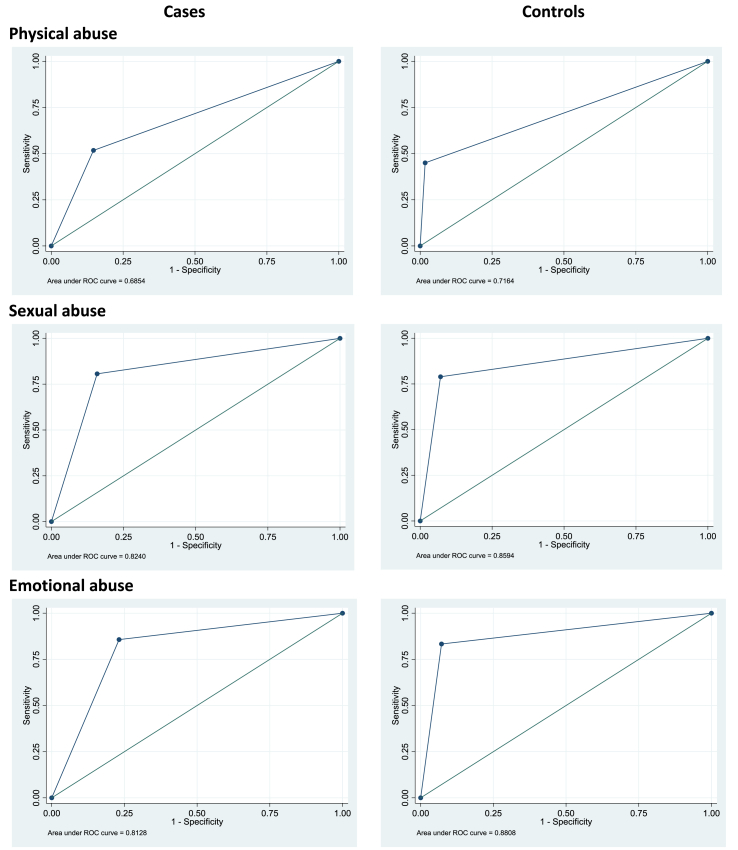
The typical reliance on self-report questionnaires in retrospective case-control studies of childhood abuse and psychotic disorders has been criticised, due to the potential for recall bias associated with, amongst other factors, cognitive impairments and detachment from reality, among individuals with psychosis. One way to establish if any substantial bias may exist is to examine whether the concordance of reports of childhood abuse established from retrospective self-report methods versus more comprehensive interviewer-rated assessments differ between individuals with psychosis and controls. Data from the Childhood Adversity and Psychosis (CAPsy) study were used to examine the accuracy, strength of agreement, and convergent validity of two distinct retrospective measures of childhood abuse: a self-report questionnaire (the Childhood Trauma Questionnaire; CTQ) and a comprehensive interview (the Childhood Experiences of Care and Abuse schedule; CECA). In a sample of 234 cases with first-episode psychosis and 293 controls, we found no strong evidence that the validity of the two measures differed between cases and controls. For reports of sexual and emotional abuse, we found fair levels of agreement between CECA and CTQ ratings in both groups (kappa coefficients 0.43-0.53), moderate to high sensitivity and specificity, and reasonably high convergent validity (tetrachoric correlations of 0.78-0.80). For physical abuse, convergent validity was slightly lower in cases compared with controls. Both measures can be used in future studies to retrospectively assess associations between childhood abuse and psychotic phenomena, but time-permitting, the CECA is preferable as it provides additional important contextual details of abuse exposure.
在回顾性病例对照研究中,典型的依赖于自我报告问卷来研究儿童期虐待和精神障碍的方法受到了批评,因为与认知障碍和与现实脱节等因素相关,个体在精神病中的回忆偏差的可能性。一种确定是否存在任何实质性偏差的方法是检查从回顾性自我报告方法与更全面的访谈者评定评估中确定的儿童虐待报告的一致性是否在精神病患者和对照组之间存在差异。童年逆境与精神病学(CAPsy)研究的数据用于检查两种不同的儿童虐待回顾性测量方法的准确性、一致性和收敛效度:自我报告问卷(儿童期创伤问卷;CTQ)和全面访谈(儿童期经历关爱和虐待量表;CECA)。在一个首发精神病的 234 例病例和 293 例对照的样本中,我们没有发现有力证据表明这两种测量方法在病例和对照组之间的有效性存在差异。对于性虐待和情感虐待的报告,我们发现 CECA 和 CTQ 在两组中的评分之间存在公平的一致性(kappa 系数 0.43-0.53)、中等至高度的敏感性和特异性,以及相当高的收敛效度(四分相关系数为 0.78-0.80)。对于身体虐待,病例组的收敛效度略低于对照组。两种方法都可以在未来的研究中用于回顾性评估儿童期虐待与精神现象之间的关联,但如果时间允许,CECA 是更好的选择,因为它提供了关于虐待暴露的更多重要的背景细节。