Center for the Study of Traumatic Stress, Department of Psychiatry, Uniformed Services University of the Health Sciences, Bethesda, MD, 20814, USA.
Transl Psychiatry. 2020 Jan 23;10(1):31. doi: 10.1038/s41398-020-0693-1.
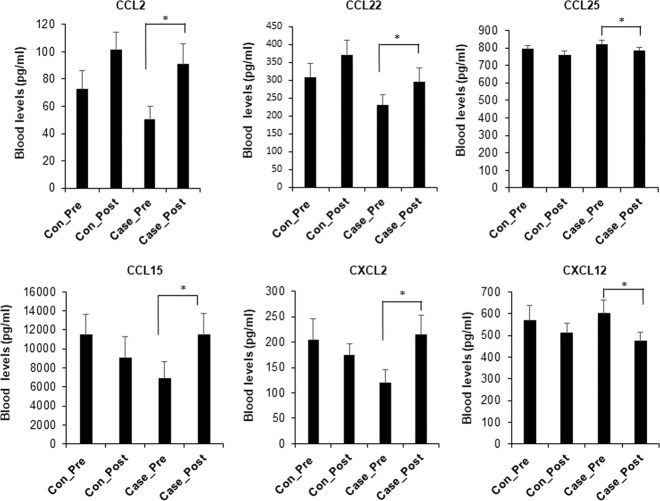
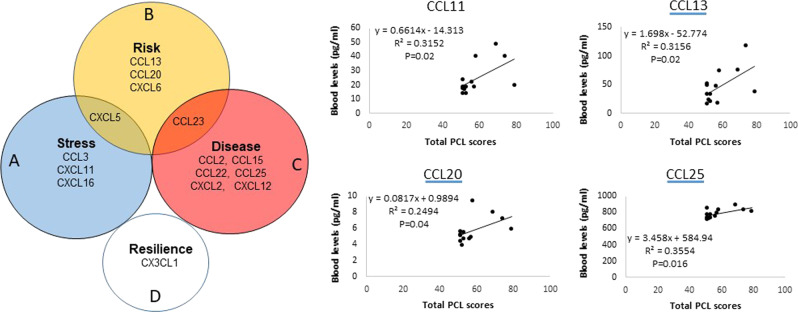
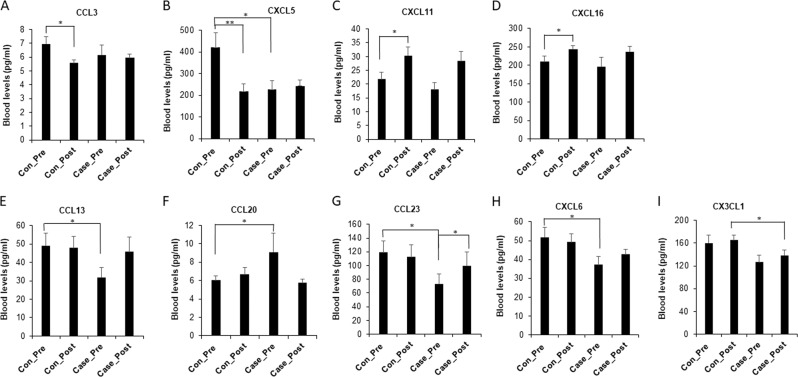
Cytokines, including chemokines, are small secreted proteins, which specifically effect on the interactions and communications between cells. Pro-inflammatory cytokines are produced predominantly by activated macrophages and are involved in the upregulation of inflammatory reactions. Dysregulation of cytokines is associated with post-traumatic stress disorder (PTSD). Here, we use both before-and-after and case-control studies to search for potential chemokine biomarkers associated with PTSD onset, risk, and resilience as well as stress responses in US military service members deployed to Iraq and Afghanistan. Blood samples and scores of the PTSD Checklist (PCL) were obtained from soldiers pre- and post deployment (pre, post). Forty chemokines were measured using the Bio-Plex Pro Human Chemokine Panel Assays. The before-and-after analysis showed potential markers (CCL2, CCL15, CCL22, CCL25, CXCL2, and CXCL12) are associated with PTSD onset, and CCL3, CXCL11, and CXCL16 are related to stress response. The case-control study demonstrated that CCL13, CCL20, and CXCL6 were possible PTSD risk markers, and CX3CL1 might be a resilience marker. In addition, CCL11, CCL13, CCL20, and CCL25 were correlated with the PCL scores, indicating their association with PTSD symptom severity. Our data, for the first time, suggest that these dysregulated chemokines may serve as biomarkers for PTSD onset, risk, and resilience as well as stress responses, and may benefit developing approaches not only for PTSD diagnosis but also for PTSD treatment.
细胞因子,包括趋化因子,是小的分泌蛋白,它们特异性地影响细胞之间的相互作用和通讯。促炎细胞因子主要由活化的巨噬细胞产生,并参与炎症反应的上调。细胞因子的失调与创伤后应激障碍(PTSD)有关。在这里,我们使用前后对照和病例对照研究来寻找与 PTSD 发病、风险和恢复相关的潜在趋化因子生物标志物,以及与部署到伊拉克和阿富汗的美国军人的应激反应相关的潜在趋化因子生物标志物。在部署前(pre)和部署后(post),从士兵身上获得 PTSD 检查表(PCL)的分数和血液样本。使用 Bio-Plex Pro 人类趋化因子面板分析测定了 40 种趋化因子。前后对照分析显示,潜在标志物(CCL2、CCL15、CCL22、CCL25、CXCL2 和 CXCL12)与 PTSD 发病有关,CCL3、CXCL11 和 CXCL16 与应激反应有关。病例对照研究表明,CCL13、CCL20 和 CXCL6 可能是 PTSD 风险标志物,而 CX3CL1 可能是恢复标志物。此外,CCL11、CCL13、CCL20 和 CCL25 与 PCL 分数相关,表明它们与 PTSD 症状严重程度有关。我们的数据首次表明,这些失调的趋化因子可能作为 PTSD 发病、风险和恢复以及应激反应的生物标志物,并可能有助于开发不仅用于 PTSD 诊断而且用于 PTSD 治疗的方法。