Duke Brain Imaging and Analysis Center, Duke University School of Medicine, Durham, NC, USA.
Mid-Atlantic Mental Illness Research Education and Clinical Center (MIRECC), Durham, NC, USA.
Transl Psychiatry. 2020 Feb 10;10(1):61. doi: 10.1038/s41398-020-0739-4.
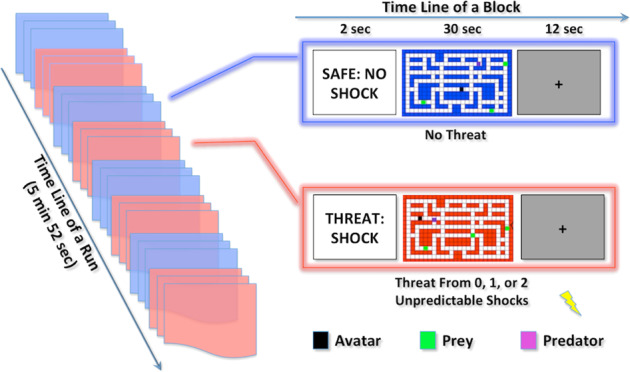
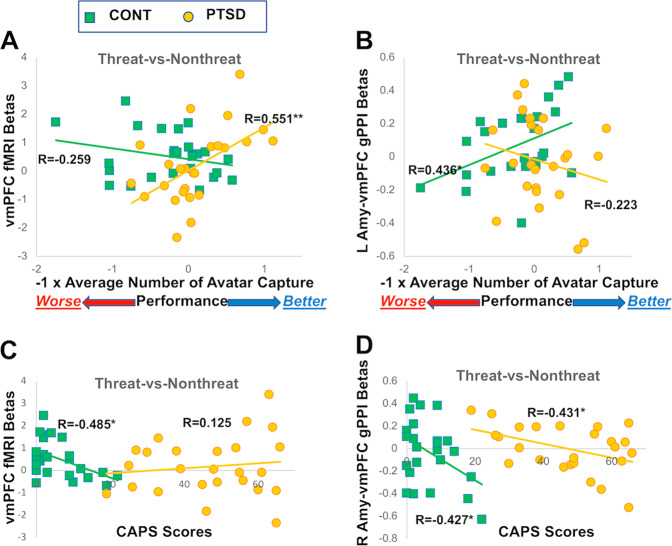
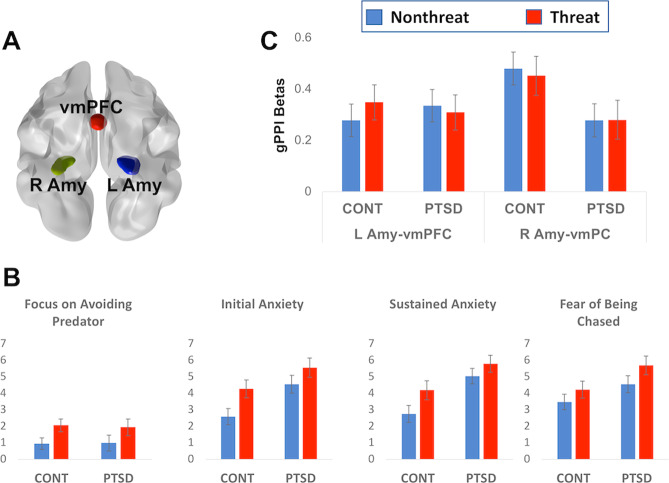
To investigate how unpredictable threat during goal pursuit impacts fronto-limbic activity and functional connectivity in posttraumatic stress disorder (PTSD), we compared military veterans with PTSD (n = 25) vs. trauma-exposed control (n = 25). Participants underwent functional magnetic resonance imaging (fMRI) while engaged in a computerized chase-and-capture game task that involved optimizing monetary rewards obtained from capturing virtual prey while simultaneously avoiding capture by virtual predators. The game was played under two alternating contexts-one involving exposure to unpredictable task-irrelevant threat from randomly occurring electrical shocks, and a nonthreat control condition. Activation in and functional connectivity between the amygdala and ventromedial prefrontal cortex (vmPFC) was tested across threat and nonthreat task contexts with generalized psychophysiological interaction (gPPI) analyses. PTSD patients reported higher anxiety than controls across contexts. Better task performance represented by successfully avoiding capture by predators under threat compared with nonthreat contexts was associated with stronger left amygdala-vmPFC functional connectivity in controls and greater vmPFC activation in PTSD patients. PTSD symptom severity was negatively correlated with vmPFC activation in trauma-exposed controls and with right amygdala-vmPFC functional connectivity across all participants in the threat relative to nonthreat contexts. The findings showed that veterans with PTSD have disrupted amygdala-vmPFC functional connectivity and greater localized vmPFC processing under threat modulation of goal-directed behavior, specifically related to successfully avoiding loss of monetary rewards. In contrast, trauma survivors without PTSD relied on stronger threat-modulated left amygdala-vmPFC functional connectivity during goal-directed behavior, which may represent a resilience-related functional adaptation.
为了研究在追求目标过程中不可预测的威胁如何影响创伤后应激障碍(PTSD)患者的额- limbic 活动和功能连接,我们比较了 PTSD 退伍军人(n=25)和创伤暴露对照组(n=25)。参与者在进行计算机追逐和捕获游戏任务时接受了功能磁共振成像(fMRI),该任务涉及优化从捕获虚拟猎物中获得的货币奖励,同时避免被虚拟捕食者捕获。游戏在两种交替的情境下进行 - 一种涉及到来自随机发生的电击的不可预测的任务无关威胁,另一种是无威胁的对照条件。使用广义心理生理相互作用(gPPI)分析测试了威胁和非威胁任务情境下杏仁核和腹内侧前额叶皮层(vmPFC)之间的激活和功能连接。PTSD 患者在所有情境中报告的焦虑程度都高于对照组。与非威胁情境相比,在威胁情境下成功避免被捕食者捕获的更好的任务表现与对照组左杏仁核-vmPFC 功能连接增强和 PTSD 患者 vmPFC 激活增加有关。创伤后应激障碍症状严重程度与创伤暴露对照组的 vmPFC 激活以及所有参与者在威胁情境下的右杏仁核-vmPFC 功能连接呈负相关,而非威胁情境。研究结果表明,患有 PTSD 的退伍军人在威胁调节目标导向行为时,杏仁核-vmPFC 功能连接中断,vmPFC 局部处理增加,具体与成功避免货币奖励损失有关。相比之下,没有 PTSD 的创伤幸存者在目标导向行为中依赖于更强的威胁调节的左杏仁核-vmPFC 功能连接,这可能代表与弹性相关的功能适应。