Department of Statistics, University of Oxford, Oxford, United Kingdom.
UCB Pharma, Slough, United Kingdom.
PLoS Comput Biol. 2020 Feb 18;16(2):e1007636. doi: 10.1371/journal.pcbi.1007636. eCollection 2020 Feb.
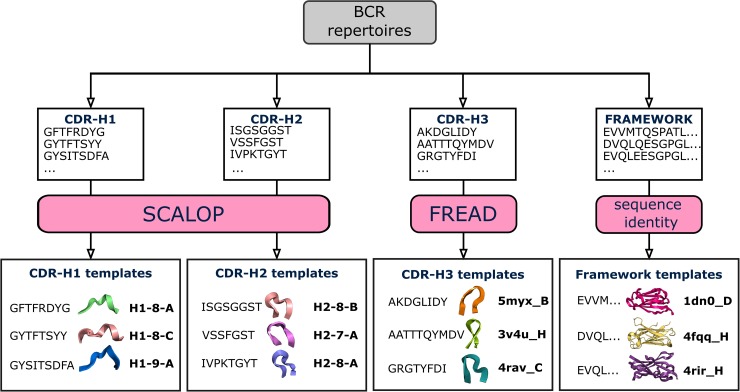
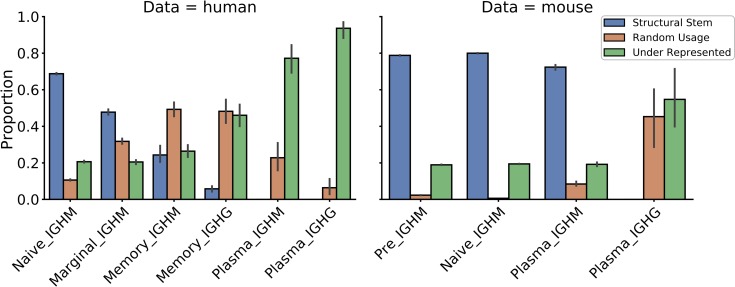
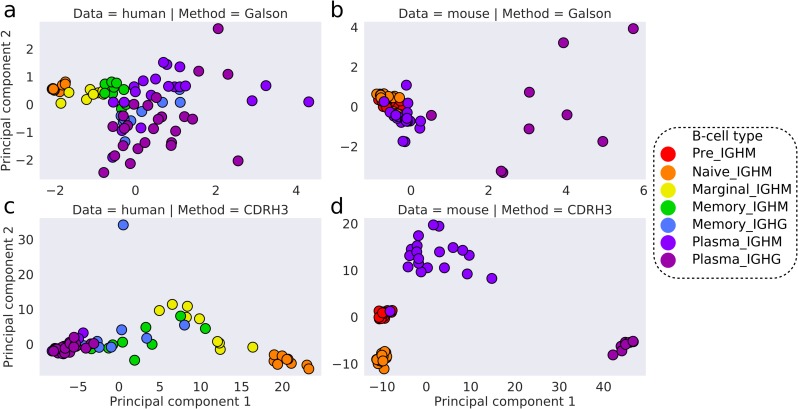
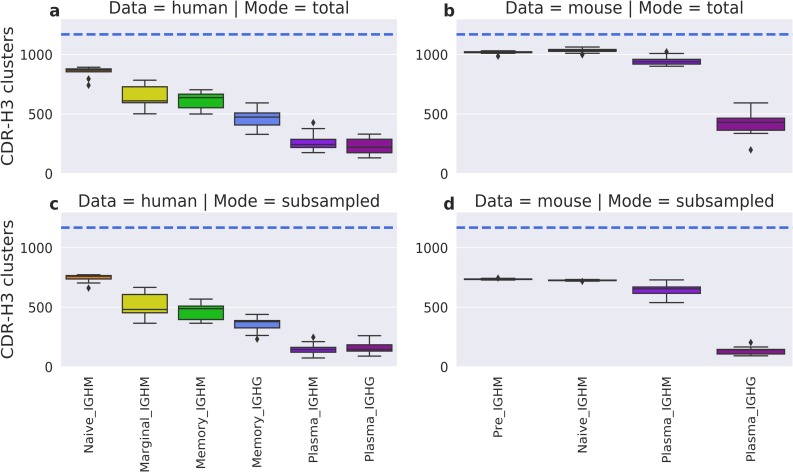
Most current analysis tools for antibody next-generation sequencing data work with primary sequence descriptors, leaving accompanying structural information unharnessed. We have used novel rapid methods to structurally characterize the complementary-determining regions (CDRs) of more than 180 million human and mouse B-cell receptor (BCR) repertoire sequences. These structurally annotated CDRs provide unprecedented insights into both the structural predetermination and dynamics of the adaptive immune response. We show that B-cell types can be distinguished based solely on these structural properties. Antigen-unexperienced BCR repertoires use the highest number and diversity of CDR structures and these patterns of naïve repertoire paratope usage are highly conserved across subjects. In contrast, more differentiated B-cells are more personalized in terms of CDR structure usage. Our results establish the CDR structure differences in BCR repertoires and have applications for many fields including immunodiagnostics, phage display library generation, and "humanness" assessment of BCR repertoires from transgenic animals. The software tool for structural annotation of BCR repertoires, SAAB+, is available at https://github.com/oxpig/saab_plus.
大多数用于抗体下一代测序数据的当前分析工具都使用主要序列描述符,而忽略了伴随的结构信息。我们使用新颖的快速方法对超过 1.8 亿个人类和小鼠 B 细胞受体 (BCR) 库序列的互补决定区 (CDR) 进行了结构表征。这些结构注释的 CDR 为适应性免疫反应的结构决定因素和动力学提供了前所未有的见解。我们表明,仅基于这些结构特性就可以区分 B 细胞类型。抗原未经验的 BCR 库使用最多数量和最多样化的 CDR 结构,并且这些原始库变构位使用模式在受试者之间高度保守。相比之下,分化程度更高的 B 细胞在 CDR 结构使用方面更具个性化。我们的结果确立了 BCR 库中 CDR 结构的差异,并在许多领域有应用,包括免疫诊断、噬菌体展示文库生成以及从转基因动物评估 BCR 库的“人类”特征。用于 BCR 库结构注释的软件工具 SAAB+可在 https://github.com/oxpig/saab_plus 上获得。