Department of Preventive Medicine, University of Tennessee Health Science Center, Memphis, TN 38163, USA.
Departments of Pediatrics and Physiology, University of Tennessee Health Science Center, and Children's Foundation Research Institute, Le Bonheur Children's Hospital, Memphis, TN 38103, USA.
Nutrients. 2020 Feb 13;12(2):465. doi: 10.3390/nu12020465.
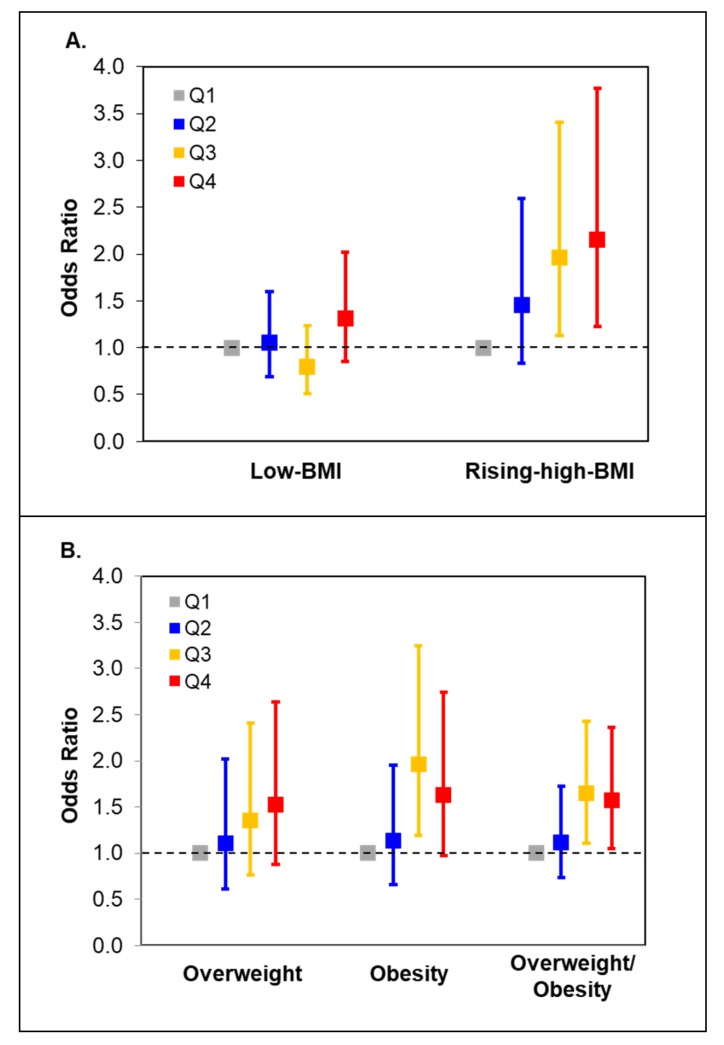
We investigated the associations between maternal dietary patterns during pregnancy and early childhood growth trajectories and overweight/obesity risk in offspring. Maternal diet was assessed using a food frequency questionnaire during the second trimester, and dietary patterns were derived by reduced rank regression. The associations between maternal dietary pattern scores and body mass index (BMI) trajectories from birth to age four (rising-high, moderate, and low BMI trajectories) as well as overweight/obesity risk at age four were analyzed ( = 1257). Two maternal dietary patterns were identified. The fast food pattern included a higher intake of fried chicken and fish, fruit juices, mayonnaise, and sugar-sweetened beverages, while the processed food pattern included a higher intake of dairy, salad dressing, processed meat, and cold breakfast cereal. Women with greater adherence to the fast food pattern were more likely to have children in the rising-high BMI trajectory group [OR (95% CI) = 1.32 (1.07-1.62); = 0.008] or having overweight/obesity at age four [OR (95% CI) = 1.31 (1.11-1.54); = 0.001]. The processed food pattern was not associated with these outcomes. The maternal dietary pattern during pregnancy represented by fried foods and sugar-sweetened beverages may contribute to rapid early childhood growth and increased risk for obesity in offspring.
我们研究了孕妇饮食模式与婴幼儿生长轨迹和子女超重/肥胖风险之间的关系。在妊娠中期,使用食物频率问卷评估了母亲的饮食,通过降秩回归得出了饮食模式。分析了母亲饮食模式评分与出生至 4 岁时体重指数(BMI)轨迹(上升-高、中、低 BMI 轨迹)以及 4 岁时超重/肥胖风险之间的关系(=1257)。确定了两种母亲饮食模式。快餐模式包括更高的炸鸡和鱼、果汁、蛋黄酱和含糖饮料的摄入量,而加工食品模式包括更高的乳制品、沙拉酱、加工肉和冷早餐麦片的摄入量。更倾向于快餐模式的女性,其子女更有可能处于上升-高 BMI 轨迹组[比值比(95%置信区间)=1.32(1.07-1.62);=0.008]或在 4 岁时超重/肥胖[比值比(95%置信区间)=1.31(1.11-1.54);=0.001]。加工食品模式与这些结果无关。代表油炸食品和含糖饮料的孕妇饮食模式可能导致婴幼儿快速生长,并增加子女肥胖的风险。