Service de Médecine Interne, Centre de Référence des Maladies Lysosomales, AP-HP.Nord, Site Beaujon, Université de Paris, F-92110 Clichy, France.
Centre de Recherche en Epidémiologie et Santé des Populations, INSERM U1018, Université Paris-Sud, F-94805 Villejuif, France.
Int J Mol Sci. 2020 Feb 13;21(4):1247. doi: 10.3390/ijms21041247.
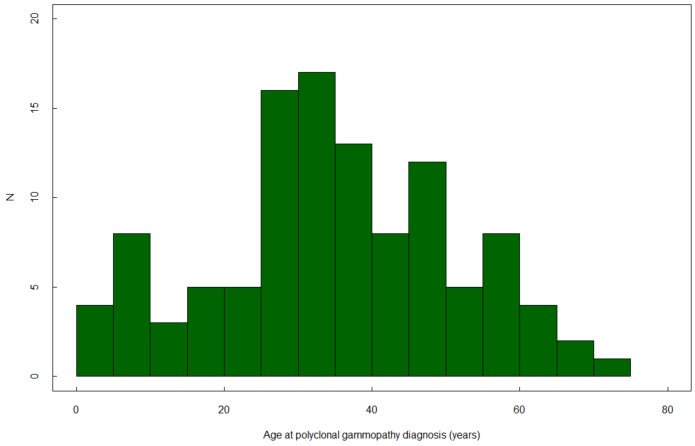
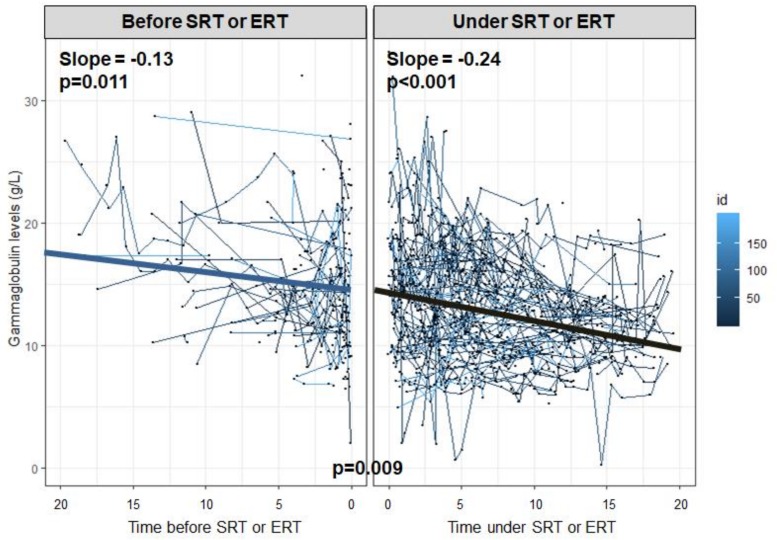
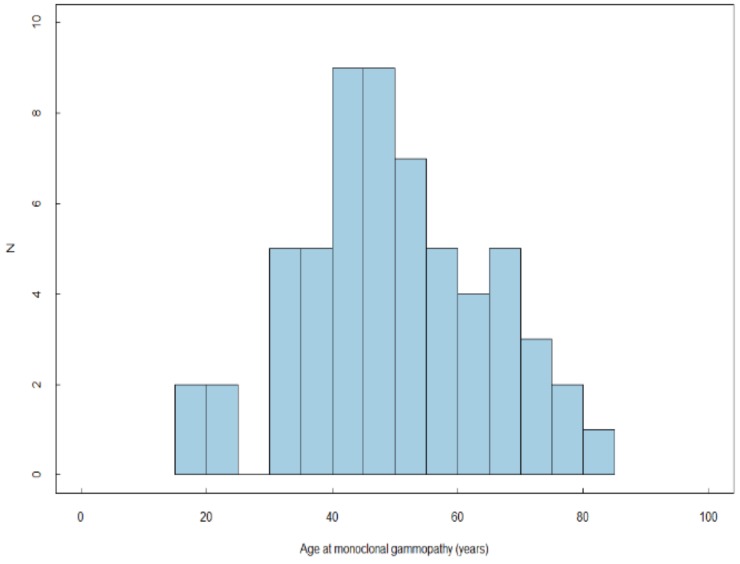
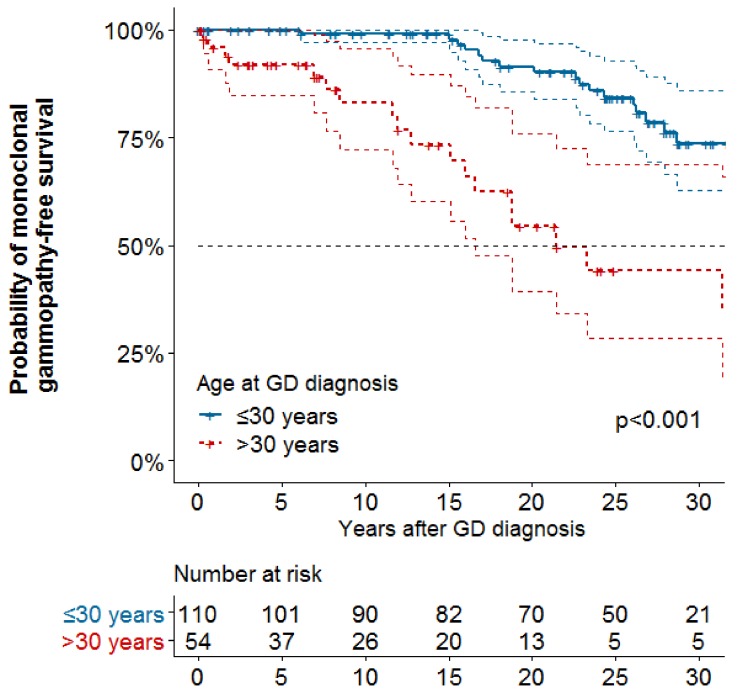
Gaucher disease (GD) is a rare lysosomal autosomal-recessive disorder due to deficiency of glucocerebrosidase; polyclonal gammopathy (PG) and/or monoclonal gammopathy (MG) can occur in this disease. We aimed to describe these immunoglobulin abnormalities in a large cohort of GD patients and to study the risk factors, clinical significance, and evolution. Data for patients enrolled in the French GD Registry were studied retrospectively. The risk factors of PG and/or MG developing and their association with clinical bone events and severe thrombocytopenia, two markers of GD severity, were assessed with multivariable Cox models and the effect of GD treatment on gammaglobulin levels with linear/logarithmic mixed models. Regression of MG and the occurrence of hematological malignancies were described. The 278 patients included (132 males, 47.5%) were followed up during a mean (SD) of 19 (14) years after GD diagnosis. PG occurred in 112/235 (47.7%) patients at GD diagnosis or during follow-up and MG in 59/187 (31.6%). Multivariable analysis retained age at GD diagnosis as the only independent risk factor for MG (> 30 vs. ≤30 years, HR 4.71, 95%CI [2.40-9.27]; < 0.001). Risk of bone events or severe thrombocytopenia was not significantly associated with PG or MG. During follow-up, non-Hodgkin lymphoma developed in five patients and multiple myeloma in one. MG was observed in almost one third of patients with GD. Immunoglobulin abnormalities were not associated with the disease severity. However, prolonged surveillance of patients with GD is needed because hematologic malignancies may occur.
戈谢病(GD)是一种罕见的溶酶体常染色体隐性遗传疾病,由于葡萄糖脑苷脂酶缺乏所致;在这种疾病中可能会出现多克隆丙种球蛋白病(PG)和/或单克隆丙种球蛋白病(MG)。我们旨在描述 GD 患者中的这些免疫球蛋白异常,并研究其危险因素、临床意义和演变。回顾性研究了参加法国 GD 登记处的患者的数据。使用多变量 Cox 模型评估 PG 和/或 MG 发展的危险因素及其与临床骨骼事件和严重血小板减少症(GD 严重程度的两个标志物)的关联,使用线性/对数混合模型评估 GD 治疗对丙种球蛋白水平的影响。描述了 MG 的消退和血液系统恶性肿瘤的发生。纳入的 278 例患者(132 名男性,47.5%)在 GD 诊断后平均(SD)19(14)年的时间内进行了随访。112/235(47.7%)患者在 GD 诊断时或随访期间出现 PG,187/187(31.6%)患者出现 MG。多变量分析保留 GD 诊断时的年龄作为 MG 的唯一独立危险因素(>30 岁与≤30 岁,HR 4.71,95%CI [2.40-9.27];<0.001)。骨骼事件或严重血小板减少症的风险与 PG 或 MG 无显著相关性。在随访期间,五名患者发生非霍奇金淋巴瘤,一名患者发生多发性骨髓瘤。近三分之一的 GD 患者观察到 MG。免疫球蛋白异常与疾病严重程度无关。然而,需要对 GD 患者进行长期监测,因为可能会发生血液系统恶性肿瘤。