Samir Jerome, Rizzetto Simone, Gupta Money, Luciani Fabio
School of Medical Sciences and Kirby Institute for Infection and Immunity, UNSW Sydney, Sydney, Australia.
Garvan Institute of Medical Research, Sydney, Australia.
BMC Med Genomics. 2020 Feb 18;13(1):29. doi: 10.1186/s12920-020-0696-z.
Single cell RNA sequencing provides unprecedented opportunity to simultaneously explore the transcriptomic and immune receptor diversity of T and B cells. However, there are limited tools available that simultaneously analyse large multi-omics datasets integrated with metadata such as patient and clinical information.
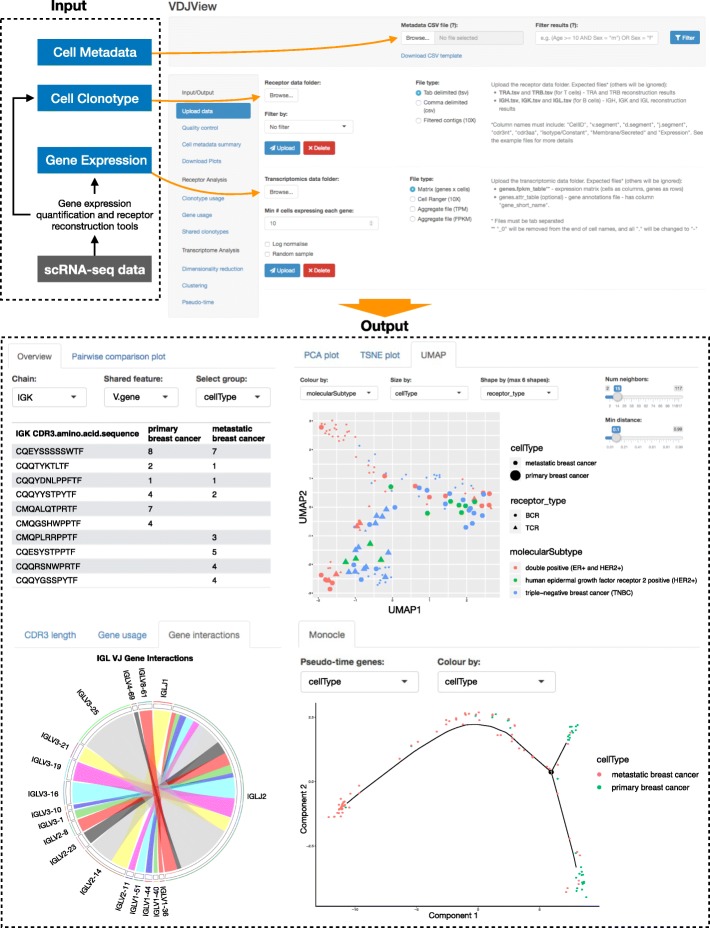
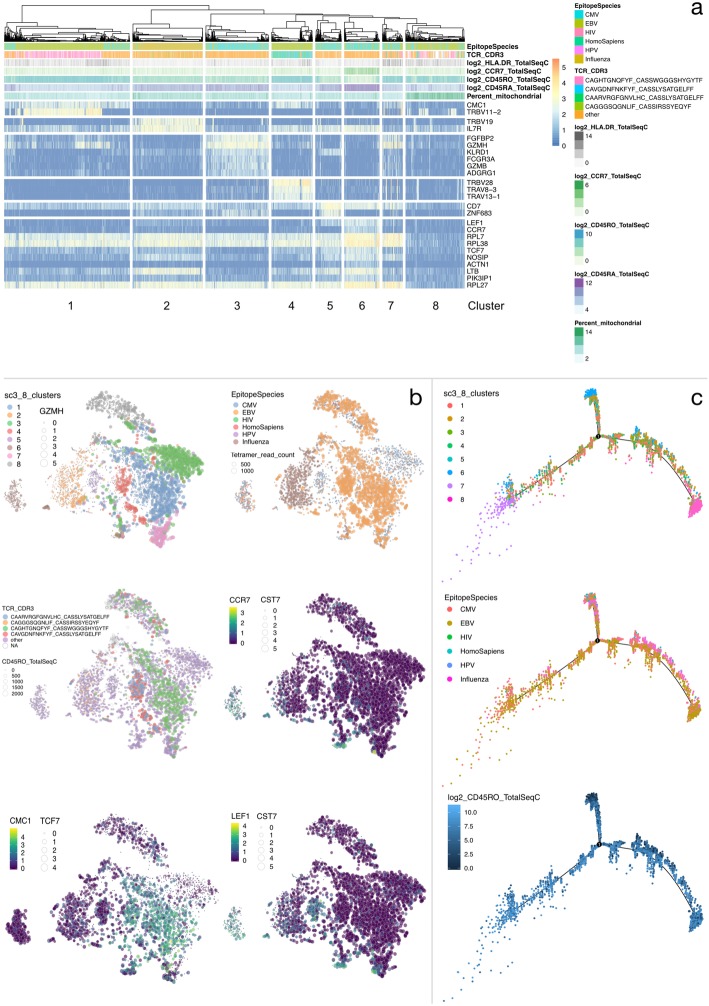
We developed VDJView, which permits the simultaneous or independent analysis and visualisation of gene expression, immune receptors, and clinical metadata of both T and B cells. This tool is implemented as an easy-to-use R shiny web-application, which integrates numerous gene expression and TCR analysis tools, and accepts data from plate-based sorted or high-throughput single cell platforms. We utilised VDJView to analyse several 10X scRNA-seq datasets, including a recent dataset of 150,000 CD8 T cells with available gene expression, TCR sequences, quantification of 15 surface proteins, and 44 antigen specificities (across viruses, cancer, and self-antigens). We performed quality control, filtering of tetramer non-specific cells, clustering, random sampling and hypothesis testing to discover antigen specific gene signatures which were associated with immune cell differentiation states and clonal expansion across the pathogen specific T cells. We also analysed 563 single cells (plate-based sorted) obtained from 11 subjects, revealing clonally expanded T and B cells across primary cancer tissues and metastatic lymph-node. These immune cells clustered with distinct gene signatures according to the breast cancer molecular subtype. VDJView has been tested in lab meetings and peer-to-peer discussions, showing effective data generation and discussion without the need to consult bioinformaticians.
VDJView enables researchers without profound bioinformatics skills to analyse immune scRNA-seq data, integrating and visualising this with clonality and metadata profiles, thus accelerating the process of hypothesis testing, data interpretation and discovery of cellular heterogeneity. VDJView is freely available at https://bitbucket.org/kirbyvisp/vdjview.
单细胞RNA测序为同时探索T细胞和B细胞的转录组学及免疫受体多样性提供了前所未有的机会。然而,能够同时分析整合了诸如患者和临床信息等元数据的大型多组学数据集的工具却很有限。
我们开发了VDJView,它允许对T细胞和B细胞的基因表达、免疫受体及临床元数据进行同时或独立的分析和可视化。该工具被实现为一个易于使用的R shiny网络应用程序,它整合了众多基因表达和TCR分析工具,并接受来自基于平板分选或高通量单细胞平台的数据。我们利用VDJView分析了几个10X scRNA-seq数据集,包括最近一个包含150,000个CD8 T细胞的数据集,该数据集具有可用的基因表达、TCR序列、15种表面蛋白的定量以及44种抗原特异性(涵盖病毒、癌症和自身抗原)。我们进行了质量控制、四聚体非特异性细胞的过滤、聚类、随机抽样和假设检验,以发现与免疫细胞分化状态及病原体特异性T细胞中的克隆扩增相关的抗原特异性基因特征。我们还分析了从11名受试者获得的563个单细胞(基于平板分选),揭示了原发性癌组织和转移性淋巴结中克隆扩增的T细胞和B细胞。这些免疫细胞根据乳腺癌分子亚型聚类为不同的基因特征。VDJView已在实验室会议和同行讨论中进行了测试,显示无需咨询生物信息学家即可有效地生成和讨论数据。
VDJView使没有深厚生物信息学技能的研究人员能够分析免疫scRNA-seq数据,并将其与克隆性和元数据概况进行整合和可视化,从而加速假设检验、数据解释和细胞异质性发现的过程。VDJView可在https://bitbucket.org/kirbyvisp/vdjview免费获取。