Ren Lili, Li Junyi, Wang Chuhan, Lou Zheqi, Gao Shuangshu, Zhao Lingyu, Wang Shuoshuo, Chaulagain Anita, Zhang Minghui, Li Xiaobo, Tang Jing
Department of Pathology, Harbin Medical University, Harbin, 150081, China.
Department of Microbiology, Harbin Medical University, Harbin, 150081, China.
Cell Death Discov. 2021 May 14;7(1):104. doi: 10.1038/s41420-021-00485-1.
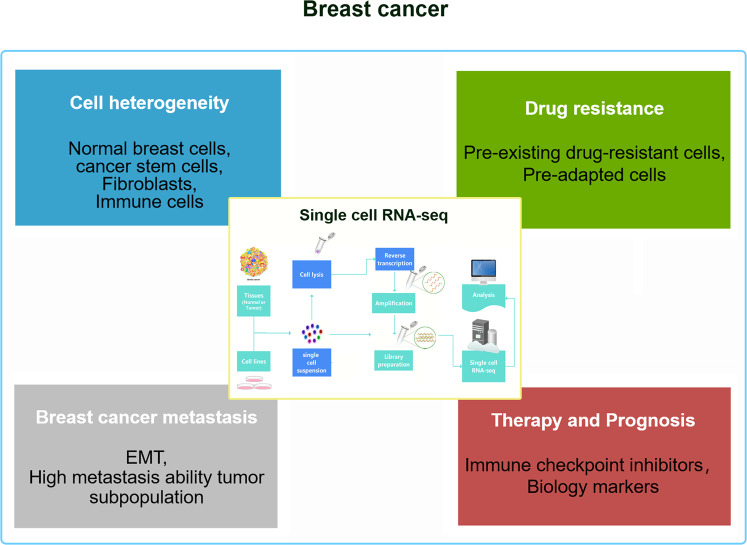
Breast cancer is one of the most common malignant tumors in women. It is a heterogeneous disease related to genetic and environmental factors. Presently, the treatment of breast cancer still faces challenges due to recurrence and metastasis. The emergence of single-cell RNA sequencing (scRNA-seq) technology has brought new strategies to deeply understand the biological behaviors of breast cancer. By analyzing cell phenotypes and transcriptome differences at the single-cell level, scRNA-seq reveals the heterogeneity, dynamic growth and differentiation process of cells. This review summarizes the application of scRNA-seq technology in breast cancer research, such as in studies on cell heterogeneity, cancer cell metastasis, drug resistance, and prognosis. scRNA-seq technology is of great significance to deeply analyze the mechanism of breast cancer occurrence and development, identify new therapeutic targets and develop new therapeutic approaches for breast cancer.
乳腺癌是女性最常见的恶性肿瘤之一。它是一种与遗传和环境因素相关的异质性疾病。目前,由于复发和转移,乳腺癌的治疗仍然面临挑战。单细胞RNA测序(scRNA-seq)技术的出现为深入了解乳腺癌的生物学行为带来了新策略。通过在单细胞水平分析细胞表型和转录组差异,scRNA-seq揭示了细胞的异质性、动态生长和分化过程。本文综述了scRNA-seq技术在乳腺癌研究中的应用,如在细胞异质性、癌细胞转移、耐药性和预后研究中的应用。scRNA-seq技术对于深入分析乳腺癌发生发展机制、识别新的治疗靶点以及开发乳腺癌新的治疗方法具有重要意义。