Institute for Global Health & Infectious Diseases, University of North Carolina at Chapel Hill, Chapel Hill, NC, USA.
International Diagnostics Centre, Department of Clinical Research, Faculty of Infectious and Tropical Diseases, London School of Hygiene and Tropical Medicine, London, UK.
Infect Dis Poverty. 2020 Feb 19;9(1):20. doi: 10.1186/s40249-020-0633-6.
Diagnostics are essential for identifying and controlling diseases. However, limited access to diagnostics hinders public health efforts in many settings. Social innovation may provide a framework for expanding access to diagnostics in the global south. Here social innovation is defined as implementing a known public health tool via a novel, community-driven technique.
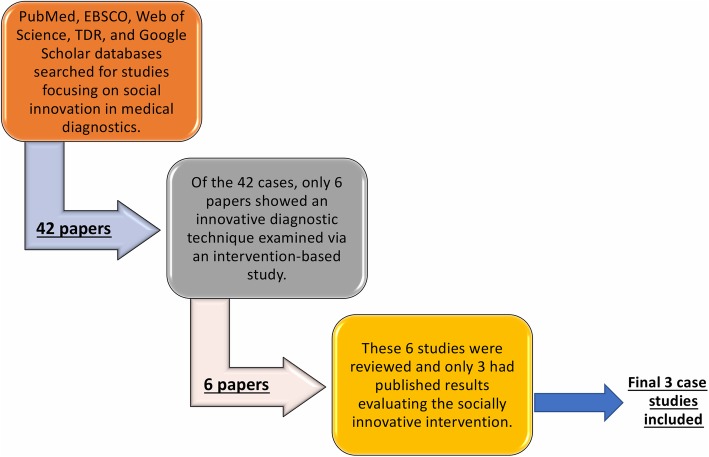
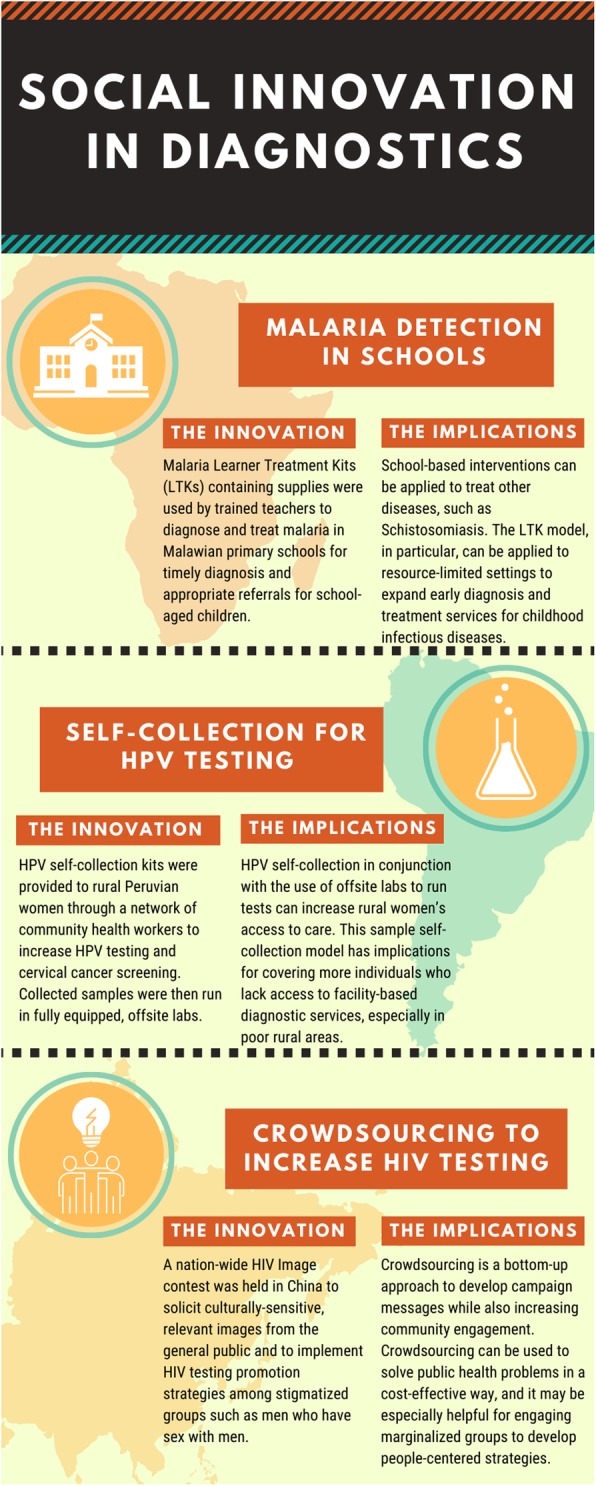
In this article, we discuss three diverse cases that show the potential for using social innovation in diagnostics. The cases chosen for inclusion here demonstrate the importance of social innovation in diagnostics across different geographic, cultural, and health system contexts. They include malaria testing via schools in Malawi, cervical human papillomavirus (HPV) sample self-collection in Peru, and crowdsourcing human immunodeficiency virus (HIV) testing in China. For each case, we present the public health problem and the impact of using social innovation to increase accessibility of diagnostics. We discuss implications of each diagnostic approach and the importance of social innovation in creating these potential solutions. We argue that social innovation is useful in improving the delivery of essential diagnostic tools in low- and middle-income countries.
Interventions in Malawi, Peru, and China suggest social innovation increases uptake of diagnostics. The same tools and principles utilized in these cases can be adapted for use in other contexts. Such diagnostic innovations may help improve identification of and linkage to care for many diseases. The approach presents a unique opportunity to better address public health issues and increase accessibility in LMIC health systems.
诊断对于识别和控制疾病至关重要。然而,在许多情况下,诊断服务的获取受到限制,这阻碍了公共卫生工作的开展。社会创新可以为在全球南方扩大诊断服务的获取提供一个框架。在这里,社会创新被定义为通过新颖的、由社区驱动的技术来实施已知的公共卫生工具。
在本文中,我们讨论了三个不同的案例,这些案例展示了在诊断中利用社会创新的潜力。这里选择的案例表明,社会创新在不同的地理、文化和卫生系统背景下对诊断具有重要意义。它们包括马拉维通过学校进行疟疾检测、秘鲁的宫颈人乳头瘤病毒(HPV)样本自我采集以及中国的 HIV 检测众包。对于每个案例,我们都介绍了公共卫生问题以及利用社会创新提高诊断可及性的影响。我们讨论了每种诊断方法的意义以及社会创新在创造这些潜在解决方案中的重要性。我们认为,社会创新有助于改善在中低收入国家提供基本诊断工具的方式。
马拉维、秘鲁和中国的干预措施表明,社会创新提高了诊断的采用率。这些案例中使用的相同工具和原则可以适应其他情况。这些诊断创新可能有助于更好地识别和为许多疾病提供治疗服务。这种方法为改善中低收入国家的卫生系统提供了一个独特的机会,以更好地解决公共卫生问题并提高可及性。