Meese Emily N, Lowe Christopher G
1Department of Biological Sciences, CSULB Shark Lab, Long Beach, CA 90840 USA.
2Present address: Texas A&M University Galveston, 1001 Texas Clipper Road, Galveston, TX 77551 USA.
Mov Ecol. 2020 Feb 10;8:8. doi: 10.1186/s40462-020-0191-3. eCollection 2020.
California horn sharks () are nocturnally active, non-obligate ram ventilating sharks in rocky reef habitats that play an important ecological role in regulating invertebrate communities. We predicted horn sharks would use an area restricted search (ARS) movement strategy to locate dense resource patches while minimizing energetic costs of travel and nighttime activity. As ectotherms, we predicted environmental temperature would play a significant role in driving movement and activity patterns.
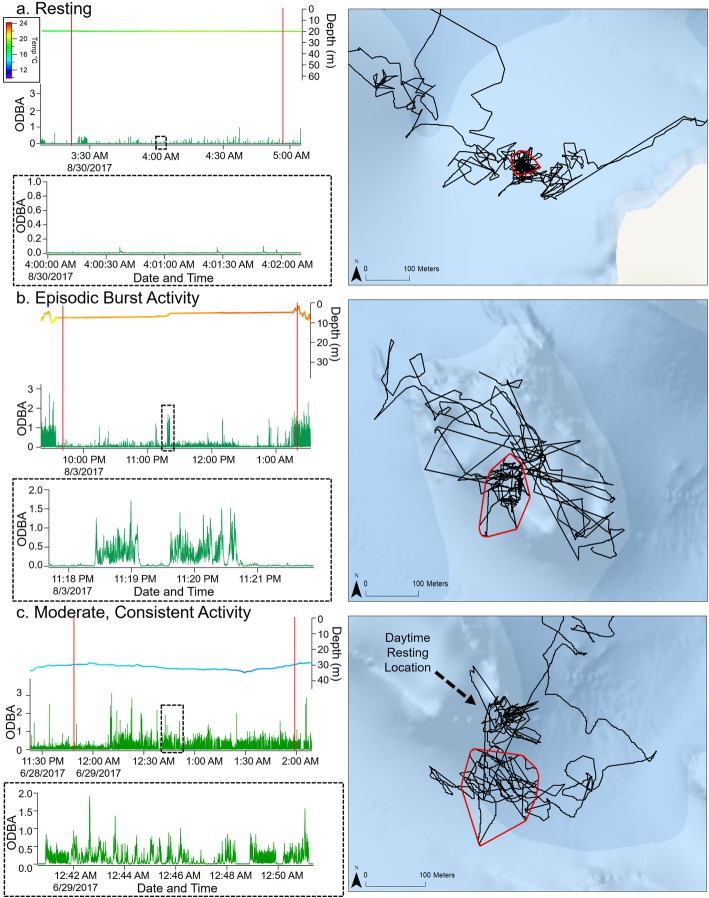
Continuous active acoustic tracking methods and acceleration data loggers were used to quantify the diel fine-scale spatial movements and activity patterns of horn sharks. First passage time was used to identify the scale and locations of patches indicative of ARS. Activity was assessed using overall dynamic body acceleration (ODBA) as a proxy for energy expenditure. Behavior within a patch was characterized into three activity patterns: resting, episodic burst activity, and moderate, consistent activity.
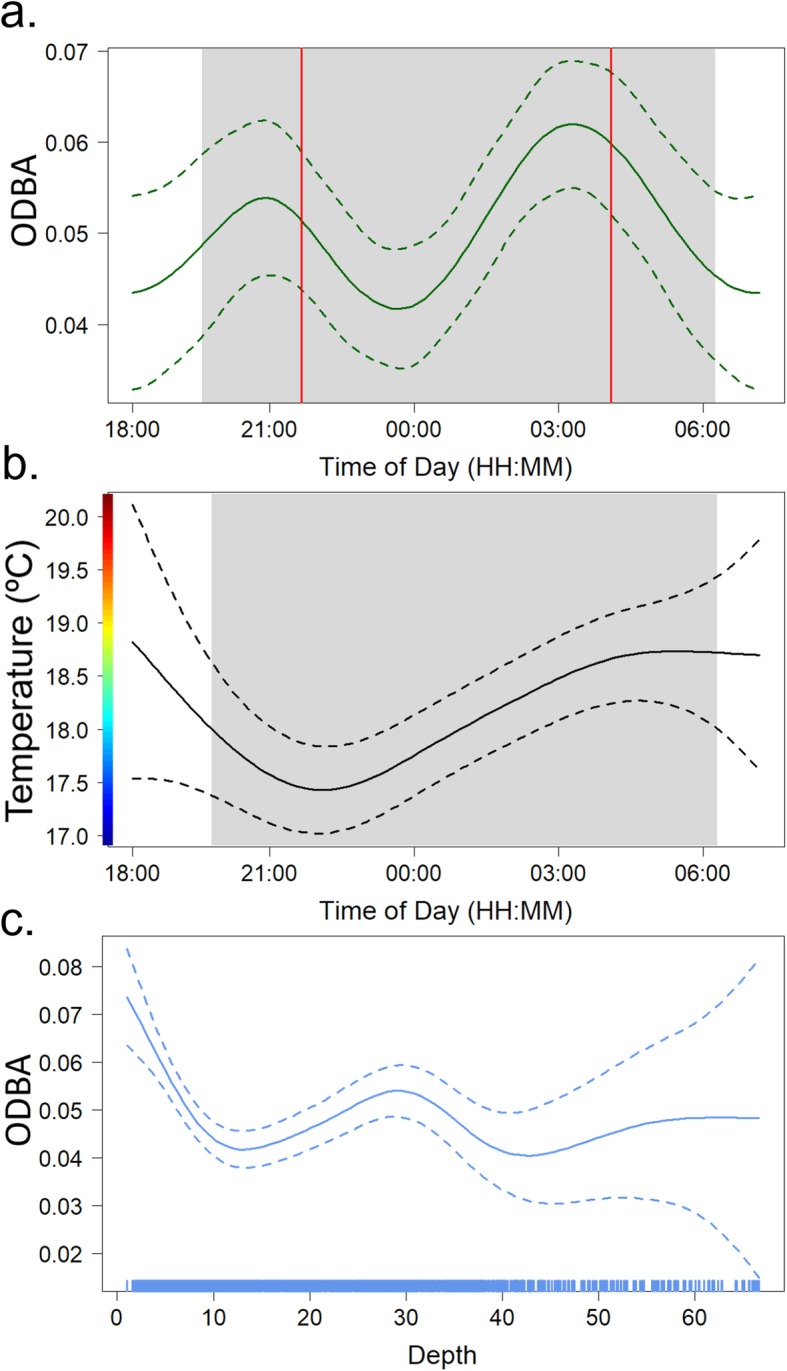
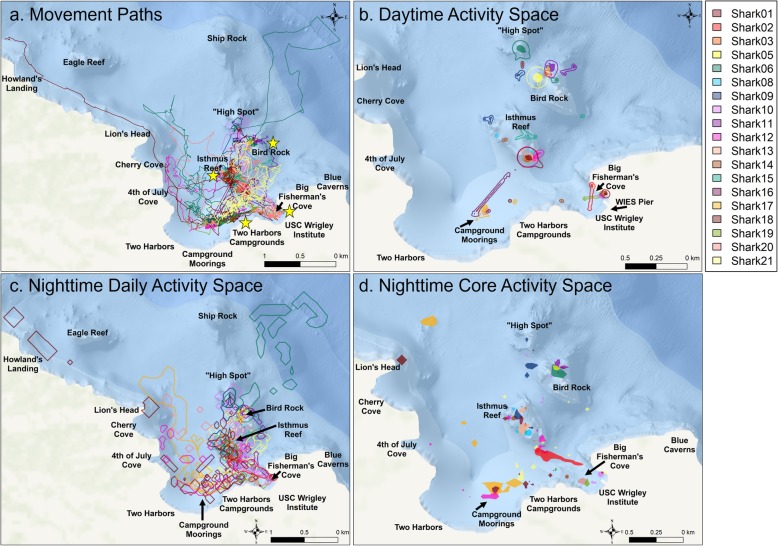
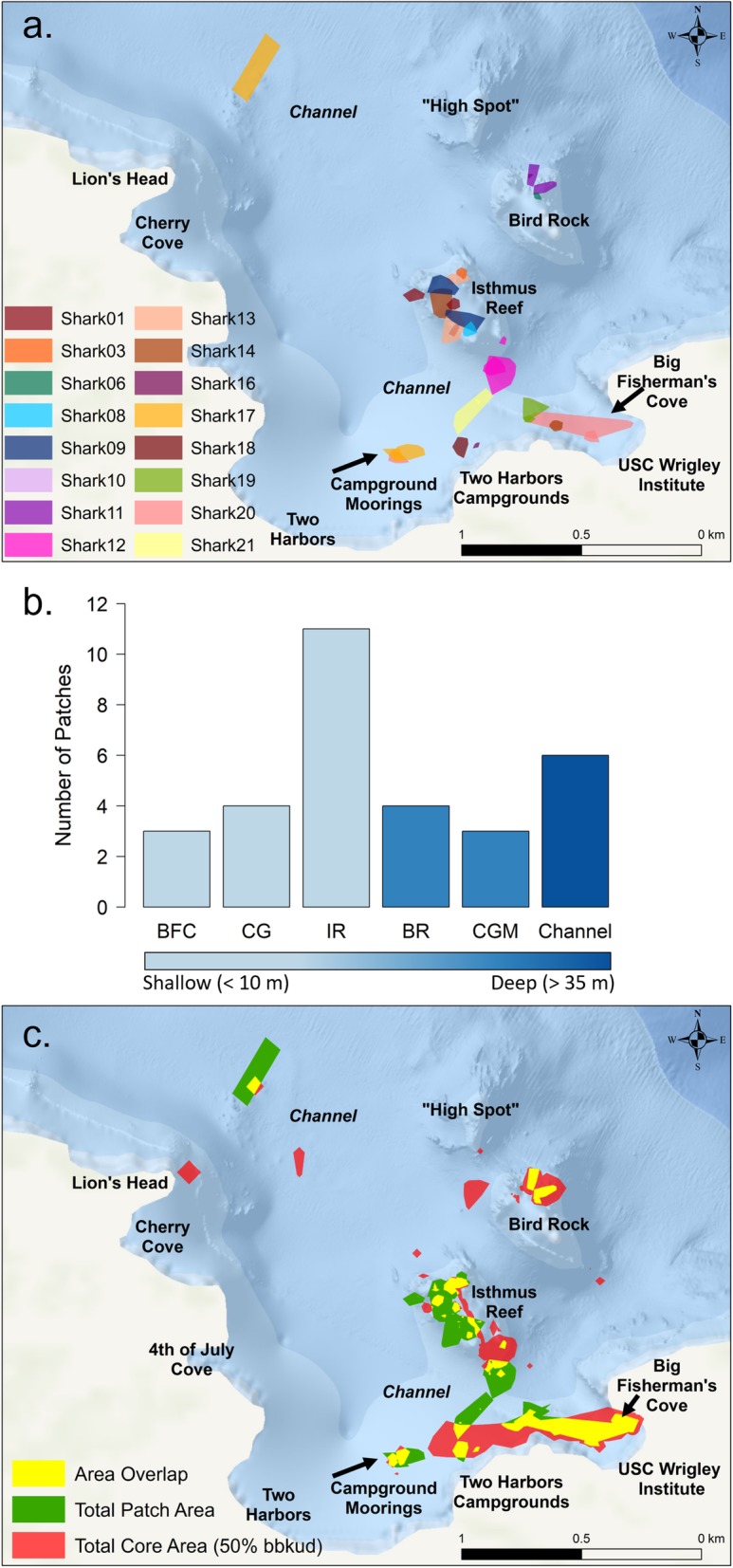
After resting in daytime shelters, individuals travelled to multiple reefs throughout the night, traversing through depths of 2-112 m and temperatures of 10.0-23.8 °C. All sharks exhibited area restricted search patch use and arrived at their first patch approximately 3.4 ± 2.2 h (mean ± SD) after sunset. Sharks exhibited moderate, consistent activity in 54% of the patches used, episodic burst activity in 33%, and few (13%) were identified as resting at night. ODBA peaked while sharks were swimming through relatively deeper (~ 30 m), colder channels when traversing from one patch to the next. There was no consistent pattern between ODBA and temperature.
We provide one of the largest fine-scale, high-resolution paired data sets for an elasmobranch movement ecology study. Horn sharks exhibited ARS movement patterns for various activity patterns. Individuals likely travel to reefs known to have profitable and predictable patches, potentially tolerating less suitable environmental temperatures. We demonstrate how gathering high-resolution information on the movement decisions of a community resident enhances knowledge of community structure and overall ecosystem function.
加利福尼亚角鲨()是夜行性活跃的鲨鱼,在岩石礁栖息地中并非必须通过冲撞进行呼吸,它们在调节无脊椎动物群落方面发挥着重要的生态作用。我们预测角鲨会采用区域限制搜索(ARS)移动策略来定位密集的资源斑块,同时将旅行和夜间活动的能量消耗降至最低。作为变温动物,我们预测环境温度在驱动移动和活动模式方面将发挥重要作用。
使用连续主动声学跟踪方法和加速度数据记录器来量化角鲨的昼夜精细尺度空间移动和活动模式。首次通过时间用于识别指示ARS的斑块的尺度和位置。使用总体动态身体加速度(ODBA)作为能量消耗的指标来评估活动。斑块内的行为被分为三种活动模式:休息、间歇性爆发活动和适度、持续的活动。
在白天的庇护所休息后,个体在夜间前往多个礁石,穿越深度为2 - 112米、温度为10.0 - 23.8°C的区域。所有鲨鱼都表现出对区域限制搜索斑块的利用,并且在日落大约3.4±2.2小时(平均值±标准差)后到达它们的第一个斑块。鲨鱼在54%的使用斑块中表现出适度、持续的活动,33%表现出间歇性爆发活动,只有少数(13%)在夜间被确定为休息。当鲨鱼从一个斑块游向另一个斑块时,ODBA在它们游过相对较深(约30米)、较冷的通道时达到峰值。ODBA和温度之间没有一致的模式。
我们为一项板鳃亚纲动物移动生态学研究提供了最大的精细尺度、高分辨率配对数据集之一。角鲨在各种活动模式中表现出ARS移动模式。个体可能前往已知有丰富且可预测斑块的礁石,可能容忍不太适宜的环境温度。我们展示了收集关于群落居民移动决策的高分辨率信息如何增强对群落结构和整体生态系统功能的了解。