Chochlakis D, Cutler S, Giadinis N D, Psaroulaki A
Department of Clinical Microbiology and Microbial Pathogenesis, School of Medicine, University of Crete, Voutes - Staurakia, 71110, Heraklion, Crete, Greece.
School of Health, Sports & Bioscience, University of East London, London, UK.
New Microbes New Infect. 2020 Jan 16;34:100652. doi: 10.1016/j.nmni.2020.100652. eCollection 2020 Mar.
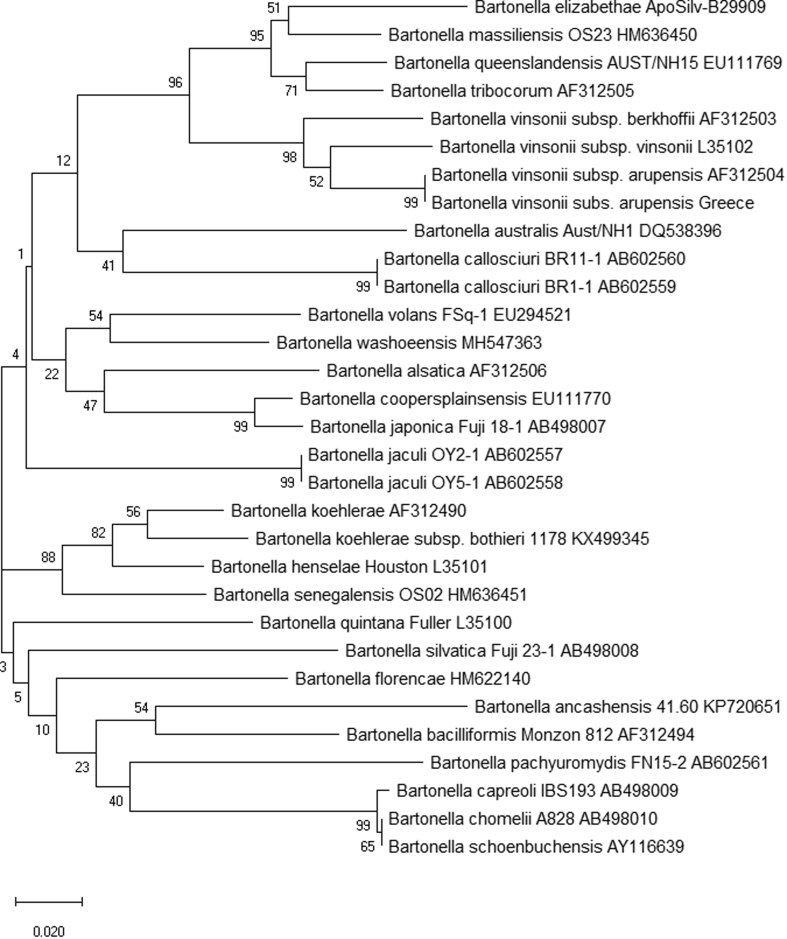
Testing for vector-borne pathogens in livestock is largely reliant upon blood and tissue. The role of biopsy samples remains poorly explored for detecting tick-borne bacteria in animals. In a 2-year survey, animals of veterinary importance from farms throughout the northern part of Greece were routinely checked for the presence of biopsy samples. Where detected, either a portion or a biopsy was collected together with whole blood samples and any ticks at the site of the biopsy sample. Molecular testing was carried out by real-time PCR targeting the internal transcribed spacer gene of species. A total of 68 samples (28 blood samples, 28 biopsy samples and 12 ticks (nine and three )) were collected from goats (64 samples) and cattle (four samples). Eight (11.8%) of the 68 samples were positive for species. Of the biopsy and whole blood samples, four (14.3%) of each type were positive for species. None of the ticks tested positive for species. All pairs of positive biopsy samples/whole blood samples originated from the same animals. Positive samples were identified as subsp. . Although many more samples from a much wider spectrum of animal species is required before concluding upon the merit of biopsy samples in the study of tick-borne diseases, the significance of our finding warrants further study, both for clinical consequences in small ruminants and for those humans who are farming infected animals.
对家畜中媒介传播病原体的检测很大程度上依赖于血液和组织样本。活检样本在检测动物蜱传细菌方面的作用仍未得到充分探索。在一项为期两年的调查中,对希腊北部各农场具有兽医重要性的动物定期检查是否存在活检样本。一旦检测到,会收集一部分样本或进行活检,并采集全血样本以及活检样本部位的任何蜱虫。通过针对 物种内部转录间隔区基因的实时聚合酶链反应(PCR)进行分子检测。总共从山羊(64个样本)和牛(4个样本)身上采集了68个样本(28个血液样本、28个活检样本和12只蜱虫(9只 和3只 ))。68个样本中有8个(11.8%)对 物种呈阳性。在活检样本和全血样本中,每种类型各有4个(14.3%)对 物种呈阳性。所检测的蜱虫中没有一个对 物种呈阳性。所有阳性活检样本/全血样本对均来自同一动物。阳性样本被鉴定为 亚种。尽管在就活检样本在蜱传疾病研究中的价值得出结论之前,还需要从更广泛的动物物种中获取更多样本,但我们这一发现的重要性值得进一步研究,这对于小型反刍动物的临床后果以及养殖感染动物的人类来说都是如此。