Dowd A Justine, Warbeck Cassandra B, Tang Karen Ty, Fung Tak, Culos-Reed S Nicole
Faculty of Kinesiology, University of Calgary, Canada.
Faculty of Arts, University of Calgary, Canada.
Digit Health. 2020 Feb 2;6:2055207620903627. doi: 10.1177/2055207620903627. eCollection 2020 Jan-Dec.
The purpose of this study was to assess the effectiveness of a smartphone app (MyHealthyGut) in helping adults self-manage celiac disease or gluten intolerance and improve their gut health.
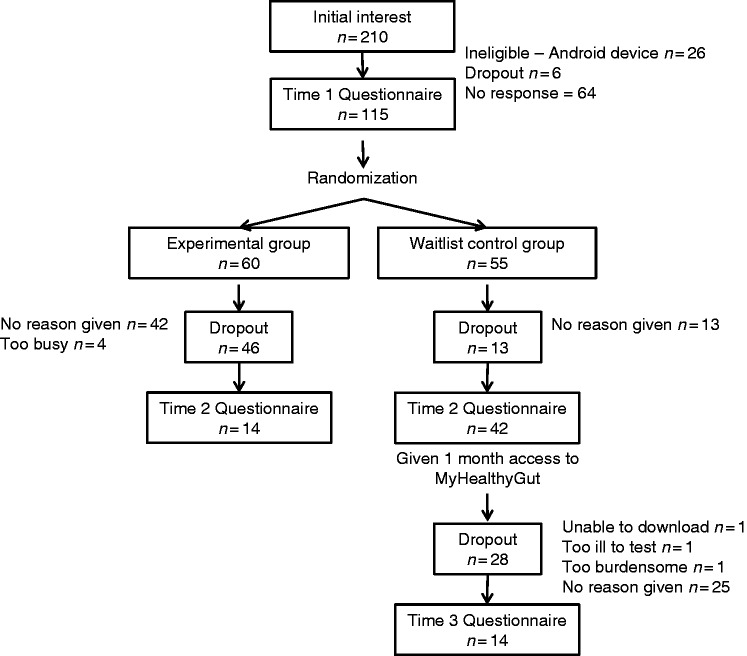
Adults diagnosed with celiac disease or gluten intolerance ( = 115) were randomized into two groups: experimental group 1 (had access to the app for a one-month period) or wait list control (WLC). After one month, WLC participants were given one-month access to the app (experimental group 2). An online questionnaire was administered to assess (a) user satisfaction with the app and (b) changes in the following patient-reported outcomes: adherence to a gluten-free diet, quality of life (QoL), self-regulatory efficacy, and feelings of depression and anxiety. Generalized estimating equations were used to assess changes in the outcome variables over time between the groups.
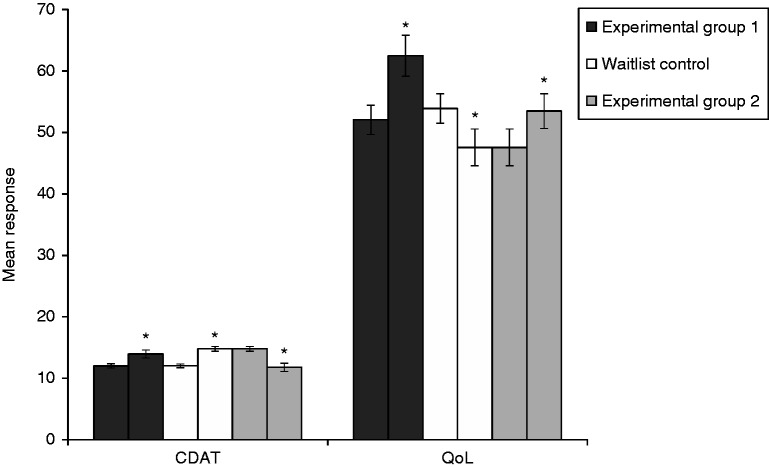
Participants reported high levels of app usability, were satisfied with features of the app, and felt that the app was best suited for people newly diagnosed with celiac disease. Participants in the experimental groups reported improvements in adherence, gastrointestinal symptoms (experimental group 1 only), QoL, self-regulatory efficacy (experimental group 2 only), anxiety (experimental group 1 only), and depression (experimental group 2 only). Experimental group 1 and the WLC group reported significantly worse adherence after using the app based on the Celiac Dietary Adherence Test, which was in contrast to the accidental and purposeful measures of gluten consumption and symptoms for experimental group 1 but consistent with reports of accidental and purposeful gluten consumption and symptoms for the WLC group.
Based on feedback from the participants, the app may be best suited for individuals newly diagnosed or struggling with celiac disease or gluten intolerance. After using the MyHealthyGut app for a one-month period, adults with celiac disease reported improvements in psychosocial outcomes. Further iterations of the app are needed to meet the needs of this population better. MyHealthyGut is the first evidence-based app designed to help people with celiac disease or gluten intolerance.
本研究旨在评估一款智能手机应用程序(MyHealthyGut)在帮助成年人自我管理乳糜泻或麸质不耐受以及改善肠道健康方面的有效性。
115名被诊断为乳糜泻或麸质不耐受的成年人被随机分为两组:实验组1(可使用该应用程序一个月)或等待列表对照组(WLC)。一个月后,WLC组参与者获得了为期一个月的应用程序使用权限(实验组2)。通过在线问卷来评估:(a)用户对应用程序的满意度,以及(b)以下患者报告结局的变化:无麸质饮食的依从性、生活质量(QoL)、自我调节效能以及抑郁和焦虑情绪。使用广义估计方程来评估两组之间结局变量随时间的变化。
参与者报告该应用程序具有较高的可用性,对应用程序的功能感到满意,并认为该应用程序最适合新诊断出乳糜泻的人群。实验组的参与者报告在依从性、胃肠道症状(仅实验组1)、生活质量、自我调节效能(仅实验组2)、焦虑(仅实验组1)和抑郁(仅实验组2)方面有所改善。根据乳糜泻饮食依从性测试,实验组1和WLC组在使用应用程序后报告的依从性明显更差,这与实验组1中麸质摄入和症状的偶然及有意测量结果形成对比,但与WLC组中麸质摄入和症状的偶然及有意报告结果一致。
根据参与者的反馈,该应用程序可能最适合新诊断出或正在与乳糜泻或麸质不耐受作斗争的个体。在使用MyHealthyGut应用程序一个月后,患有乳糜泻的成年人报告心理社会结局有所改善。需要对该应用程序进行进一步迭代,以更好地满足这一人群的需求。MyHealthyGut是首个旨在帮助患有乳糜泻或麸质不耐受的人群的循证应用程序。