School of Chemical Engineering and Technology, Tianjin University, Tianjin, 300350, People's Republic of China.
Key Laboratory of System Bioengineering (Tianjin University), Ministry of Education, Tianjin, 300350, People's Republic of China.
Microb Cell Fact. 2020 Feb 19;19(1):41. doi: 10.1186/s12934-020-01306-3.
Ginsenoside compound K (CK), one of the primary active metabolites of protopanaxadiol-type ginsenosides, is produced by the intestinal flora that degrade ginseng saponins and exhibits diverse biological properties such as anticancer, anti-inflammatory, and anti-allergic properties. However, it is less abundant in plants. Therefore, enabling its commercialization by construction of a Saccharomyces cerevisiae cell factory is of considerable significance.
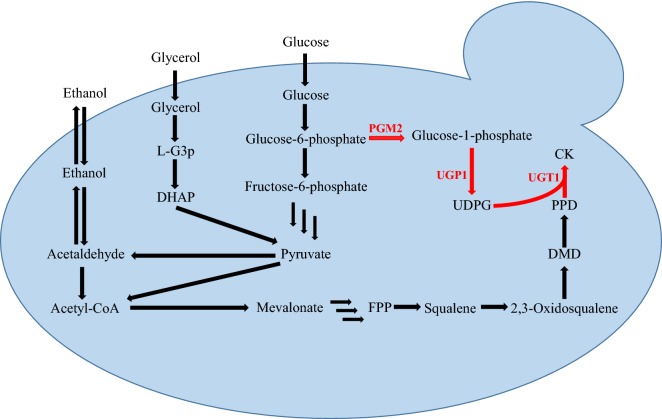
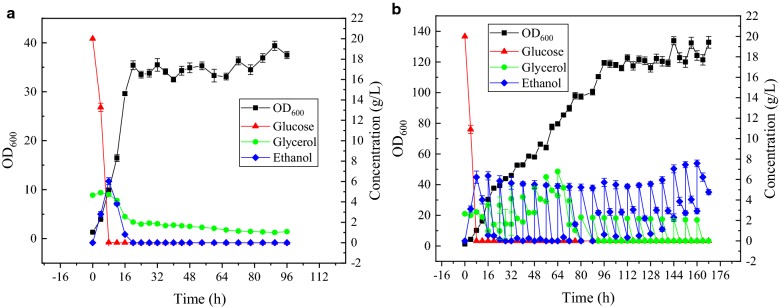
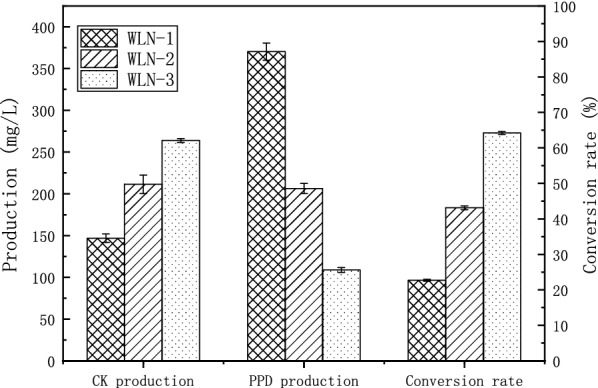
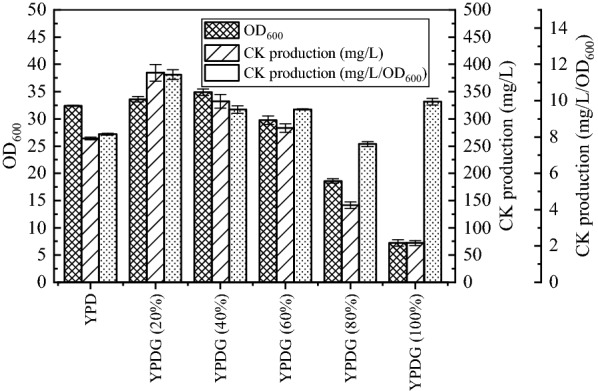
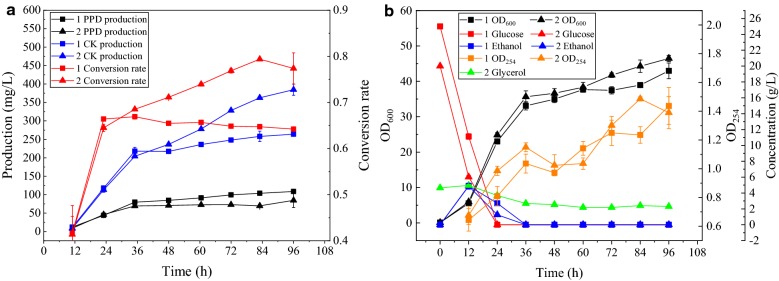
We induced overexpression of PGM2, UGP1, and UGT1 genes in WLT-MVA5, and obtained a strain that produces ginsenoside CK. The production of CK at 96 h was 263.94 ± 2.36 mg/L, and the conversion rate from protopanaxadiol (PPD) to ginsenoside CK was 64.23 ± 0.41%. Additionally, it was observed that the addition of glycerol was beneficial to the synthesis of CK. When 20% glucose (C mol) in the YPD medium was replaced by the same C mol glycerol, CK production increased to 384.52 ± 15.23 mg/L, which was 45.68% higher than that in YPD medium, and the PPD conversion rate increased to 77.37 ± 3.37% as well. As we previously observed that ethanol is beneficial to the production of PPD, ethanol and glycerol were fed simultaneously in the 5-L bioreactor fed fermentation, and the CK levels reached 1.70 ± 0.16 g/L.
In this study, we constructed an S. cerevisiae cell factory that efficiently produced ginsenoside CK. Glycerol effectively increased the glycosylation efficiency of PPD to ginsenoside CK, guiding higher carbon flow to the synthesis of ginsenosides and effectively improving CK production. CK production attained in a 5-L bioreactor was 1.7 g/L after simultaneous feeding of glycerol and ethanol.
人参皂苷化合物 K(CK)是原人参二醇型皂苷肠道菌群降解产生的主要活性代谢产物之一,具有抗癌、抗炎、抗过敏等多种生物学特性。然而,它在植物中的含量较少。因此,通过构建酿酒酵母细胞工厂实现其商业化具有重要意义。
我们在 WLT-MVA5 中诱导过表达 PGM2、UGP1 和 UGT1 基因,获得了一株能够产生人参皂苷 CK 的菌株。在 96 h 时,CK 的产量为 263.94±2.36 mg/L,原人参二醇(PPD)转化为人参皂苷 CK 的转化率为 64.23±0.41%。此外,我们发现添加甘油有利于 CK 的合成。当 YPD 培养基中 20%的葡萄糖(C mol)被等量的 C mol 甘油替代时,CK 的产量增加到 384.52±15.23 mg/L,比 YPD 培养基中的产量提高了 45.68%,PPD 的转化率也提高到 77.37±3.37%。因为我们之前观察到乙醇有利于 PPD 的生成,所以在 5-L 生物反应器分批发酵中同时补加乙醇和甘油,CK 水平达到 1.70±0.16 g/L。
本研究构建了一种高效生产人参皂苷 CK 的酿酒酵母细胞工厂。甘油有效地提高了 PPD 向人参皂苷 CK 的糖基化效率,引导更多的碳流用于人参皂苷的合成,有效地提高了 CK 的产量。在 5-L 生物反应器中同时补加甘油和乙醇后,CK 的产量达到 1.7 g/L。