Villafana Ria T, Rampersad Sephra N
Faculty of Science and Technology Department of Life Sciences Biochemistry Research Lab The University of the West Indies St. Augustine Trinidad and Tobago - West Indies.
Ecol Evol. 2020 Jan 21;10(3):1425-1443. doi: 10.1002/ece3.5998. eCollection 2020 Feb.
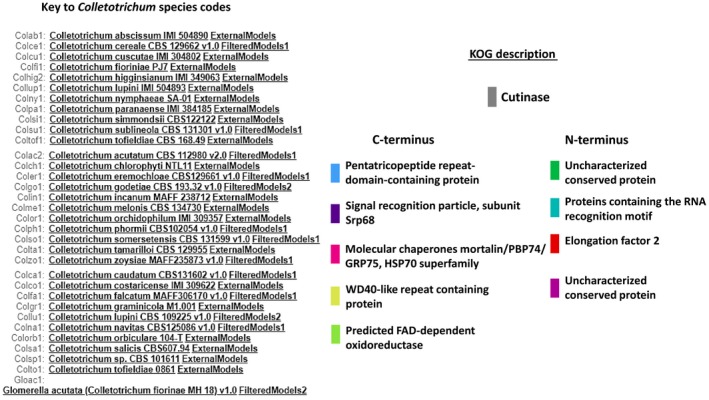
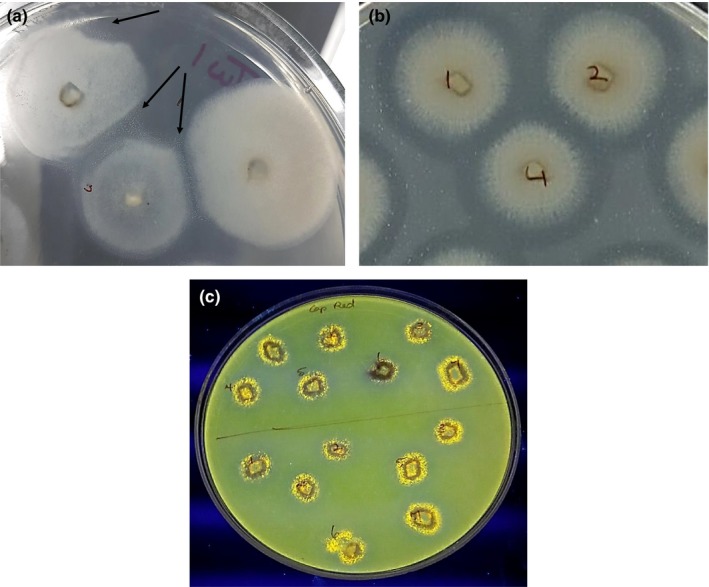
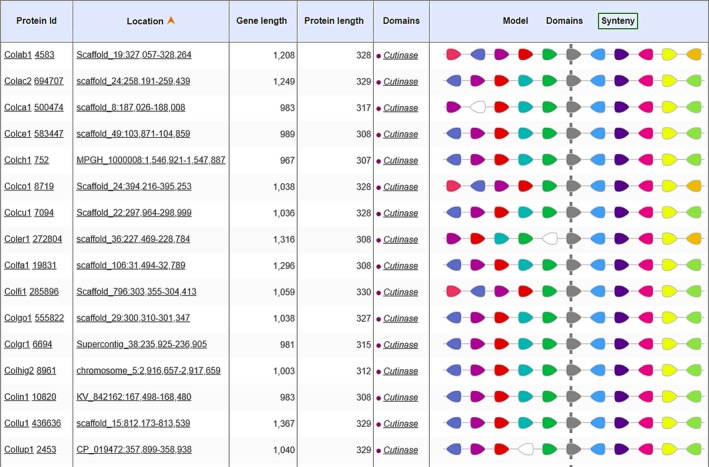
species complexes are among the top 10 economically important fungal plant pathogens worldwide because they can infect climacteric and nonclimacteric fruit at the pre and/or postharvest stages. is the major pathogen responsible for anthracnose of green and red bell pepper fruit worldwide. was recently reported to be a minor pathogen of red bell pepper fruit in Trinidad, but has recently been reported as pathogenic to other host species in other countries. The ability of these phytopathogens to produce and secrete cutinase is required for dismantling the cuticle of the host plant and, therefore, crucial to the necrotrophic phase of their infection strategy. In vitro bioassays using different lipid substrates confirmed the ability of and isolates from green and red bell peppers to secrete cutinase. The diversity, structure and organization and synteny of the cutinase gene were determined among different species. Cluster analysis indicated a low level of nucleotide variation among sequences. Nucleotide sequences of were more related to cutinase nucleotide sequences than to . Cluster patterns coincided with haplotype and there was evidence of significant positive selection with no recombination signatures. The structure of the cutinase gene included two exons with one intervening intron and, therefore, one splice variant. Although amino acid sequences were highly conserved among isolates, diversity "hot spots" were revealed when the 66-amino acid coding region of 200 fungal species was compared. Twenty cutinase s were detected among different fungal species, whose common ancestor is Pezizomycotina and it is purported that these s arose through a single gene duplication event prior to speciation. The cutinase domain was retained both in structure and arrangement among 34 different species. The order of aligned genomic blocks between species and the arrangement of flanking protein domains were also conserved and shared for those domains immediately located at the N- and C-terminus of the cutinase domain. Among these were an RNA recognition motif, translation elongation factor, signal peptide, pentatricopeptide repeat, and Hsp70 family of chaperone proteins, all of which support the expression of the cutinase gene. The findings of this study are important to understanding the evolution of the cutinase gene in as a key component of the biotrophic-necrotrophic switch which may be useful in developing gene-targeting strategies to decrease the pathogenic potential of species.
种复合体是全球十大经济上重要的真菌植物病原体之一,因为它们可以在采前和/或采后阶段感染跃变型和非跃变型果实。 是全球范围内绿色和红色甜椒果实炭疽病的主要病原体。最近有报道称 在特立尼达是红色甜椒果实的次要病原体,但最近在其他国家也有报道其对其他寄主物种具有致病性。这些植物病原体产生和分泌角质酶的能力是分解寄主植物角质层所必需的,因此对于它们感染策略的坏死营养阶段至关重要。使用不同脂质底物的体外生物测定证实了从绿色和红色甜椒中分离出的 和 能够分泌角质酶。在不同的 物种中确定了角质酶基因的多样性、结构、组织和共线性。聚类分析表明 序列之间的核苷酸变异水平较低。 的核苷酸序列与 角质酶核苷酸序列的关系比与 的更密切。聚类模式与单倍型一致,并且有明显的正选择证据,没有重组特征。角质酶基因的结构包括两个外显子和一个间隔内含子,因此有一个剪接变体。尽管 分离株之间的氨基酸序列高度保守,但在比较200种真菌物种的66个氨基酸编码区域时发现了多样性“热点”。在不同的真菌物种中检测到20种角质酶,它们的共同祖先是粪壳菌纲,据推测这些角质酶是在物种形成之前通过一次基因复制事件产生的。在34种不同的 物种中,角质酶结构域在结构和排列上都得以保留。物种之间比对的基因组块顺序以及侧翼蛋白结构域的排列也得以保留,并且对于紧邻角质酶结构域N端和C端的那些结构域是共享的。其中包括一个RNA识别基序、翻译延伸因子、信号肽、五肽重复序列和伴侣蛋白的Hsp70家族,所有这些都支持角质酶基因的表达。本研究的结果对于理解 中角质酶基因的进化很重要,角质酶基因是生物营养-坏死营养转换的关键组成部分,这可能有助于开发基因靶向策略以降低 物种的致病潜力。