Department of Ecology, P.O Box 7044, 750 07, Uppsala, Sweden.
Chair of Silviculture, Faculty of Environment and Natural Resources, University of Freiburg, Tennenbacherstr. 4, 79106, Freiburg, Germany.
Ambio. 2020 Jan;49(1):85-97. doi: 10.1007/s13280-019-01190-1. Epub 2019 May 4.
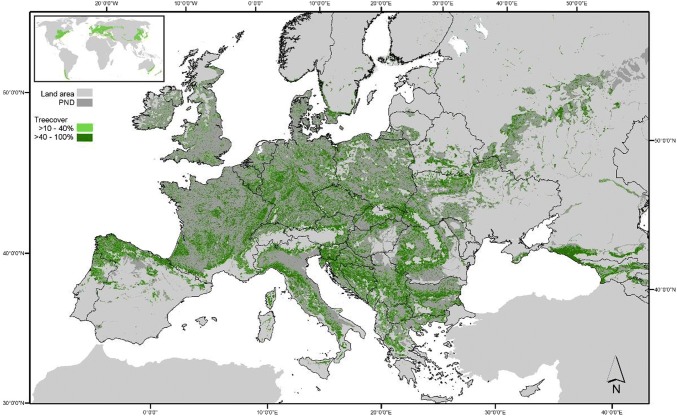
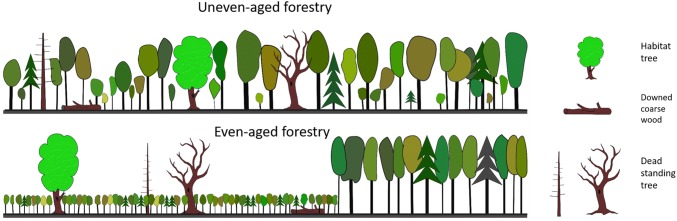
Retention forestry implies that biological legacies like dead and living trees are deliberately selected and retained beyond harvesting cycles to benefit biodiversity and ecosystem functioning. This model has been applied for several decades in even-aged, clearcutting (CC) systems but less so in uneven-aged, continuous-cover forestry (CCF). We provide an overview of retention in CCF in temperate regions of Europe, currently largely focused on habitat trees and dead wood. The relevance of current meta-analyses and many other studies on retention in CC is limited since they emphasize larger patches in open surroundings. Therefore, we reflect here on the ecological foundations and socio-economic frameworks of retention approaches in CCF, and highlight several areas with development potential for the future. Conclusions from this perspective paper, based on both research and current practice on several continents, although highlighting Europe, are also relevant to other temperate regions of the world using continuous-cover forest management approaches.
保留林业意味着,生物遗产,如死树和活树,被故意选择并保留在收获周期之外,以造福生物多样性和生态系统功能。这种模式已经在同龄的皆伐(CC)系统中应用了几十年,但在异龄的连续覆盖林业(CCF)中应用较少。我们概述了目前在欧洲温带地区的 CCF 中的保留情况,目前主要集中在栖息地树木和枯木上。由于它们强调了开放环境中的较大斑块,因此当前关于 CC 中保留的多项元分析和其他研究的相关性有限。因此,我们在这里反思了 CCF 中保留方法的生态基础和社会经济框架,并强调了未来具有发展潜力的几个领域。本文基于在多个大陆的研究和当前实践,虽然重点介绍了欧洲,但对其他使用连续覆盖森林管理方法的世界温带地区也具有相关性。