Finch Damien, Gleadow Andrew, Hergt Janet, Levchenko Vladimir A, Heaney Pauline, Veth Peter, Harper Sam, Ouzman Sven, Myers Cecilia, Green Helen
School of Earth Sciences, The University of Melbourne, Melbourne, Vic 3010, Australia.
Australian Nuclear Science and Technology Organisation, Locked Bag 2001, Kirrawee DC, NSW 2232, Australia.
Sci Adv. 2020 Feb 5;6(6):eaay3922. doi: 10.1126/sciadv.aay3922. eCollection 2020 Feb.
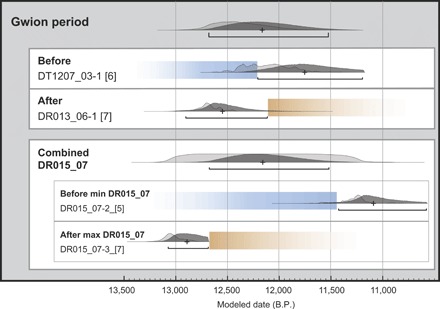
The Kimberley region in Western Australia hosts one of the world's most substantial bodies of indigenous rock art thought to extend in a series of stylistic or iconographic phases from the present day back into the Pleistocene. As with other rock art worldwide, the older styles have proven notoriously difficult to date quantitatively, requiring new scientific approaches. Here, we present the radiocarbon ages of 24 mud wasp nests that were either over or under pigment from 21 anthropomorphic motifs of the Gwion style (previously referred to as "Bradshaws") from the middle of the relative stylistic sequence. We demonstrate that while one date suggests a minimum age of c. 17 ka for one motif, most of the dates support a hypothesis that these Gwion paintings were produced in a relatively narrow period around 12,000 years ago.
西澳大利亚的金伯利地区拥有世界上最丰富的土著岩石艺术群之一,这些岩石艺术被认为以一系列风格或图像阶段从现今追溯到更新世。与世界各地的其他岩石艺术一样,事实证明,较古老的风格极难进行定量年代测定,需要新的科学方法。在此,我们展示了24个泥蜂巢穴的放射性碳年代,这些巢穴位于相对风格序列中部的21个吉翁风格(以前称为“布拉德肖”)拟人化图案的颜料之上或之下。我们证明,虽然有一个年代测定结果表明一个图案的最小年龄约为1.7万年,但大多数年代测定结果支持这样一种假设,即这些吉翁绘画是在约12000年前的一个相对较短的时期内创作的。