Morato Telmo, González-Irusta José-Manuel, Dominguez-Carrió Carlos, Wei Chih-Lin, Davies Andrew, Sweetman Andrew K, Taranto Gerald H, Beazley Lindsay, García-Alegre Ana, Grehan Anthony, Laffargue Pascal, Murillo Francisco Javier, Sacau Mar, Vaz Sandrine, Kenchington Ellen, Arnaud-Haond Sophie, Callery Oisín, Chimienti Giovanni, Cordes Erik, Egilsdottir Hronn, Freiwald André, Gasbarro Ryan, Gutiérrez-Zárate Cristina, Gianni Matthew, Gilkinson Kent, Wareham Hayes Vonda E, Hebbeln Dierk, Hedges Kevin, Henry Lea-Anne, Johnson David, Koen-Alonso Mariano, Lirette Cam, Mastrototaro Francesco, Menot Lénaick, Molodtsova Tina, Durán Muñoz Pablo, Orejas Covadonga, Pennino Maria Grazia, Puerta Patricia, Ragnarsson Stefán Á, Ramiro-Sánchez Berta, Rice Jake, Rivera Jesús, Roberts J Murray, Ross Steve W, Rueda José L, Sampaio Íris, Snelgrove Paul, Stirling David, Treble Margaret A, Urra Javier, Vad Johanne, van Oevelen Dick, Watling Les, Walkusz Wojciech, Wienberg Claudia, Woillez Mathieu, Levin Lisa A, Carreiro-Silva Marina
Okeanos Research Centre, Departamento de Oceanografia e Pesca, Universidade dos Açores, Horta, Portugal.
IMAR Instituto do Mar, Departamento de Oceanografia e Pesca, Universidade dos Açores, Horta, Portugal.
Glob Chang Biol. 2020 Apr;26(4):2181-2202. doi: 10.1111/gcb.14996. Epub 2020 Feb 20.
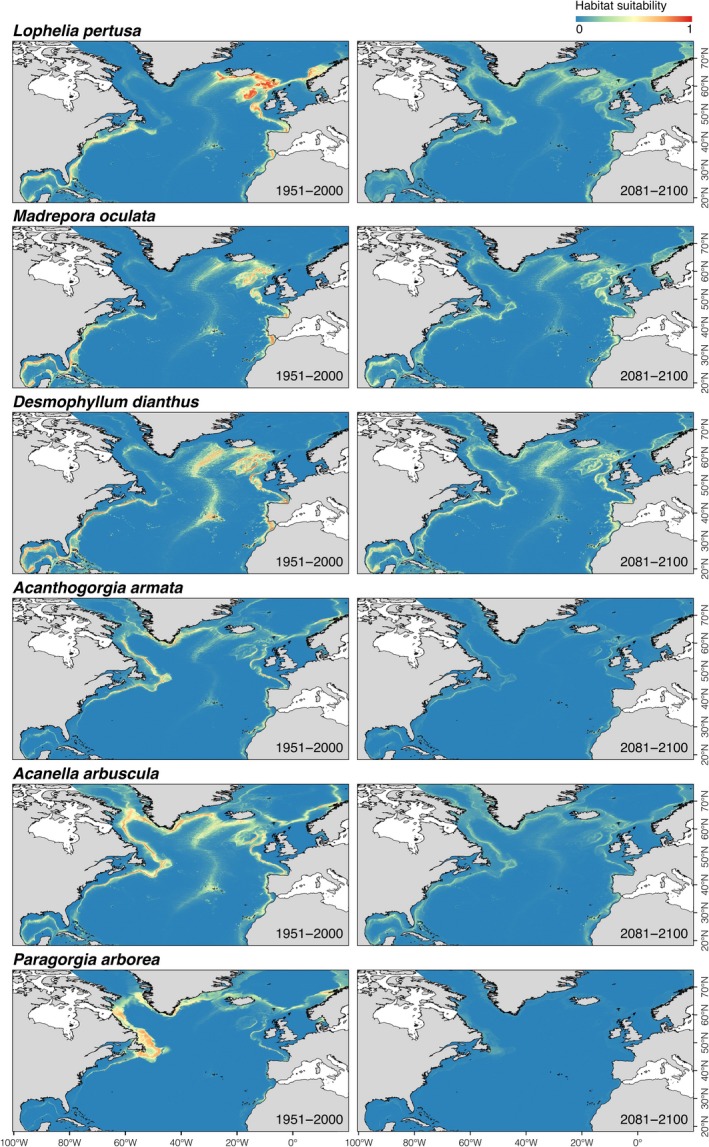
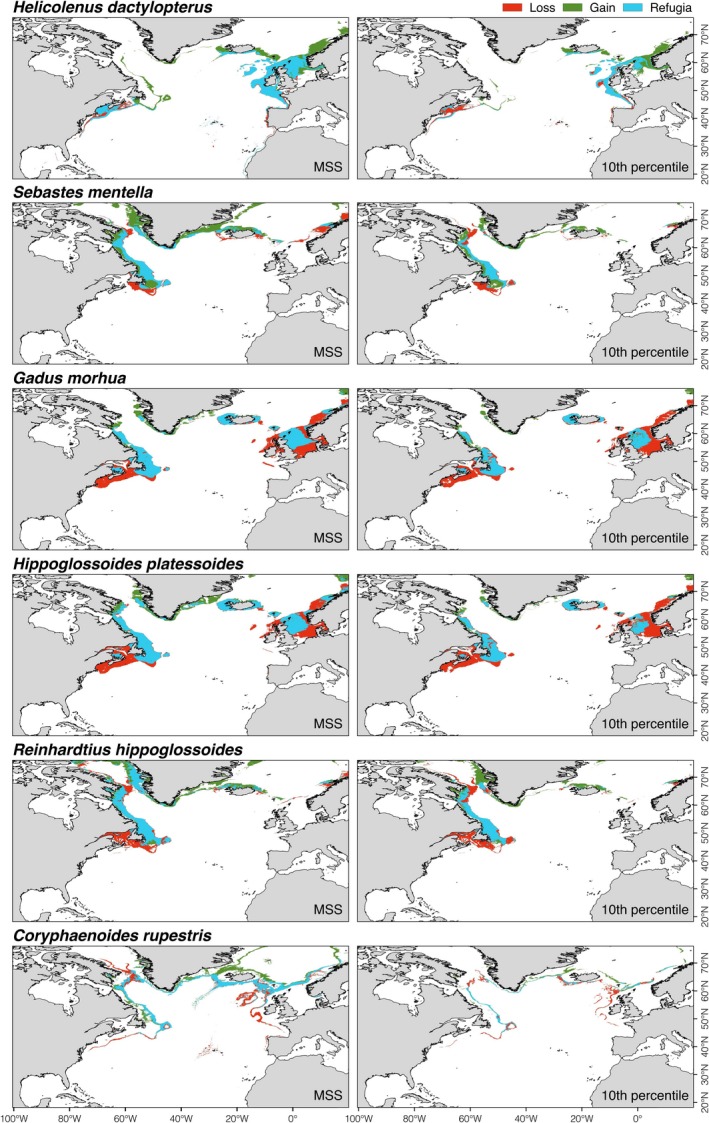
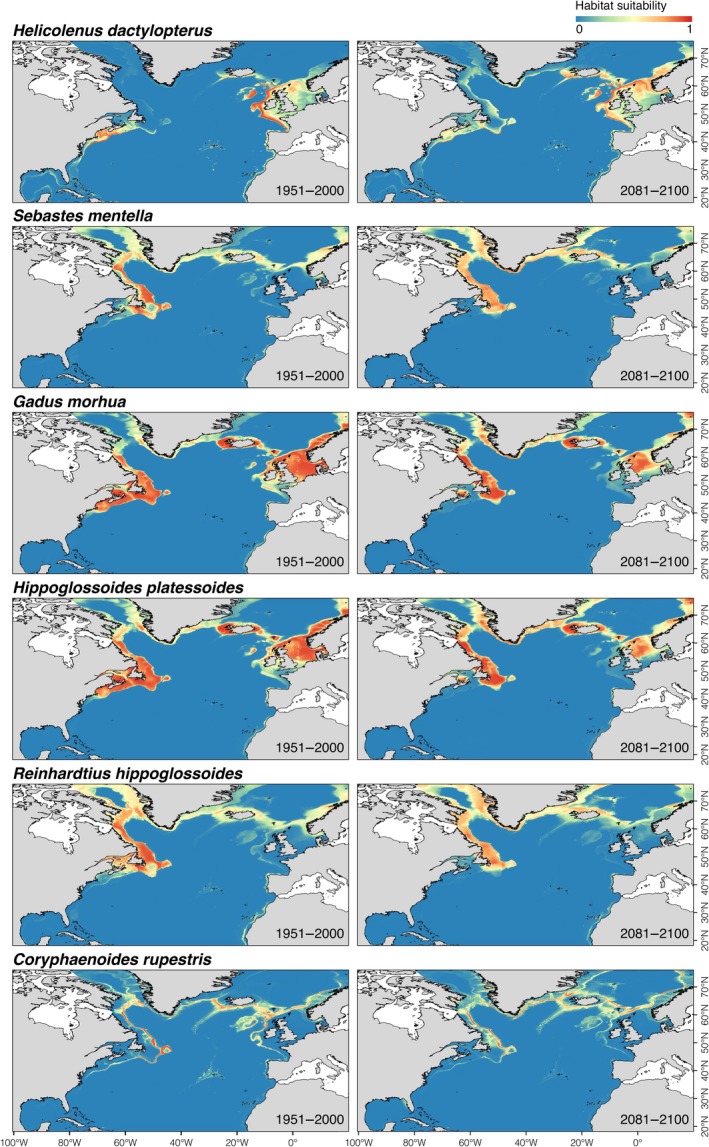
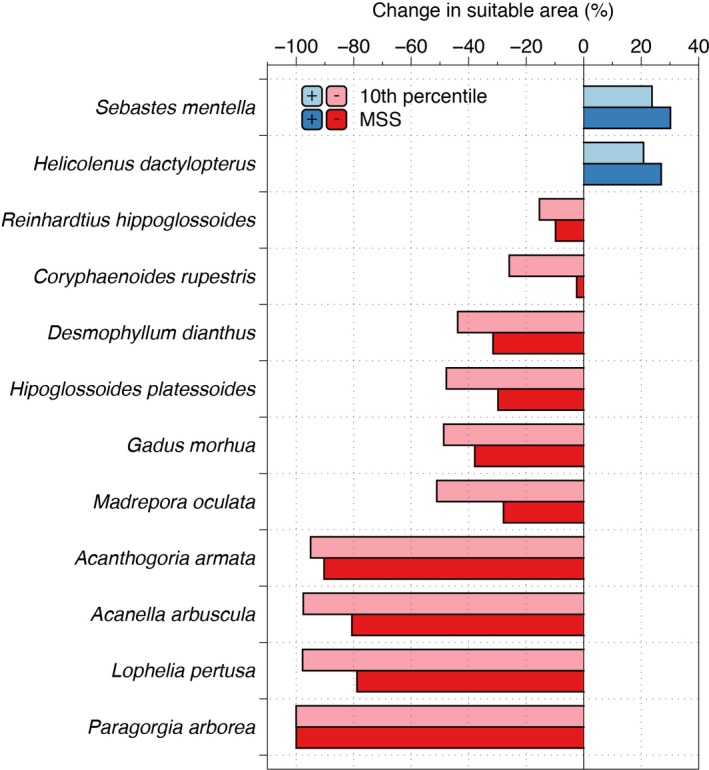
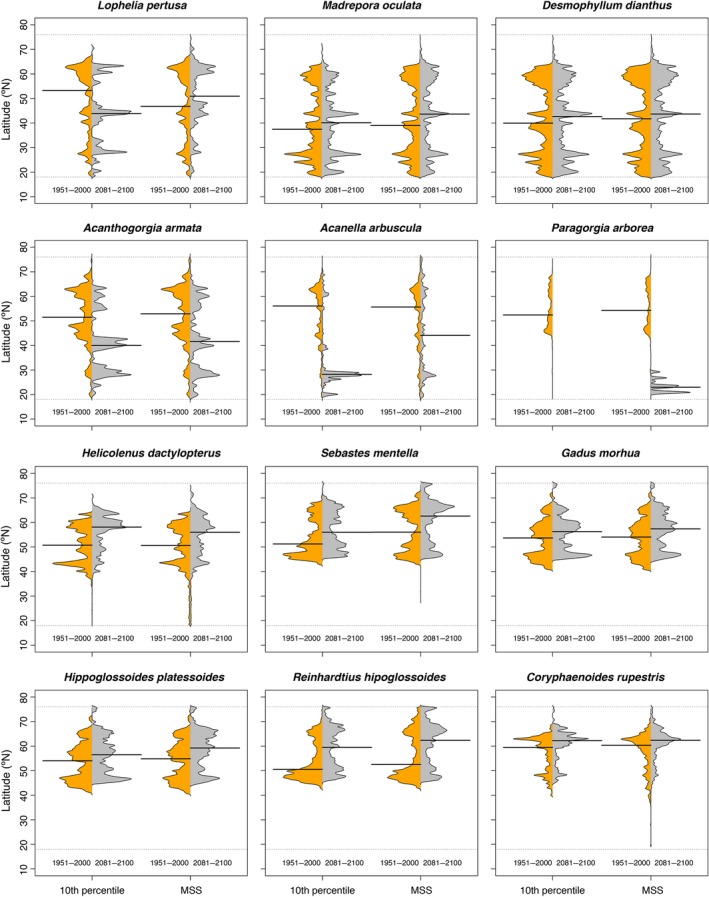
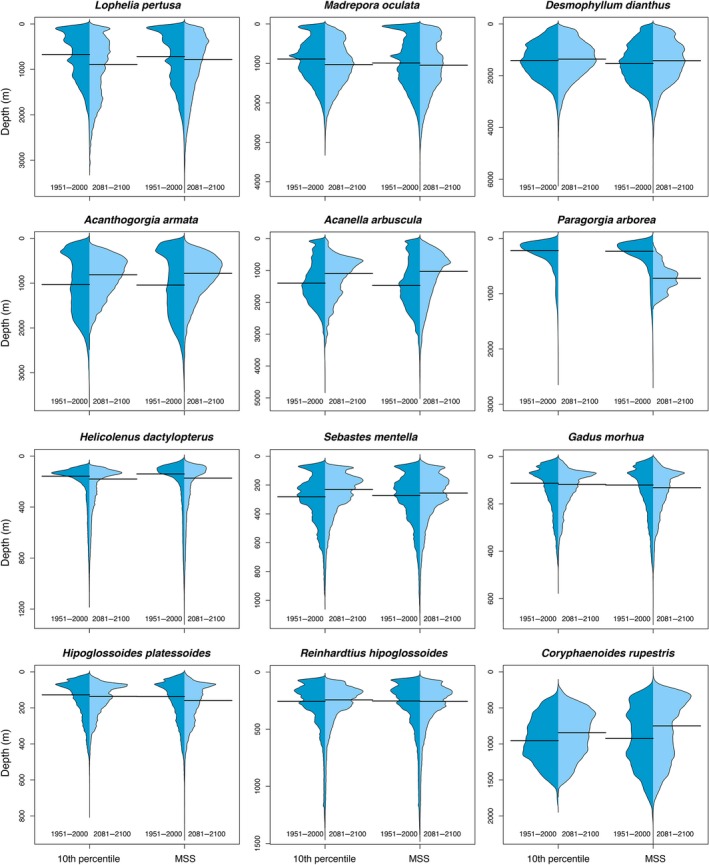
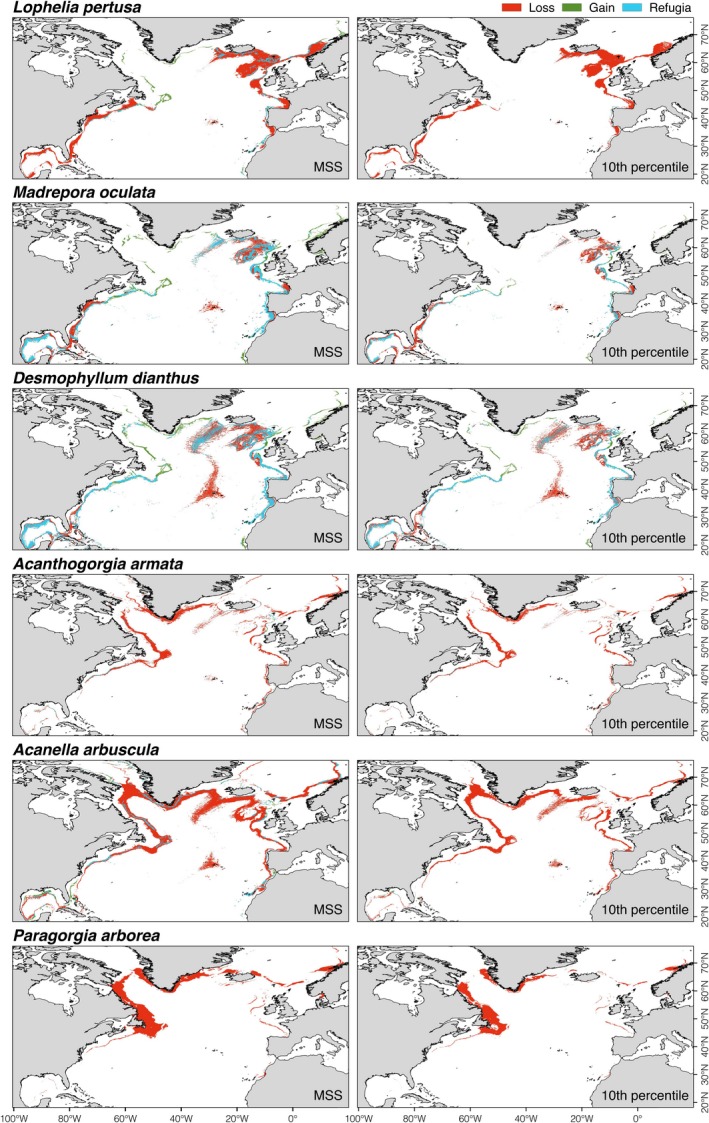
The deep sea plays a critical role in global climate regulation through uptake and storage of heat and carbon dioxide. However, this regulating service causes warming, acidification and deoxygenation of deep waters, leading to decreased food availability at the seafloor. These changes and their projections are likely to affect productivity, biodiversity and distributions of deep-sea fauna, thereby compromising key ecosystem services. Understanding how climate change can lead to shifts in deep-sea species distributions is critically important in developing management measures. We used environmental niche modelling along with the best available species occurrence data and environmental parameters to model habitat suitability for key cold-water coral and commercially important deep-sea fish species under present-day (1951-2000) environmental conditions and to project changes under severe, high emissions future (2081-2100) climate projections (RCP8.5 scenario) for the North Atlantic Ocean. Our models projected a decrease of 28%-100% in suitable habitat for cold-water corals and a shift in suitable habitat for deep-sea fishes of 2.0°-9.9° towards higher latitudes. The largest reductions in suitable habitat were projected for the scleractinian coral Lophelia pertusa and the octocoral Paragorgia arborea, with declines of at least 79% and 99% respectively. We projected the expansion of suitable habitat by 2100 only for the fishes Helicolenus dactylopterus and Sebastes mentella (20%-30%), mostly through northern latitudinal range expansion. Our results projected limited climate refugia locations in the North Atlantic by 2100 for scleractinian corals (30%-42% of present-day suitable habitat), even smaller refugia locations for the octocorals Acanella arbuscula and Acanthogorgia armata (6%-14%), and almost no refugia for P. arborea. Our results emphasize the need to understand how anticipated climate change will affect the distribution of deep-sea species including commercially important fishes and foundation species, and highlight the importance of identifying and preserving climate refugia for a range of area-based planning and management tools.
深海通过吸收和储存热量及二氧化碳,在全球气候调节中发挥着关键作用。然而,这种调节作用导致了深层海水的变暖、酸化和脱氧,进而导致海底食物供应减少。这些变化及其预测结果可能会影响深海动物的生产力、生物多样性和分布,从而损害关键的生态系统服务。了解气候变化如何导致深海物种分布的变化,对于制定管理措施至关重要。我们利用环境生态位建模,结合现有的最佳物种出现数据和环境参数,对当前(1951 - 2000年)环境条件下关键冷水珊瑚和具有商业重要性的深海鱼类物种的栖息地适宜性进行建模,并预测在北大西洋未来(2081 - 2100年)高排放情景(RCP8.5情景)下的变化情况。我们的模型预测,冷水珊瑚适宜栖息地将减少28% - 100%,深海鱼类适宜栖息地将向高纬度地区移动2.0° - 9.9°。石珊瑚鹿角珊瑚和八放珊瑚树状拟软珊瑚的适宜栖息地预计减少最多,分别至少减少79%和99%。到2100年,预计只有长鳍凹腹鳕和马氏平鲉的适宜栖息地会扩大(20% - 30%),主要是通过向北扩展纬度范围。我们的结果预测,到2100年,北大西洋石珊瑚的气候避难所位置有限(占当前适宜栖息地的30% - 42%),八放珊瑚丛生棘柳珊瑚和武装刺柳珊瑚的避难所位置更小(6% - 14%),而树状拟软珊瑚几乎没有避难所。我们的研究结果强调了理解预期气候变化将如何影响包括具有商业重要性的鱼类和基础物种在内的深海物种分布的必要性,并突出了识别和保护气候避难所对于一系列基于区域的规划和管理工具的重要性。