Department of Psychiatry, University of California San Diego, San Diego, CA, USA.
Department of Psychology and Latin American Latino Studies Institute, Fordham University, Bronx, NY, USA.
Clin Neuropsychol. 2021 Feb;35(2):396-418. doi: 10.1080/13854046.2020.1713400. Epub 2020 Feb 20.
We developed demographically-corrected norms for Spanish-speakers from the U.S.-Mexico border regions of California and Arizona on two tests of motor skills - the Grooved Pegboard Test (Pegboard) and Finger Tapping Test (Tapping) - as part of a larger normative effort.
Participants were native Spanish-speakers from the Neuropsychological Norms for the U.S.-Mexico Border Region in Spanish (NP-NUMBRS) Project (Pegboard: = 254; Tapping: = 183; age: 19-60 years; education: 0-20 years; 59% women). We examined the association of demographics (age, education and gender) with raw scores. Raw test scores were then converted to demographically-corrected T-scores via fractional polynomial equations. We also examined rates of impairment (T-score < 40) based on the current norms and on previously published norms for English-speaking non-Hispanic Whites and Blacks.
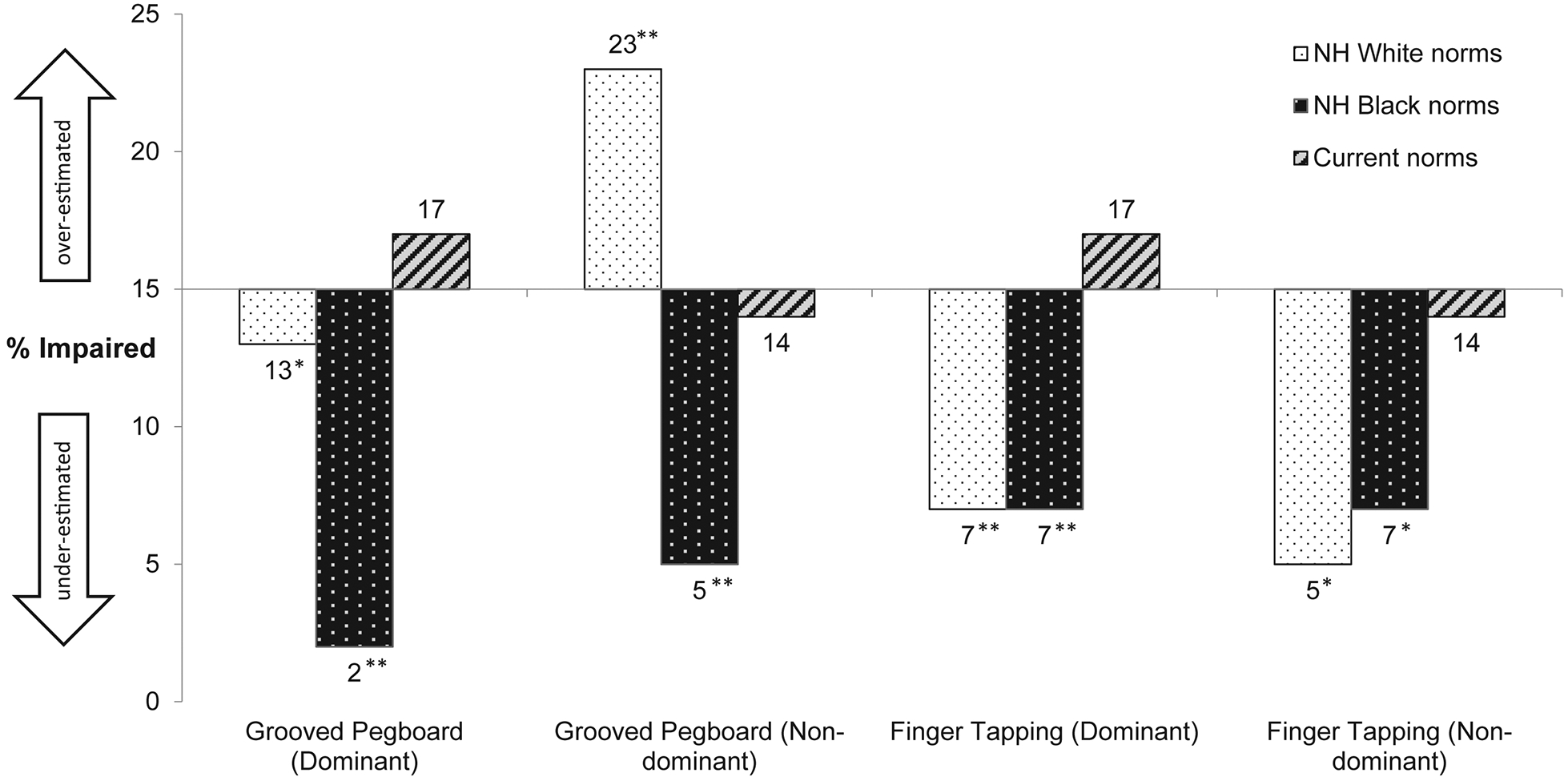
Having more years of education was associated with better raw test score performance on both tests ( < .001), and increased age was associated with worse performance on Pegboard ( < .001). Men outperformed women on Tapping, and older age was associated with lower raw scores in men only on the Tapping non-dominant hand trial ( = .02). The normed T-scores were confirmed to be normally distributed and free from demographic influences, and resulted in expected rates of impairment. Applying existing norms for English-speaking non-Hispanic Whites and Blacks to the raw scores of Spanish-speakers generally yielded lower than expected impairment rates (2-13%), with one exception: non-dominant Pegboard, for which non-Hispanic White norms overestimated impairment (23%).
Present findings underscore the importance of appropriate, population-specific normative data, even for tests of motor ability.
我们为来自美国-墨西哥边境加利福尼亚州和亚利桑那州的西班牙语使用者开发了两个运动技能测试(镶嵌板测试(Pegboard)和手指敲击测试(Tapping))的人口统计学校正常模,作为更大的常模工作的一部分。
参与者是来自美国-墨西哥边境地区西班牙语神经心理标准项目(NP-NUMBRS)的母语为西班牙语的人(镶嵌板:= 254;敲击:= 183;年龄:19-60 岁;教育:0-20 年;女性占 59%)。我们检查了人口统计学因素(年龄、教育和性别)与原始分数的关系。然后,通过分数多项式方程将原始测试分数转换为人口统计学校正 T 分数。我们还根据当前常模和以前发表的英语非西班牙裔白人和黑人常模检查了损伤率(T 分数<40)。
受教育年限越多,两种测试的原始测试分数表现越好(<0.001),年龄越大,镶嵌板测试表现越差(<0.001)。男性在敲击测试中的表现优于女性,只有男性的敲击非主导手测试中,年龄越大,原始分数越低(=0.02)。标准化 T 分数被证实呈正态分布且不受人口统计学因素影响,并且产生了预期的损伤率。将现有的英语非西班牙裔白人和黑人常模应用于西班牙语使用者的原始分数通常会导致低于预期的损伤率(2-13%),只有一个例外:非主导手镶嵌板,非西班牙裔白人常模高估了损伤率(23%)。
目前的发现强调了适当的、特定于人群的常模数据的重要性,即使是针对运动能力的测试也是如此。