Laboratório de Interações Celulares, Instituto de Ciências Biomédicas, Universidade Federal do Rio de Janeiro Prédio de Ciências da Saúde-Cidade Universitária, Ilha do Fundão, Av. Carlos Chagas, 373-bloco F, sala 26, Rio de Janeiro CEP: 21941-902, RJ, Brazil.
Programa de Carcinogênese Molecular, Instituto Nacional de Câncer-INCA, Rua André Cavalcanti, 37-Centro, Rio de Janeiro CEP: 20231-050, RJ, Brazil.
Cells. 2020 Feb 17;9(2):455. doi: 10.3390/cells9020455.
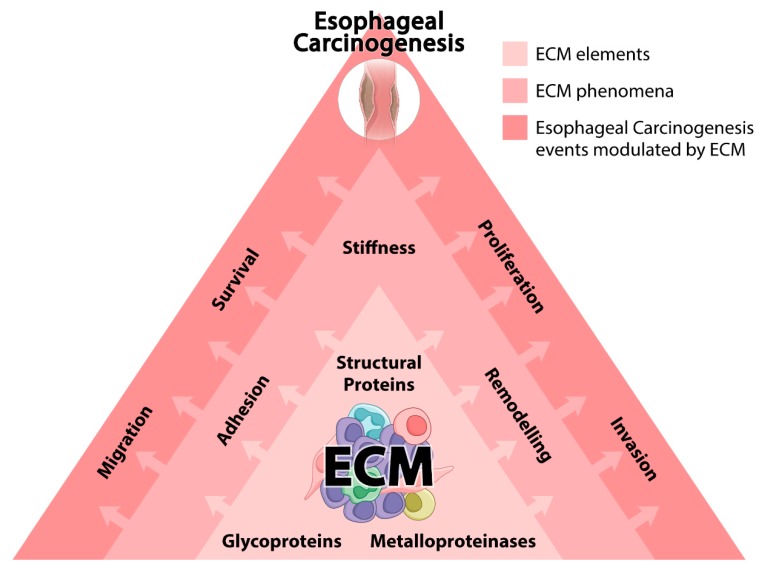
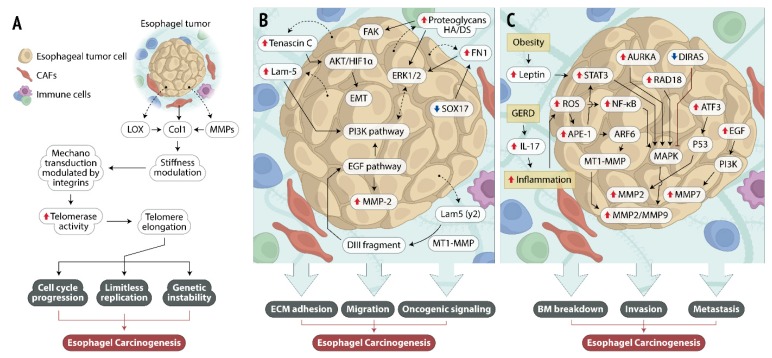
In the last years, the extracellular matrix (ECM) has been reported as playing a relevant role in esophageal cancer (EC) development, with this compartment being related to several aspects of EC genesis and progression. This sounds very interesting due to the complexity of this highly incident and lethal tumor, which takes the sixth position in mortality among all tumor types worldwide. The well-established increase in ECM stiffness, which is able to trigger mechanotransduction signaling, is capable of regulating several malignant behaviors by converting alteration in ECM mechanics into cytoplasmatic biochemical signals. In this sense, it has been shown that some molecules play a key role in these events, particularly the different collagen isoforms, as well as enzymes related to its turnover, such as lysyl oxidase (LOX) and matrix metalloproteinases (MMPs). In fact, MMPs are not only involved in ECM stiffness, but also in other events related to ECM homeostasis, which includes ECM remodeling. Therefore, the crucial role of distinct MMPs isoform has already been reported, especially MMP-2, -3, -7, and -9, along EC development, thus strongly associating these proteins with the control of important cellular events during tumor progression, particularly in the process of invasion during metastasis establishment. In addition, by distinct mechanisms, a vast diversity of glycoproteins and proteoglycans, such as laminin, fibronectin, tenascin C, galectin, dermatan sulfate, and hyaluronic acid exert remarkable effects in esophageal malignant cells due to the activation of oncogenic signaling pathways mainly involved in cytoskeleton alterations during adhesion and migration processes. Finally, the wide spectrum of interactions potentially mediated by ECM may represent a singular intervention scenario in esophageal carcinogenesis natural history and, due to the scarce knowledge on the cellular and molecular mechanisms involved in EC development, the growing body of evidence on ECM's role along esophageal carcinogenesis might provide a solid base to improve its management in the future.
在过去的几年中,细胞外基质 (ECM) 已被报道在食管癌 (EC) 发展中发挥相关作用,该隔室与 EC 发生和进展的几个方面有关。由于这种高发性和致命性肿瘤的复杂性,它在全球所有肿瘤类型的死亡率中排名第六,这听起来非常有趣。众所周知,ECM 硬度的增加能够触发机械转导信号,能够将 ECM 力学的改变转化为细胞质生化信号,从而调节几种恶性行为。在这方面,已经表明一些分子在这些事件中起着关键作用,特别是不同的胶原蛋白同工型,以及与其周转相关的酶,如赖氨酰氧化酶 (LOX) 和基质金属蛋白酶 (MMPs)。事实上,MMPs 不仅参与 ECM 硬度,还参与与 ECM 动态平衡相关的其他事件,包括 ECM 重塑。因此,不同 MMPs 同工型的关键作用已经得到报道,特别是 MMP-2、-3、-7 和 -9,沿着 EC 的发展,因此强烈将这些蛋白质与肿瘤进展过程中重要细胞事件的控制联系起来,特别是在转移建立过程中的侵袭过程。此外,通过不同的机制,大量的糖蛋白和蛋白聚糖,如层粘连蛋白、纤维连接蛋白、腱糖蛋白 C、半乳糖凝集素、硫酸皮肤素和透明质酸,由于主要涉及细胞骨架改变的致癌信号通路的激活,对食管恶性细胞产生显著影响在粘附和迁移过程中。最后,ECM 可能介导的广泛相互作用可能代表食管癌变自然史中的一个独特干预场景,并且由于涉及 EC 发展的细胞和分子机制的知识甚少,沿食管癌变的 ECM 作用的不断增加的证据可能为改善其未来管理提供坚实的基础。