Huang Zixing, Liu Dan, Chen Xinzu, Yu Pengxin, Wu Jiangfen, Song Bin, Hu Jiankun, Wu Bing
Department of Radiology, West China Hospital.
Department of Gastrointestinal Surgery and Laboratory of Gastric Cancer, West China Hospital, Sichuan University, Chengdu.
Medicine (Baltimore). 2020 Feb;99(8):e19157. doi: 10.1097/MD.0000000000019157.
Peritoneal metastasis (PM) is a frequent condition in patients presenting with gastric cancer, especially in younger patients with advanced tumor stages. Computer tomography (CT) is the most common noninvasive modality for preoperative staging in gastric cancer. However, the challenges of limited CT soft tissue contrast result in poor CT depiction of small peritoneal tumors. The sensitivity for detecting PM remains low. About 16% of PM are undetected. Deep learning belongs to the category of artificial intelligence and has demonstrated amazing results in medical image analyses. So far, there has been no deep learning study based on CT images for the diagnosis of PM in gastric cancer.
CT images in the primary tumor region of gastric cancer had valuable information that could predict occult PM of gastric cancer, which could be extracted effectively through deep learning.
To develop a deep learning model for accurate preoperative diagnosis of PM in gastric cancer.
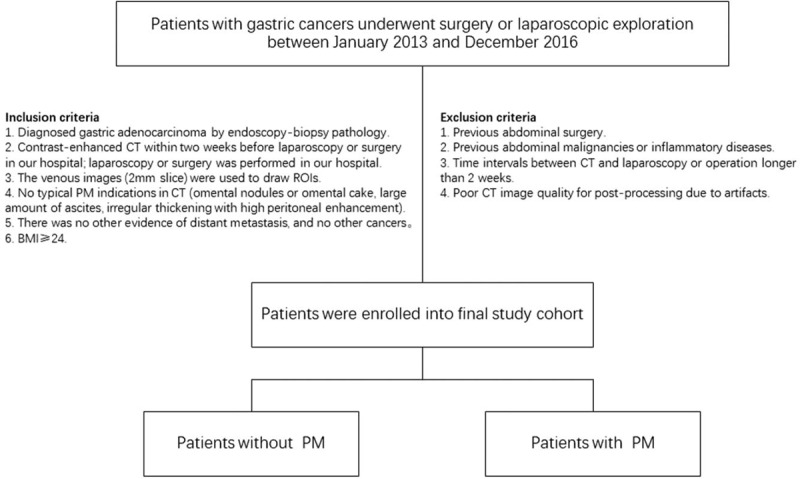
All patients with gastric cancer were retrospectively enrolled. All patients were initially diagnosed as PM negative by CT and later confirmed as positive through surgery or laparoscopy. The dataset was randomly split into training cohort (70% of all patients) and testing cohort (30% of all patients). To develop deep convolutional neural network (DCNN) models with high generalizability, 5-fold cross-validation and model ensemble were utilized. The area under the receiver operating characteristic curve, sensitivity and specificity were used to evaluate DCNN models on the testing cohort.
This study will help us know whether deep learning can improve the performance of CT in diagnosing PM in gastric cancer.
腹膜转移(PM)在胃癌患者中很常见,尤其是在肿瘤分期较晚的年轻患者中。计算机断层扫描(CT)是胃癌术前分期最常用的非侵入性检查方法。然而,CT软组织对比度有限带来的挑战导致其对小的腹膜肿瘤的显示不佳。检测PM的敏感性仍然较低。约16%的PM未被检测到。深度学习属于人工智能范畴,在医学图像分析中已显示出惊人的成果。到目前为止,尚未有基于CT图像的深度学习研究用于胃癌PM的诊断。
胃癌原发肿瘤区域的CT图像具有可预测胃癌隐匿性PM的有价值信息,这些信息可通过深度学习有效提取。
开发一种深度学习模型,用于准确术前诊断胃癌中的PM。
回顾性纳入所有胃癌患者。所有患者最初经CT诊断为PM阴性,后来通过手术或腹腔镜检查证实为阳性。数据集随机分为训练队列(所有患者的70%)和测试队列(所有患者的30%)。为开发具有高通用性的深度卷积神经网络(DCNN)模型,采用了5折交叉验证和模型集成。使用受试者操作特征曲线下面积、敏感性和特异性在测试队列上评估DCNN模型。
本研究将帮助我们了解深度学习是否能提高CT在诊断胃癌PM方面的性能。