Institute for Health and Sport (IHES), Victoria University, Victoria, Australia.
Game Insight Group, Tennis Australia, Melbourne, Australia.
Sci Rep. 2020 Feb 20;10(1):3111. doi: 10.1038/s41598-020-59475-5.
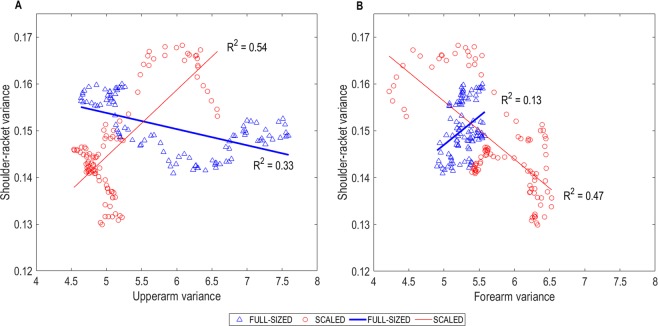
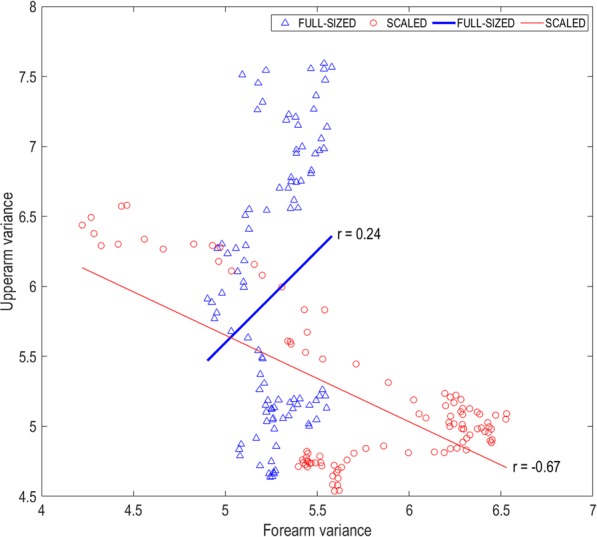
Scaling sports equipment to match the physical development of children allows motor skills to be performed with greater success and with more desirable movement patterns. It is unknown, however, how scaled equipment affects movement variability - a key factor associated with coordination. Our aim was to identify whether scaled sports equipment facilitates coordination and functional movement variability in children when performing a hitting for accuracy task in tennis. Twenty-five children were asked to execute a forehand stroke with the aim of hitting the ball to a target located 10 metres away. Participants performed the task in two conditions - a scaled equipment condition and a full-sized equipment condition. Scaled equipment led to superior hitting accuracy and greater temporal stability of the swing compared to full-sized equipment. Scaled equipment also afforded the emergence of a functional coupling between upper arm and forearm movement variability which helped regulate the distance between the shoulder and the racket. Comparatively there was a lack of coupling when full-sized equipment was used. Hence, scaled equipment promoted functional movement variability, whereas full-sized equipment resulted in the freezing of mechanical degrees of freedom. This suggests that children's skill acquisition could be hindered and potentially regress when using inappropriately sized equipment.
将运动器材按比例缩小以适应儿童的身体发育,可以让他们更成功地完成运动技能,并采用更理想的运动模式。然而,目前尚不清楚按比例缩小的设备如何影响运动可变性——这是与协调能力相关的一个关键因素。我们的目的是确定在儿童进行网球准确性击球任务时,使用按比例缩小的运动器材是否会促进协调和功能性运动可变性。我们要求 25 名儿童进行正手击球,目标是将球击向 10 米外的目标。参与者在两种条件下完成任务——使用按比例缩小的设备条件和全尺寸设备条件。与全尺寸设备相比,按比例缩小的设备可提高击球准确性,并使挥拍的时间稳定性更高。按比例缩小的设备还产生了一种功能性的耦合,即上臂和前臂运动可变性之间的耦合,这有助于调节肩部和球拍之间的距离。相比之下,使用全尺寸设备时则缺乏这种耦合。因此,按比例缩小的设备促进了功能性运动可变性,而全尺寸设备则导致机械自由度的冻结。这表明,当使用不合适尺寸的设备时,儿童的技能习得可能会受到阻碍,并可能出现倒退。