Department of Biological Psychology, Vrije Universiteit Amsterdam, Amsterdam, The Netherlands.
Amsterdam Public Health Research Institute, Amsterdam, The Netherlands.
J Child Psychol Psychiatry. 2020 Dec;61(12):1328-1338. doi: 10.1111/jcpp.13218. Epub 2020 Feb 20.
Given the role of childhood aggressive behavior (AGG) in everyday child development, precise and accurate measurement is critical in clinical practice and research. This study aims to quantify agreement among widely used measures of childhood AGG regarding item content, clinical concordance, correlation, and underlying genetic construct.
We analyzed data from 1254 Dutch twin pairs (age 8-10 years, 51.1% boys) from a general population sample for whom both parents completed the A-TAC, CBCL, and SDQ at the same occasion.
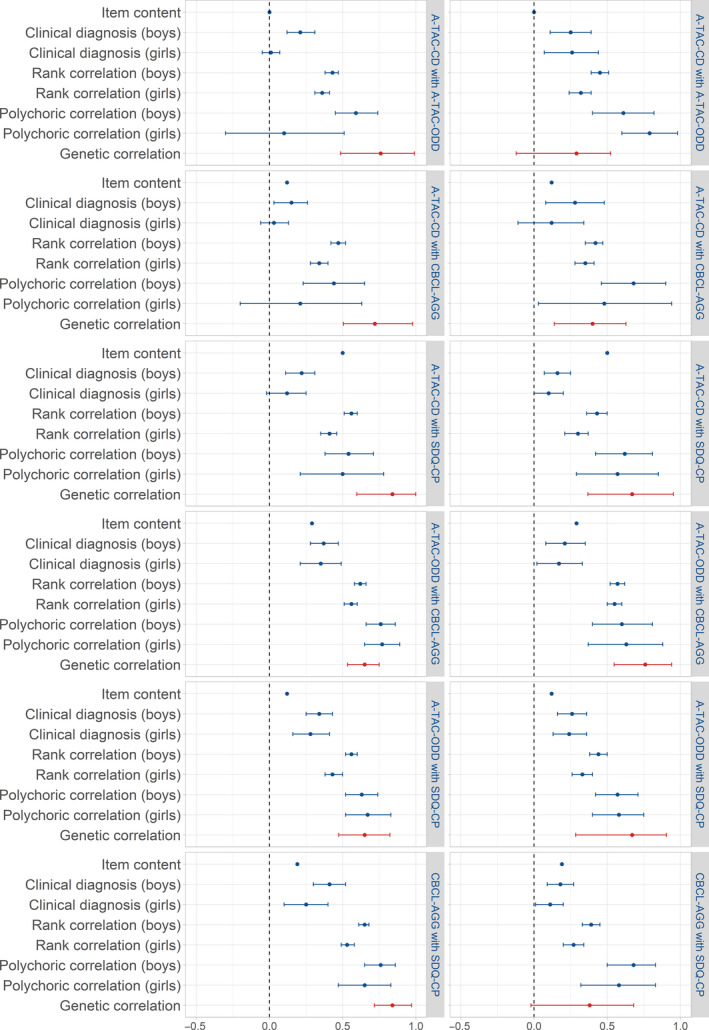
There was substantial variation in item content among AGG measures, ranging from .00 (i.e., mutually exclusive) to .50 (moderate agreement). Clinical concordance (i.e., do the same children score above a clinical threshold among AGG measures) was very weak to moderate with estimates ranging between .01 and .43 for mother-reports and between .12 and .42 for father-reports. Correlations among scales were weak to strong, ranging from .32 to .70 for mother-reports and from .32 to .64 for father-reports. We found weak to very strong genetic correlations among the measures, with estimates between .65 and .84 for mother-reports and between .30 and .87 for father-reports.
Our results demonstrated that degree of agreement between measures of AGG depends on the type (i.e., item content, clinical concordance, correlation, genetic correlation) of agreement considered. Because agreement was higher for correlations compared to clinical concordance (i.e., above or below a clinical cutoff), we propose the use of continuous scores to assess AGG, especially for combining data with different measures. Although item content can be different and agreement among observed measures may not be high, the genetic correlations indicate that the underlying genetic liability for childhood AGG is consistent across measures.
鉴于儿童攻击行为(AGG)在日常儿童发展中的作用,精确和准确的测量在临床实践和研究中至关重要。本研究旨在量化广泛使用的儿童 AGG 测量方法在项目内容、临床一致性、相关性和潜在遗传结构方面的一致性。
我们分析了来自一般人群样本的 1254 对荷兰双胞胎(年龄 8-10 岁,51.1%为男孩)的数据,这些双胞胎的父母在同一时间完成了 A-TAC、CBCL 和 SDQ。
AGG 测量方法的项目内容存在很大差异,从 0.00(即互斥)到 0.50(中等一致性)不等。临床一致性(即,相同的儿童在 AGG 测量方法中是否得分高于临床阈值)非常弱到中等,母亲报告的估计值在 0.01 到 0.43 之间,父亲报告的估计值在 0.12 到 0.42 之间。量表之间的相关性较弱到较强,母亲报告的范围在 0.32 到 0.70 之间,父亲报告的范围在 0.32 到 0.64 之间。我们发现这些测量方法之间存在较弱到很强的遗传相关性,母亲报告的估计值在 0.65 到 0.84 之间,父亲报告的估计值在 0.30 到 0.87 之间。
我们的结果表明,AGG 测量方法之间的一致性程度取决于所考虑的一致性类型(即项目内容、临床一致性、相关性、遗传相关性)。由于相关性的一致性高于临床一致性(即高于或低于临床截止值),我们建议使用连续分数来评估 AGG,特别是在将不同测量方法的数据结合起来时。虽然项目内容可能不同,观察到的测量方法之间的一致性可能不高,但遗传相关性表明,儿童 AGG 的潜在遗传倾向在各种测量方法中是一致的。