Department of Internal Medicine, Lund University Hospital, Lund, Sweden.
Department of Clinical Experimental Research, Glostrup Research Institute, Rigshospitalet Glostrup Hospital, Copanhagen, Denmark.
J Mol Neurosci. 2020 Jun;70(6):930-944. doi: 10.1007/s12031-020-01493-z. Epub 2020 Feb 22.
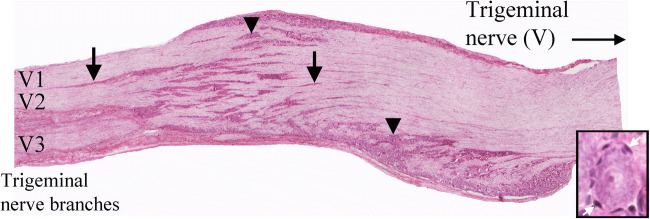
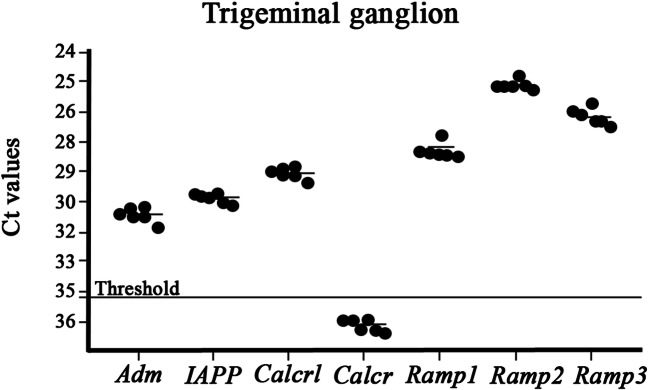
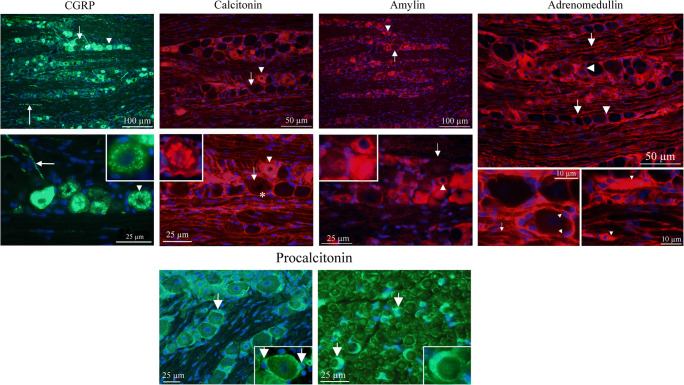
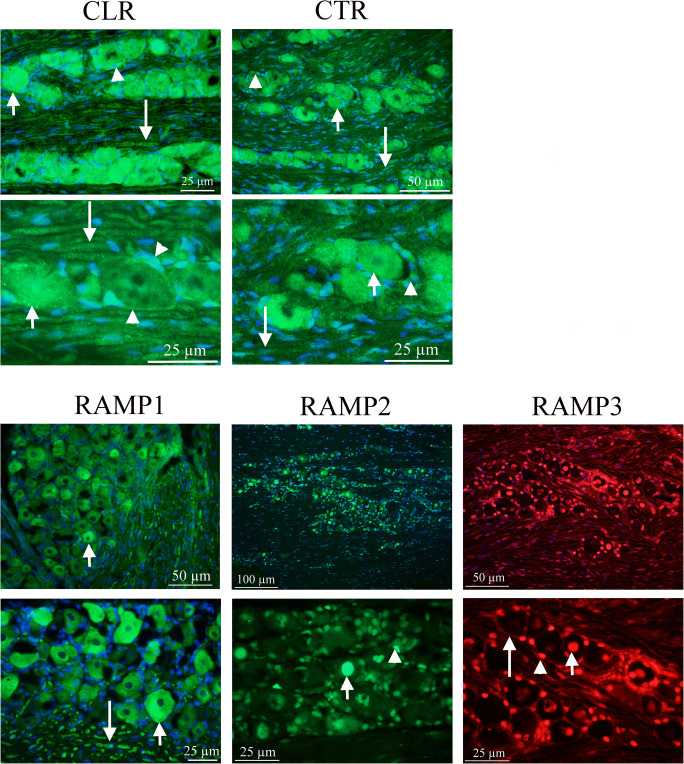
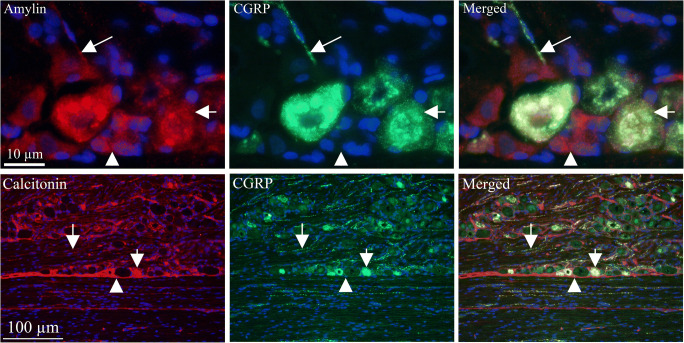
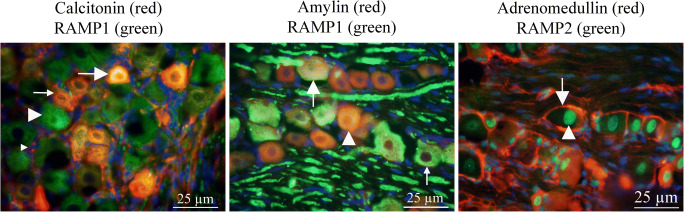
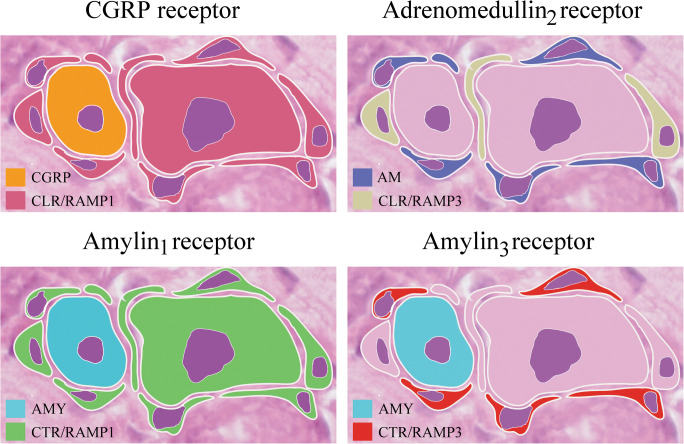
The calcitonin gene-related peptide (CGRP) family of neuropeptides, consists of CGRP, adrenomedullin, amylin, and calcitonin. The receptors consist of either calcitonin receptor-like receptor (CLR) or calcitonin receptor (CTR) which for function needs an accessory protein, receptor activity-modifying proteins (RAMPs). CGRP has a pivotal role in primary headaches but the role of the other members of the CGRP family of peptides in headaches is not known. Here, we describe the expression of these molecules in the trigeminal ganglion (TG) to understand more on their possible role(s). Single or double immunohistochemistry were applied on frozen sections of rat TG using primary antibodies against CGRP, procalcitonin, calcitonin, adrenomedullin, amylin, RAMP1/2/3, CLR, and CTR. In addition, mRNA expression was measured by quantitative qPCR on TGs. CGRP and calcitonin showed rich expression in the cytoplasm of small to medium-sized neurons, and co-localized sometimes. Procalcitonin was observed in the glial cells. Immunoreactive fibers storing both CGRP and calcitonin were also observed. Adrenomedullin immunoreactivity was found in the satellite glial cells and in fibers, probably the myelinating Schwann cells. Amylin was found in the cytoplasm in many TG neurons. Levels of mRNA expression for adrenomedullin, amylin, CLR, RAMP1, RAMP2, RAMP3, and CTR were measured using qPCR. The experiments verified the expression of mRNA in the TG with the exception of CTR, which was above the limit of detection indicating little or no mRNA expression. In addition to the well-known CGRP receptor (CLR/RAMP1) and the receptor for calcitonin-CTR, we propose that other receptors exist in the rat TG: adrenomedullin receptor AM (CLR/RAMP3) in mainly the satellite glial cells, amylin receptors AMY (CTR/RAMP1) in mainly neurons, and AMY (CTR/RAMP3) in the satellite glial cells. It is important to compare peptides and receptors side-by-side in studies to help address questions of actions resulting from cross-reactivity between receptors. Several of the diverse biological actions of the CGRP family of peptides are clinically relevant. Our findings demonstrate the specific ligand and receptor sites in the rat trigeminal ganglion, highlighting recognition mechanisms to facilitate drug development.
降钙素基因相关肽(CGRP)家族的神经肽,由 CGRP、肾上腺髓质素、胰岛淀粉样肽和降钙素组成。受体由降钙素受体样受体(CLR)或降钙素受体(CTR)组成,其功能需要辅助蛋白,即受体活性修饰蛋白(RAMP)。CGRP 在原发性头痛中起关键作用,但 CGRP 家族肽的其他成员在头痛中的作用尚不清楚。在这里,我们描述了这些分子在三叉神经节(TG)中的表达,以更深入地了解它们可能的作用。使用针对 CGRP、降钙素原、降钙素、肾上腺髓质素、胰岛淀粉样肽、RAMP1/2/3、CLR 和 CTR 的一抗,对大鼠 TG 的冷冻切片进行了单或双免疫组织化学染色。此外,通过定量 qPCR 测量 TG 中的 mRNA 表达。CGRP 和降钙素在中小神经元的细胞质中表现出丰富的表达,有时会发生共定位。降钙素原在神经胶质细胞中观察到。还观察到储存 CGRP 和降钙素的免疫反应性纤维。肾上腺髓质素免疫反应性存在于卫星神经胶质细胞和纤维中,可能是髓鞘形成 Schwann 细胞。胰岛淀粉样肽存在于许多 TG 神经元的细胞质中。使用 qPCR 测量了肾上腺髓质素、胰岛淀粉样肽、CLR、RAMP1、RAMP2、RAMP3 和 CTR 的 mRNA 表达水平。实验验证了 TG 中 mRNA 的表达,除了 CTR,其检测限以上表明几乎没有或没有 mRNA 表达。除了众所周知的 CGRP 受体(CLR/RAMP1)和降钙素受体-CTR 外,我们还提出了大鼠 TG 中存在其他受体:主要在卫星神经胶质细胞中的肾上腺髓质素受体 AM(CLR/RAMP3)、主要在神经元中的胰岛淀粉样肽受体 AMY(CTR/RAMP1)和卫星神经胶质细胞中的 AMY(CTR/RAMP3)。在研究中并排比较肽和受体非常重要,以帮助解决受体交叉反应引起的作用问题。CGRP 家族肽的几种不同的生物学作用与临床相关。我们的发现表明了大鼠三叉神经节中的特定配体和受体部位,突出了识别机制,以促进药物开发。