Department of Infectious Diseases, Saint Jude Children's Research Hospital, Memphis, TN, USA.
Department of Preventive Veterinary Medicine, University of Chile, Santiago de Chile, Chile.
Vet Med Sci. 2020 Aug;6(3):518-526. doi: 10.1002/vms3.254. Epub 2020 Feb 21.
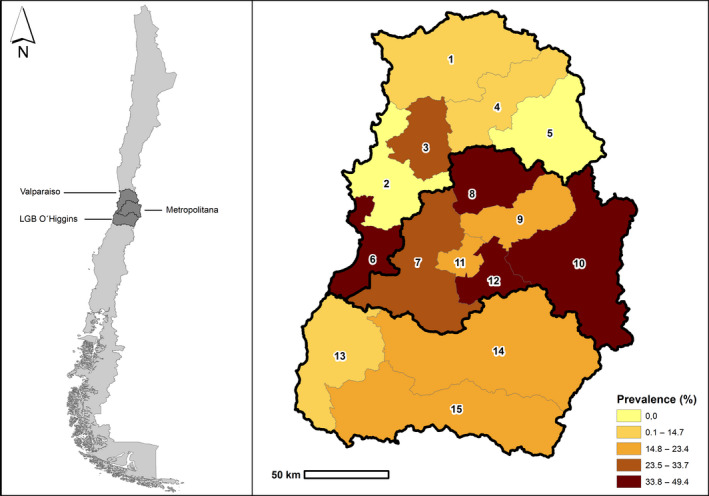
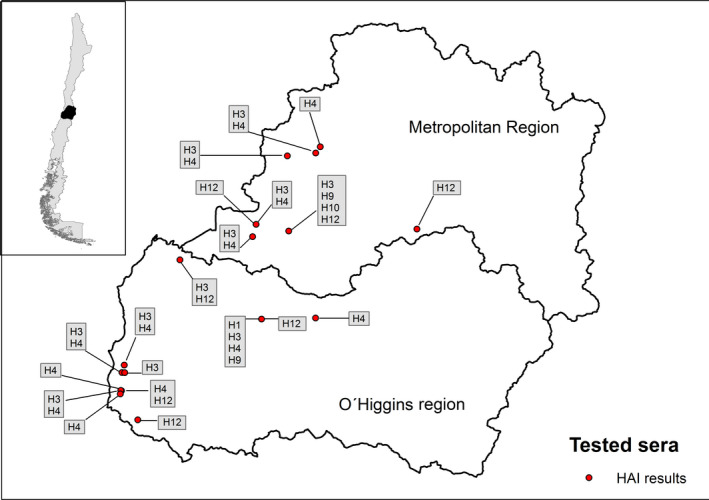
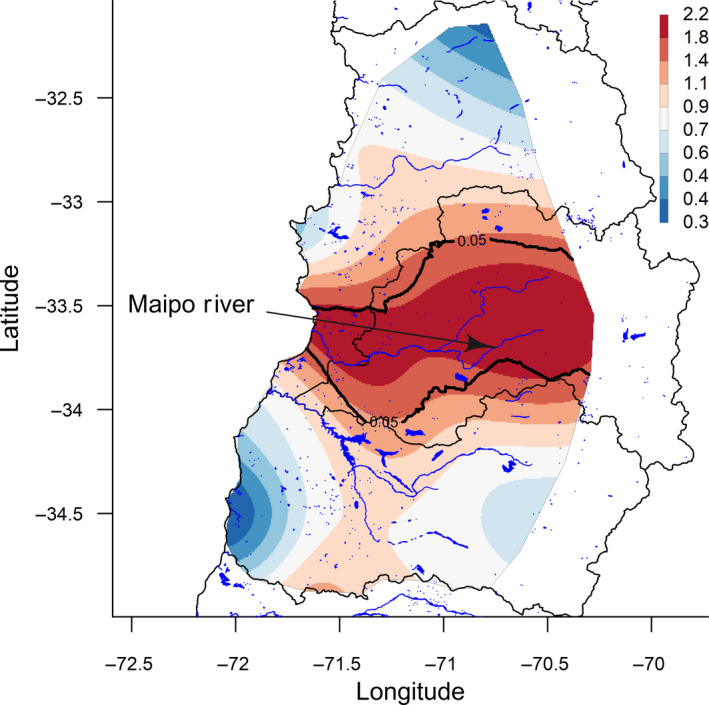
Backyard production systems (BPS) are a common form of poultry and swine production worldwide. The limited implementation of biosecurity standards in these operations makes BPS a potential source for the emergence of pathogens that have an impact on both animal and public health. Information regarding circulation of influenza A virus (IAV) in poultry and swine raised in BPS is scarce; particularly in South American countries. The objective of this study was to estimate prevalence and seroprevalence of IAV in BPS in central Chile, identify subtype diversity, evaluate risk factors and spatial relative risk for IAV. Samples were collected from 329 BPS from central Chile. Seroprevalence at BPS level was 34.7% (95% CI: 23.1%-46.2%), 19.7% (95% CI: 9.9%-30.6%) and 11.7% (95% CI: 7.2%-16.4%), whereas prevalence at BPS level was 4.2% (95% CI: 0.0%-8.8%), 8.2% (95% CI: 0.8%-14.0%) and 9.2% (95% CI: 4.8%-13.1%), for the Metropolitan, Valparaiso and LGB O'Higgins regions, respectively. Spatial analysis revealed that central-western area of Metropolitan region and the southern province of Valparaiso region could be considered as high-risk areas for IAV (spatial relative risk = 2.2, p < .05). Logistic regression models identified the practice of breeding both poultry and pigs at the BPS as a risk factor (95% CI 1.06-3.75). From 75 IAV ELISA-positive sera, 20 chicken sera had haemagglutination inhibition titres ranging from 20 to 160, and of these, 11 had microneutralization titres ranging from 40 to 960 for one or more IAV subtypes. Identified subtypes were H1, H3, H4, H9, H10 and H12. Results from this study highlight the need for further IAV surveillance programmes in BPS in Chile. Early detection of IAV strains circulating in backyard animals, especially in regions with large human populations, could have an enormous impact on animal and public health.
后院生产系统(BPS)是全球家禽和猪养殖的常见形式。这些生产系统中生物安全标准的执行有限,使得 BPS 成为对动物和公共卫生都有影响的病原体出现的潜在来源。关于在 BPS 中饲养的家禽和猪中流感病毒(IAV)的循环信息很少;特别是在南美国家。本研究的目的是估计智利中部 BPS 中 IAV 的流行率和血清流行率,确定亚型多样性,评估 IAV 的风险因素和空间相对风险。从智利中部的 329 个 BPS 中采集了样本。BPS 水平的血清流行率为 34.7%(95%CI:23.1%-46.2%)、19.7%(95%CI:9.9%-30.6%)和 11.7%(95%CI:7.2%-16.4%),而 BPS 水平的流行率为 4.2%(95%CI:0.0%-8.8%)、8.2%(95%CI:0.8%-14.0%)和 9.2%(95%CI:4.8%-13.1%),分别来自首都大区、瓦尔帕莱索大区和 LGB 奥希金斯大区。空间分析表明,首都大区的中西部地区和瓦尔帕莱索大区的南部省份可能被视为 IAV 的高风险地区(空间相对风险=2.2,p<.05)。逻辑回归模型确定了在 BPS 中同时养殖家禽和猪的做法是一个风险因素(95%CI 1.06-3.75)。从 75 份 IAV ELISA 阳性血清中,有 20 份鸡血清的血凝抑制效价范围为 20 至 160,其中 11 份对一种或多种 IAV 亚型的微量中和效价范围为 40 至 960。鉴定出的亚型为 H1、H3、H4、H9、H10 和 H12。本研究结果强调了智利有必要在 BPS 中进一步开展 IAV 监测计划。早期发现 BPS 中循环的 IAV 株,特别是在人口众多的地区,可能对动物和公共卫生产生巨大影响。