Department of Infection Control Team, Gyeongsang National University Changwon Hospital, Changwon, Republic of Korea.
Department of Laboratory Medicine, Gyeongsang National University Changwon Hospital, Changwon, Republic of Korea.
BMC Infect Dis. 2020 Feb 22;20(1):166. doi: 10.1186/s12879-020-4889-z.
In this study, we evaluated the genetic relatedness of extended-spectrum beta-lactamase-producing Klebsiella pneumoniae (ESBL-KPN) isolates from an outbreak in a neonatal intensive care unit (NICU) in August 2017, We implemented an active countermeasure to control this outbreak successfully.
The incidence of healthcare-associated ESBL-KPN bacteremia was evaluated before and after initiating enhanced infection control (IC) practices in January 2018. Surveillance cultures were set up and monitored for neonates, medical personnel, and NICU environments. Molecular analyses, including pulse-field gel electrophoresis (PFGE), sequence typing, and ESBL genotyping, were performed for the isolated KPN strains.
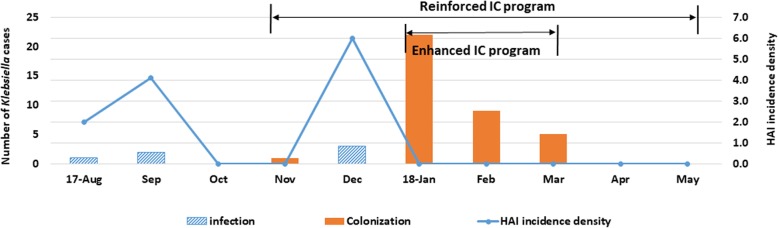
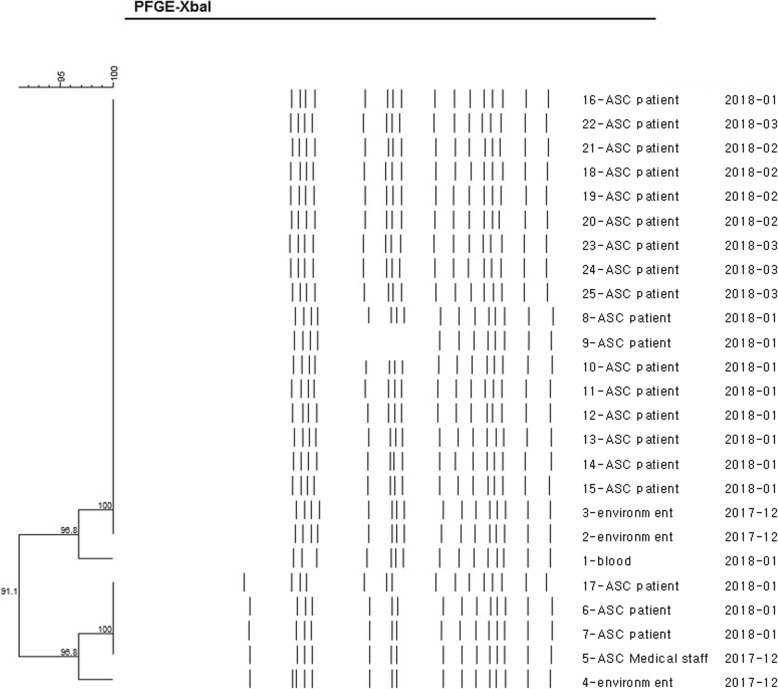
After implementing the enhanced IC procedures, the healthcare-associated bacteremia rate decreased from 6.0 to 0.0 per 1000 patient-days. Samples from neonates (n = 11/15, 73.3%), medical personnel (n = 1/41, 2.4%), and medical devices and the environments (6/181, 3.3%) tested positive for ESBL-KPN in the surveillance cultures in December 2017. Active surveillance cultures revealed that 23 of 72 neonates who were screened (31.9%) were colonized with ESBL-KPN between January and March 2018. All the isolates demonstrated closely related PFGE patterns and were identified as ST307 strain carrying the CTX-M-15 gene.
Contaminated NICU environments and medical devices, as well as transmission by medical personnel, appeared to be the source of the outbreak of ESBL-KPN infection. We employed an enhanced IC strategy during January-March 2018 and successfully controlled the clonal outbreak of CTX-M-15-positive KPN. ST307 has emerged as an important bacteremia-causing pathogen in the NICU and should be carefully monitored.
本研究评估了 2017 年 8 月发生在新生儿重症监护病房(NICU)爆发疫情中的产超广谱β-内酰胺酶肺炎克雷伯菌(ESBL-KPN)的遗传相关性。我们采取了积极的对策成功控制了此次爆发。
2018 年 1 月开始实施强化感染控制(IC)措施前后,评估了与医疗保健相关的产 ESBL-KPN 菌血症的发病率。对新生儿、医务人员和 NICU 环境进行了监测培养。对分离的肺炎克雷伯菌菌株进行了分子分析,包括脉冲场凝胶电泳(PFGE)、序列分型和 ESBL 基因分型。
实施强化 IC 程序后,与医疗保健相关的菌血症发生率从每 1000 个患者日 6.0 例降至 0.0 例。2017 年 12 月,在监测培养中,新生儿(n=15/11,73.3%)、医务人员(n=41/1,2.4%)和医疗器械及环境(n=181/6,3.3%)样本检测出 ESBL-KPN 阳性。2018 年 1 月至 3 月,主动监测培养发现,72 名筛查新生儿中有 23 名(31.9%)定植 ESBL-KPN。所有分离株均显示出密切相关的 PFGE 模式,被鉴定为携带 CTX-M-15 基因的 ST307 株。
污染的 NICU 环境和医疗器械以及医务人员的传播似乎是 ESBL-KPN 感染爆发的源头。我们在 2018 年 1 月至 3 月期间采用了强化 IC 策略,成功控制了 CTX-M-15 阳性 KPN 的克隆爆发。ST307 已成为 NICU 中一种重要的菌血症病原体,应密切监测。