Department of Gastroenterology, The First Affiliated Hospital of Nanchang University, Nanchang 330006, Jiangxi Province, China.
World J Gastroenterol. 2020 Feb 7;26(5):514-523. doi: 10.3748/wjg.v26.i5.514.
Gastrointestinal (GI) dysfunction is a common and important complication of acute pancreatitis (AP), especially in patients with severe AP. Despite this, there is no consensus means of obtaining a precise assessment of GI function.
To determine the association between acute gastrointestinal injury (AGI) grade and clinical outcomes in critically ill patients with AP.
Patients with AP admitted to our pancreatic intensive care unit from May 2017 to May 2019 were enrolled. GI function was assessed according to the AGI grade proposed by the European Society of Intensive Care Medicine in 2012, which is mainly based on GI symptoms, intra-abdominal pressure, and feeding intolerance in the first week of admission to the intensive care unit. Multivariate logistic regression analysis was performed to assess the association between AGI grade and clinical outcomes in critically ill patients with AP.
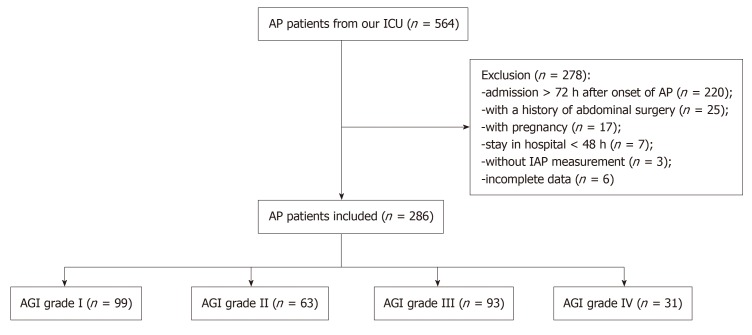
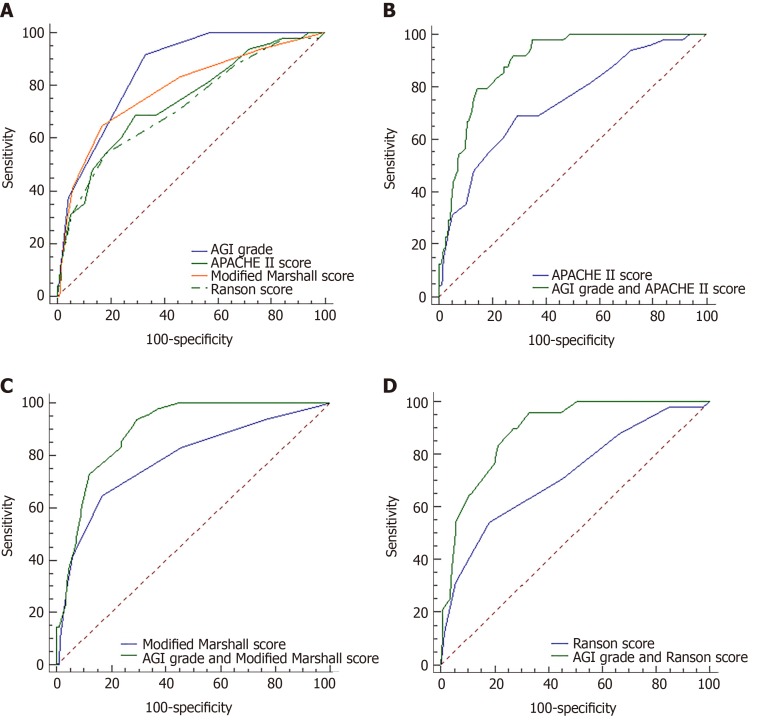
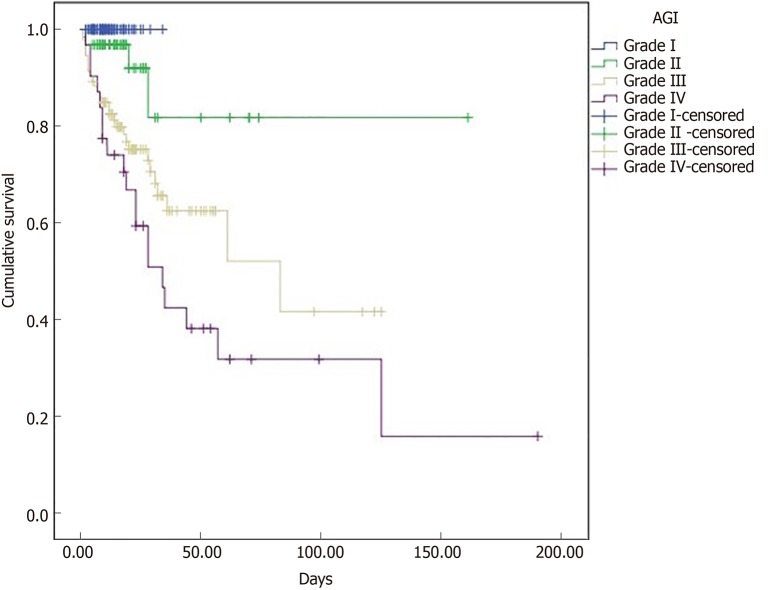
Among the 286 patients included, the distribution of patients with various AGI grades was 34.62% with grade I, 22.03% with grade II, 32.52% with grade III, and 10.84% with grade IV. The distribution of mortality was 0% among those with grade I, 6.35% among those with grade II, 30.11% among those with grade III, and 61.29% among those with grade IV, and AGI grade was positively correlated with mortality ( = 31.511, < 0.0001). Multivariate logistic regression analysis showed that age, serum calcium level, AGI grade, persistent renal failure, and persistent circulatory failure were independently associated with mortality. Compared with the Acute Physiology and Chronic Health Evaluation II score (area under the curve: 0.739 0.854; < 0.05) and Ranson score (area under the curve: 0.72 0.854; < 0.01), the AGI grade was more useful for predicting mortality.
AGI grade is useful for identifying the severity of GI dysfunction and can be used as a predictor of mortality in critically ill patients with AP.
胃肠道(GI)功能障碍是急性胰腺炎(AP)的常见且重要的并发症,尤其是在重症 AP 患者中。尽管如此,目前尚无获得 GI 功能精确评估的共识方法。
确定急性胃肠损伤(AGI)分级与重症 AP 患者临床结局之间的关系。
纳入 2017 年 5 月至 2019 年 5 月入住我院胰腺重症监护病房的 AP 患者。根据 2012 年欧洲重症监护医学会提出的 AGI 分级,主要基于入院后第一周的胃肠道症状、腹腔内压和喂养不耐受来评估 GI 功能。采用多变量逻辑回归分析评估 AGI 分级与重症 AP 患者临床结局之间的关系。
在纳入的 286 例患者中,AGI 各级患者的分布情况为:Ⅰ级 34.62%,Ⅱ级 22.03%,Ⅲ级 32.52%,Ⅳ级 10.84%。死亡率的分布为:Ⅰ级为 0%,Ⅱ级为 6.35%,Ⅲ级为 30.11%,Ⅳ级为 61.29%,AGI 分级与死亡率呈正相关( = 31.511, < 0.0001)。多变量逻辑回归分析显示,年龄、血清钙水平、AGI 分级、持续性肾功能衰竭和持续性循环衰竭与死亡率独立相关。与急性生理学和慢性健康评估 II 评分(曲线下面积:0.739 0.854; < 0.05)和 Ranson 评分(曲线下面积:0.72 0.854; < 0.01)相比,AGI 分级更有助于预测死亡率。
AGI 分级有助于识别 GI 功能障碍的严重程度,可作为重症 AP 患者死亡率的预测指标。