Armstrong Philip M, Andreadis Theodore G, Shepard John J, Thomas Michael C
Department of Environmental Sciences, Center for Vector Biology and Zoonotic Diseases, The Connecticut Agricultural Experiment Station, New Haven, Connecticut, United States of America.
PLoS Negl Trop Dis. 2017 May 18;11(5):e0005623. doi: 10.1371/journal.pntd.0005623. eCollection 2017 May.
The Asian tiger mosquito (Aedes albopictus) is an invasive species and important arbovirus vector that was introduced into the U.S. in the 1980's where it continues to expand its range. Winter temperature is an important constraint to its northward expansion, with potential range limits located between the 0° and -5°C mean cold month isotherm. Connecticut is located within this climatic zone and therefore, Ae. albopictus was monitored statewide to assess its northern range expansion and to delineate where populations can stably persist.
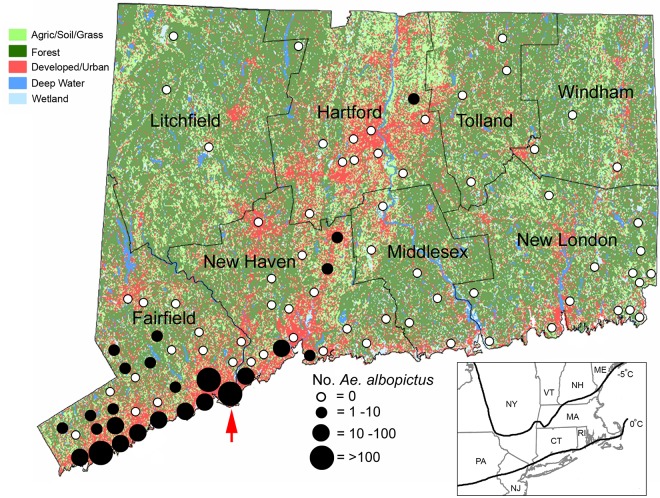
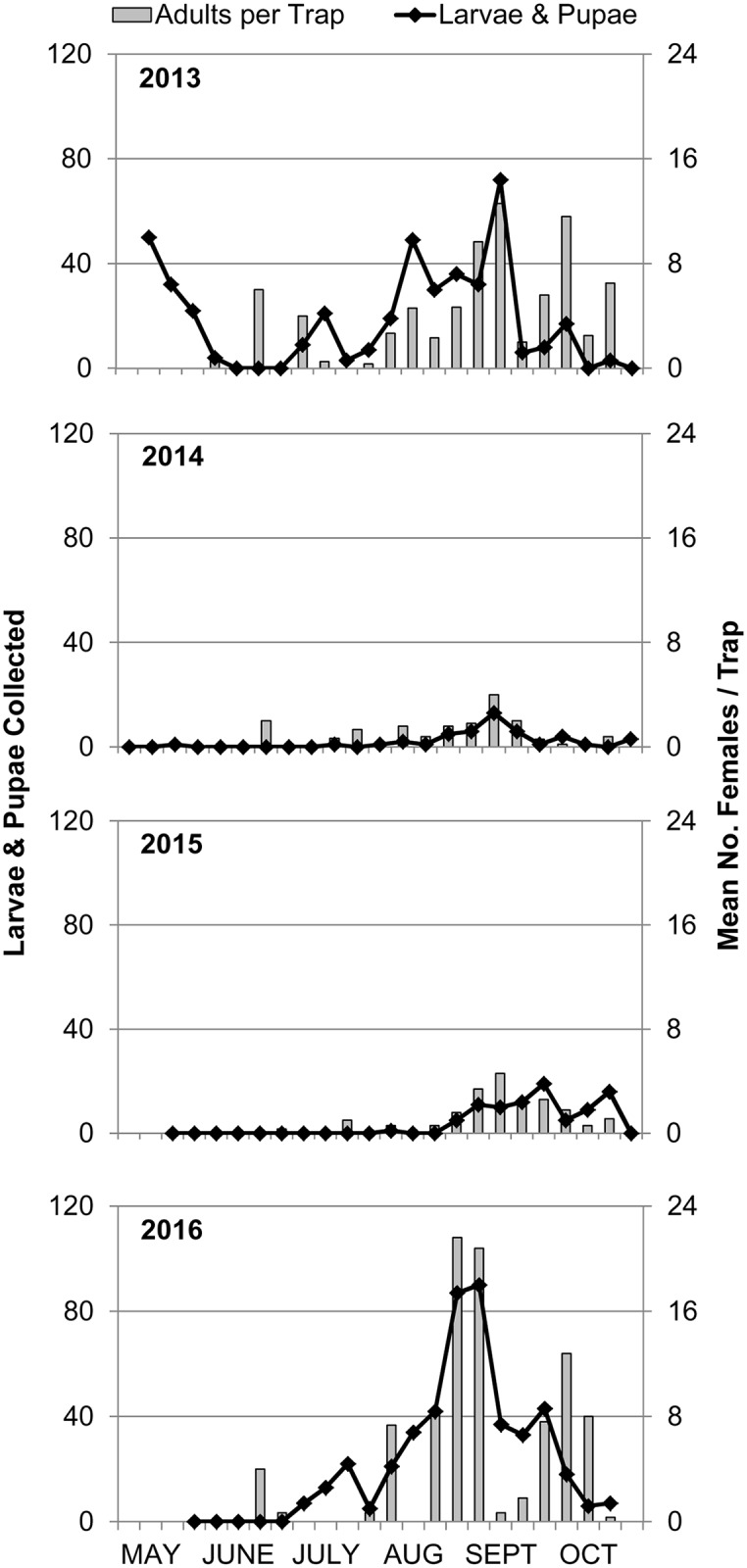
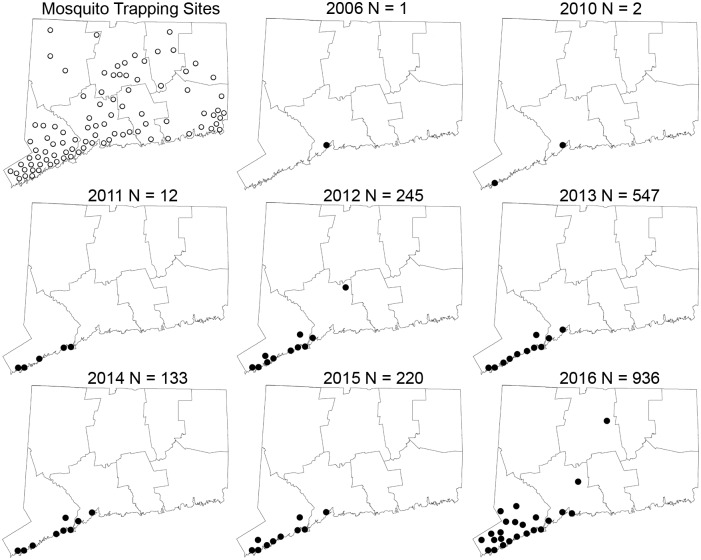
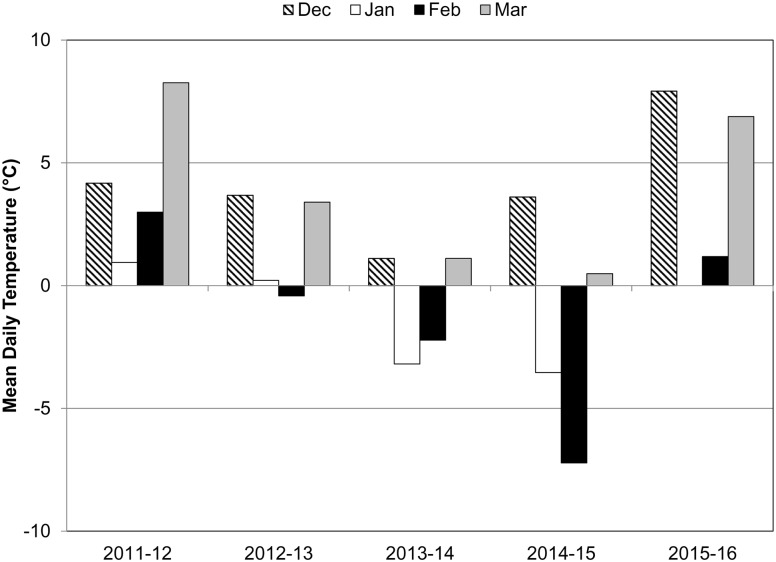
METHODOLOGY/PRINCIPAL FINDINGS: Ae. albopictus females were monitored at fixed trapping sites throughout Connecticut from June-October over a 20-year period, 1997-2016. In addition, Ae. albopictus larvae and pupae were collected from tire habitats and tires were retrieved from the field in the spring and flooded to evaluate overwintering success of hatching larvae. Ae. albopictus was first detected during statewide surveillance when a single adult female was collected in 2006. This species was not collected again until 2010 and was subsequently detected each successive year with increasing abundance and distribution except following the unusually cold winters of 2014 and 2015. Ae. albopictus mosquitoes were most abundant in urban and suburban locations along the southwestern shoreline of Connecticut; however, single specimens were occasionally detected in central parts of the state. Field-collected females were also screened for arbovirus infection yielding two isolations of Cache Valley virus and one isolation of West Nile virus, highlighting the threat posed by this mosquito. Ae. albopictus overwintered in Connecticut under mild winter conditions as shown by recovery of hatched larvae from field collected tires in spring and by early season detection of larvae and pupae.
CONCLUSIONS/SIGNIFICANCE: This study documents the establishment and expansion of Ae. albopictus at the northern boundary of its range in the northeastern U.S. and provides a baseline for monitoring the future spread of this species anticipated under climate change.
亚洲虎蚊(白纹伊蚊)是一种入侵物种,也是重要的虫媒病毒载体,于20世纪80年代被引入美国,其分布范围仍在不断扩大。冬季温度是其向北扩张的重要限制因素,潜在分布范围界限位于平均冷月等温线0°至 -5°C之间。康涅狄格州位于这一气候区内,因此对白纹伊蚊进行了全州范围的监测,以评估其向北的分布范围扩张情况,并划定其种群能够稳定存续的区域。
方法/主要发现:在1997年至2016年的20年期间,于6月至10月在康涅狄格州各地的固定诱捕地点对白纹伊蚊雌蚊进行监测。此外,从轮胎栖息地收集白纹伊蚊幼虫和蛹,并于春季从野外取回轮胎并注水,以评估孵化幼虫的越冬成功率。在2006年收集到一只成年雌蚊时,首次在全州监测中发现白纹伊蚊。直到2010年才再次采集到该物种,随后除了经历2014年和2015年异常寒冷的冬季外,每年都能检测到,且数量和分布不断增加。白纹伊蚊在康涅狄格州西南部海岸线沿线的城市和郊区最为常见;不过,该州中部偶尔也能检测到单个样本。还对野外采集的雌蚊进行了虫媒病毒感染筛查,分离出两株卡什谷病毒和一株西尼罗河病毒,凸显了这种蚊子构成的威胁。如春季从野外收集的轮胎中孵化出幼虫以及在季节早期检测到幼虫和蛹所示,白纹伊蚊在康涅狄格州温和的冬季条件下成功越冬。
结论/意义:本研究记录了白纹伊蚊在美国东北部其分布范围北界的定殖和扩张情况,并为监测气候变化下该物种未来的扩散提供了基线。