Department of Tumor Biology, Institute for Cancer Research, Oslo University Hospital, The Norwegian Radium Hospital,N-0379 Oslo, Norway.
Department of Molecular Cell Biology, Institute for Cancer Research, Oslo University Hospital, The Norwegian Radium Hospital, N-0379 Oslo, Norway.
Biomacromolecules. 2020 Apr 13;21(4):1489-1498. doi: 10.1021/acs.biomac.0c00061. Epub 2020 Mar 5.
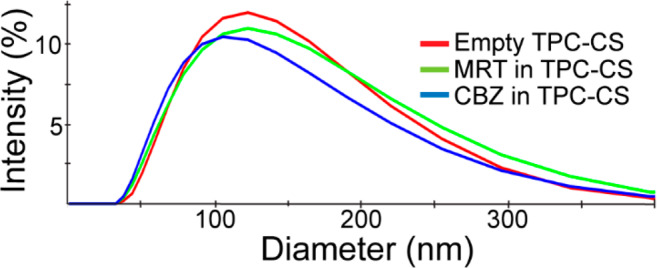
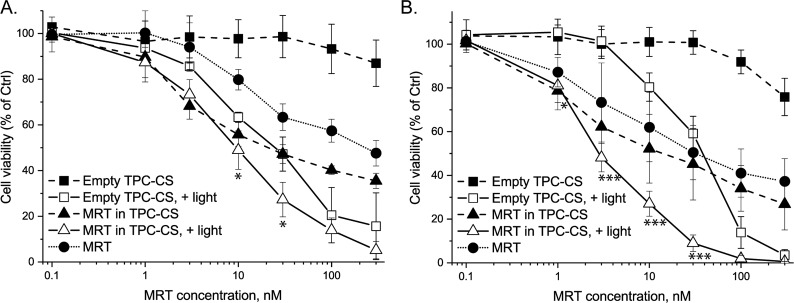
In this study we have developed biodegradable polymeric nanoparticles (NPs) containing the cytostatic drugs mertansine (MRT) or cabazitaxel (CBZ). The NPs are based on chitosan (CS) conjugate polymers synthesized with different amounts of the photosensitizer tetraphenylchlorin (TPC). These TPC-CS NPs have high loading capacity and strong drug retention due to π-π stacking interactions between the drugs and the aromatic photosensitizer groups of the polymers. CS polymers with 10% of the side chains containing TPC were found to be optimal in terms of drug loading capacity and NP stability. The TPC-CS NPs loaded with MRT or CBZ displayed higher cytotoxicity than the free form of these drugs in the breast cancer cell lines MDA-MB-231 and MDA-MB-468. Furthermore, light-induced photochemical activation of the NPs elicited a strong photodynamic therapy effect on these breast cancer cells. Biodistribution studies in mice showed that most of the TPC-CS NPs accumulated in liver and lungs, but they were also found to be localized in tumors derived from HCT-116 cells. These data suggest that the drug-loaded TPC-CS NPs have a potential in combinatory anticancer therapy and as contrast agents.
在这项研究中,我们开发了含有细胞抑制剂美登素(MRT)或卡巴他赛(CBZ)的可生物降解聚合物纳米颗粒(NPs)。这些 NPs 基于壳聚糖(CS)共轭聚合物,这些聚合物通过不同数量的光敏剂四苯基卟啉(TPC)合成。由于药物与聚合物的芳香光敏剂基团之间的π-π堆积相互作用,这些 TPC-CS NPs 具有高载药能力和强药物保留性。在载药能力和 NP 稳定性方面,含有 10%侧链 TPC 的 CS 聚合物是最佳的。负载 MRT 或 CBZ 的 TPC-CS NPs 在乳腺癌细胞系 MDA-MB-231 和 MDA-MB-468 中显示出比游离形式更高的细胞毒性。此外,NP 的光诱导光化学激活对这些乳腺癌细胞产生了强烈的光动力治疗作用。在小鼠中的分布研究表明,大多数 TPC-CS NPs 积聚在肝脏和肺部,但也发现它们定位于源自 HCT-116 细胞的肿瘤中。这些数据表明,载药 TPC-CS NPs 在联合抗癌治疗和作为对比剂方面具有潜力。