School of Automobile, Chang'an University, Xi'an 710064, China.
School of mechanical engineering, Hubei University of Arts and Science, Xiangyang 441053, China.
Int J Environ Res Public Health. 2020 Feb 19;17(4):1328. doi: 10.3390/ijerph17041328.
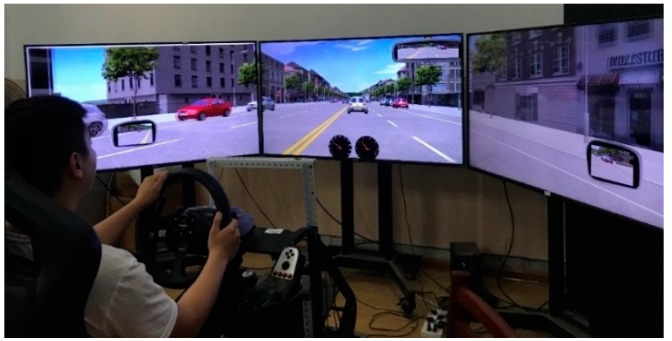
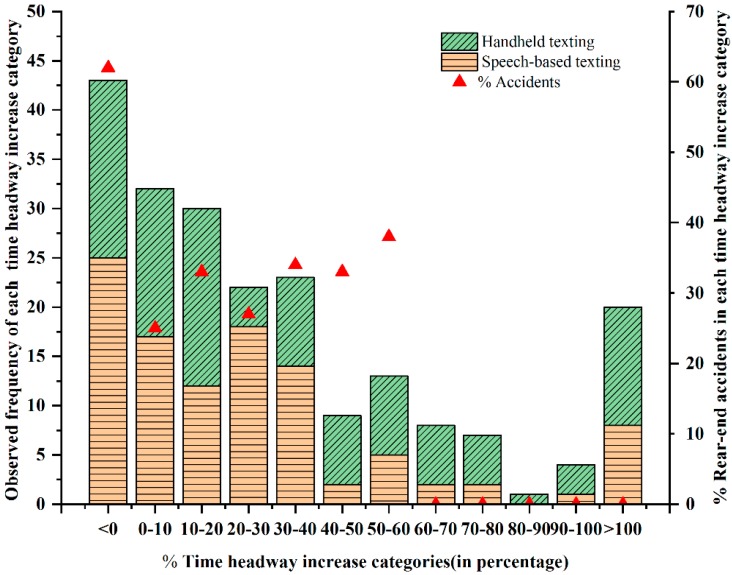
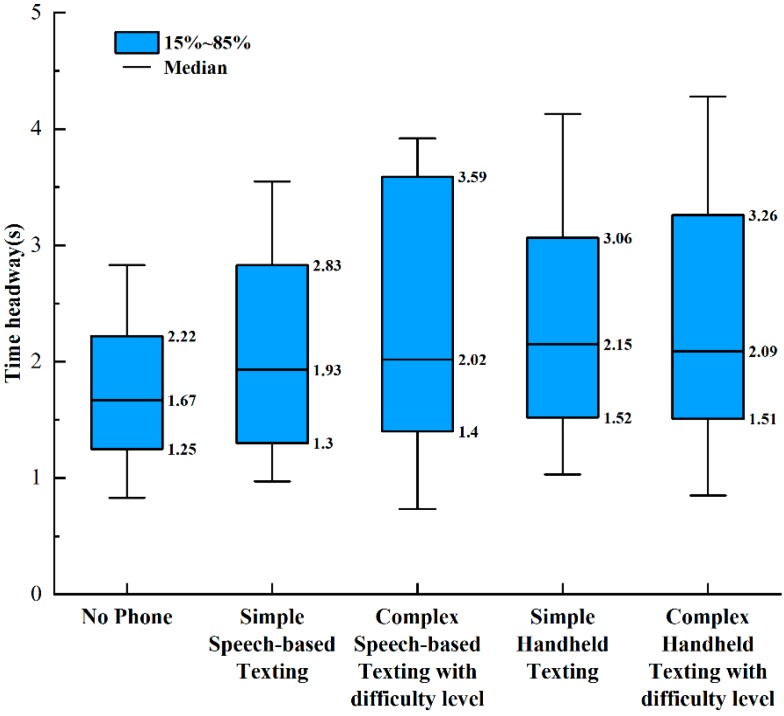
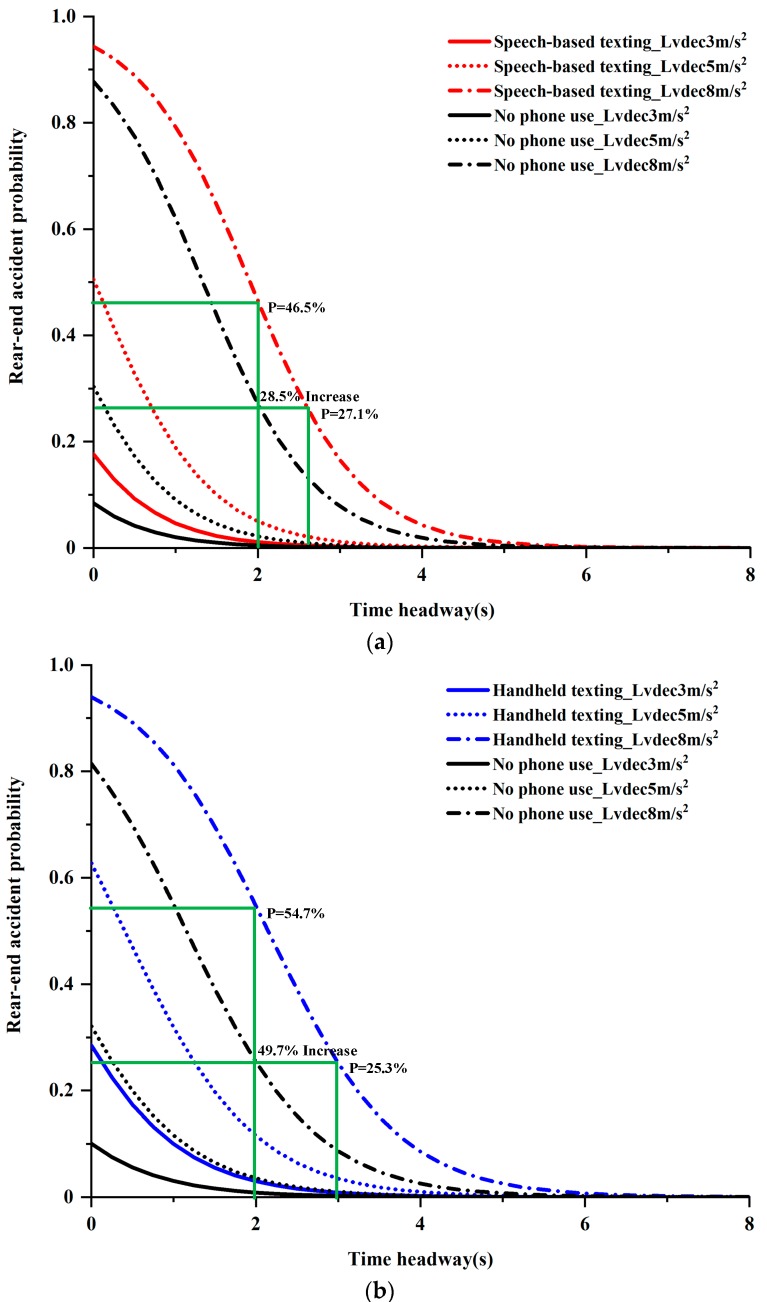
Mobile phone use while driving has become one of the leading causes of traffic accidents and poses a significant threat to public health. This study investigated the impact of speech-based texting and handheld texting (two difficulty levels in each task) on car-following performance in terms of time headway and collision avoidance capability; and further examined the relationship between time headway increase strategy and the corresponding accident frequency. Fifty-three participants completed the car-following experiment in a driving simulator. A Generalized Estimating Equation method was applied to develop the linear regression model for time headway and the binary logistic regression model for accident probability. The results of the model for time headway indicated that drivers adopted compensation behavior to offset the increased workload by increasing their time headway by 0.41 and 0.59 s while conducting speech-based texting and handheld texting, respectively. The model results for the rear-end accident probability showed that the accident probability increased by 2.34 and 3.56 times, respectively, during the use of speech-based texting and handheld texting tasks. Additionally, the greater the deceleration of the lead vehicle, the higher the probability of a rear-end accident. Further, the relationship between time headway increase patterns and the corresponding accident frequencies showed that all drivers' compensation behaviors were different, and only a few drivers increased their time headway by 60% or more, which could completely offset the increased accident risk associated with mobile phone distraction. The findings provide a theoretical reference for the formulation of traffic regulations related to mobile phone use, driver safety education programs, and road safety public awareness campaigns. Moreover, the developed accident risk models may contribute to the development of a driving safety warning system.
开车时使用手机已成为交通事故的主要原因之一,对公众健康构成重大威胁。本研究探讨了基于语音的文本输入和手持设备文本输入(每个任务有两个难度级别)对跟车性能(时距和避撞能力)的影响;并进一步研究了时距增加策略与相应事故频率之间的关系。53 名参与者在驾驶模拟器中完成了跟车实验。采用广义估计方程方法建立了线性回归模型来预测时距,建立二项逻辑回归模型来预测事故概率。时距模型的结果表明,驾驶员分别通过增加 0.41 和 0.59 秒的时距来补偿基于语音的文本输入和手持设备文本输入任务增加的工作负荷。追尾事故概率模型的结果表明,在使用基于语音的文本输入和手持设备文本输入任务时,事故概率分别增加了 2.34 倍和 3.56 倍。此外,前车减速越大,追尾事故的概率越高。此外,时距增加模式与相应事故频率之间的关系表明,所有驾驶员的补偿行为都不同,只有少数驾驶员将时距增加 60%或更多,这可以完全抵消与手机分心相关的增加的事故风险。研究结果为制定与手机使用相关的交通规则、驾驶员安全教育计划和道路安全公众意识运动提供了理论参考。此外,开发的事故风险模型可能有助于开发驾驶安全预警系统。