Department of Occupational and Environmental Medicine, Epidemiology and Hygiene, Italian Workers' Compensation Authority (INAIL), 00078 Monte Porzio Catone, Rome, Italy.
Int J Environ Res Public Health. 2020 Feb 20;17(4):1357. doi: 10.3390/ijerph17041357.
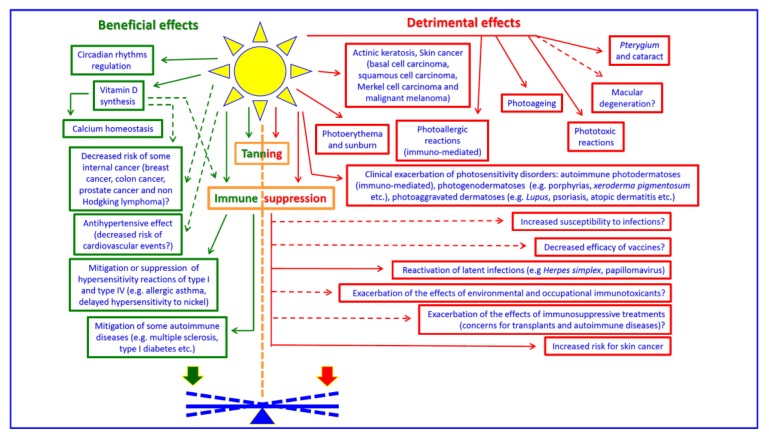
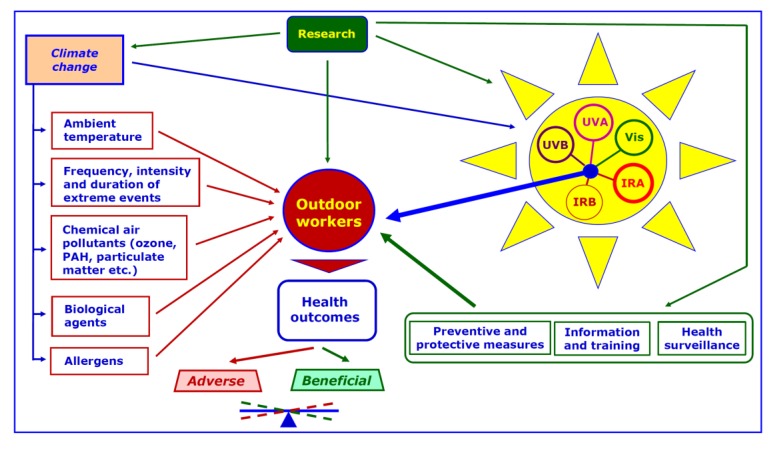
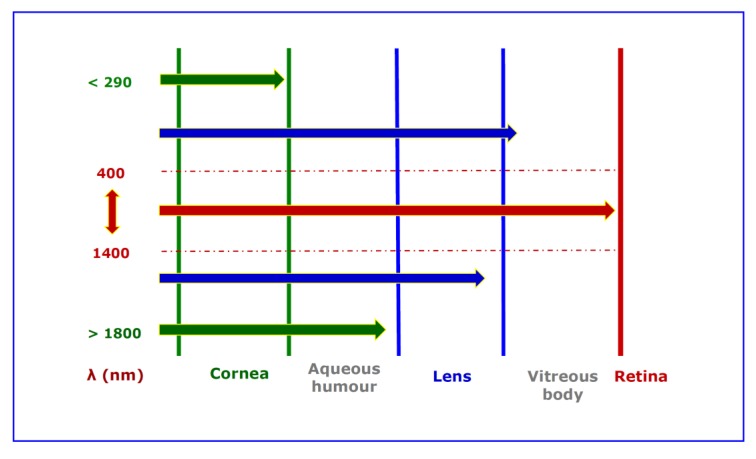
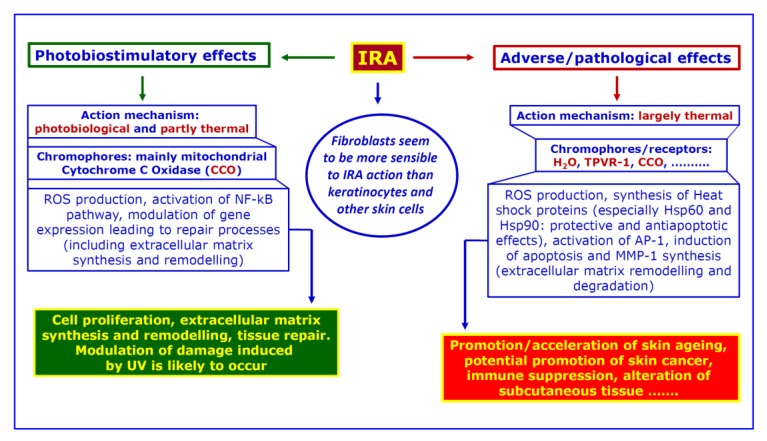
Near infrared or infrared A (IRA) accounts for over 40% of the solar spectrum (SS) and is able to reach subcutaneous tissue as well as the retina. Outdoor workers are occupationally exposed to solar radiation (SR), but the level of exposure may differ widely depending on the job performed, time spent outdoors, latitude, altitude, season, personal protection, etc. Until now, risk assessment and management for outdoor workers has focused on the prevention of both acute and long-term effects on the eye and the skin due to solar ultraviolet radiation (UVR) with little consideration of the other components of the SS (a possible exception is represented by visible radiation with reference to the eye). A growing body of evidence coming from in vitro studies indicates that IRA is involved in cellular reactive oxygen species (ROS) production and may interfere with the respiratory chain in the mitochondria. Moreover, it can modulate gene expression and some metabolic pathways. The biological action of IRA is only partly attributable to a thermal mechanism, should it be also involved in photochemical ones. The cellular and molecular pathways affected by IRA are partly similar and partly different with respect to those involved in the case of visible ultraviolet A (UVA) and ultraviolet B (UVB) radiation. Consequently, the net effect of the SS is very difficult to predict at different levels of the biological organization, making more difficult the final balance of health risk and benefits (for the skin, eye, immune system, blood pressure, etc.) in a given exposure situation. Moreover, few in vivo studies and no epidemiological data are presently available in this regard. Investigating this topic may contribute to better defining the individual exposome. More practically, it is expected to bring benefits to the risk assessment and management for outdoor workers exposed to SS, contributing to: (1) better definition of the individual profiles of susceptibility, (2) more focused preventive and protective measures, (3) better implementation of the health surveillance and (4) a more effective information and training.
近红外或红外 A(IRA)占太阳光谱(SS)的 40%以上,能够到达皮下组织和视网膜。户外工作者职业性暴露于太阳辐射(SR)下,但暴露水平可能因工作、户外时间、纬度、海拔、季节、个人防护等因素而有很大差异。到目前为止,户外工作者的风险评估和管理主要集中在预防太阳紫外线辐射(UVR)对眼睛和皮肤的急性和长期影响上,而对 SS 的其他成分(可能的例外是可见光辐射,与眼睛有关)考虑较少。越来越多的体外研究证据表明,IRA 参与细胞活性氧(ROS)的产生,并可能干扰线粒体中的呼吸链。此外,它可以调节基因表达和一些代谢途径。IRA 的生物学作用部分归因于热机制,如果它也涉及光化学机制的话。IRA 影响的细胞和分子途径与可见光紫外线 A(UVA)和紫外线 B(UVB)辐射的途径既有相似之处,也有不同之处。因此,在不同的生物组织层次上,很难预测 SS 的净效应,这使得在特定暴露情况下,健康风险和收益(皮肤、眼睛、免疫系统、血压等)之间的最终平衡更加困难。此外,目前在这方面几乎没有体内研究和流行病学数据。研究这个课题可能有助于更好地定义个体的暴露组。更实际地说,它有望为 SS 暴露的户外工作者的风险评估和管理带来好处,有助于:(1)更好地定义个体易感性的特征,(2)更有针对性的预防和保护措施,(3)更好地实施健康监测,以及(4)更有效的信息和培训。