Federal Institute of Maranhão; Federal University of Maranhão, Post Graduate Program in Collective Health, Rua Barão de Itapary, nº 155, Centro, Zipcode: 65.020-070, São Luís, MA, Brazil.
Federal University of Maranhão, Post Graduate Program in Collective Health, Rua Barão de Itapary, nº 155, Centro, Zipcode: 65.020-070, São Luís, MA, Brazil.
Sci Rep. 2020 Feb 24;10(1):3249. doi: 10.1038/s41598-020-59910-7.
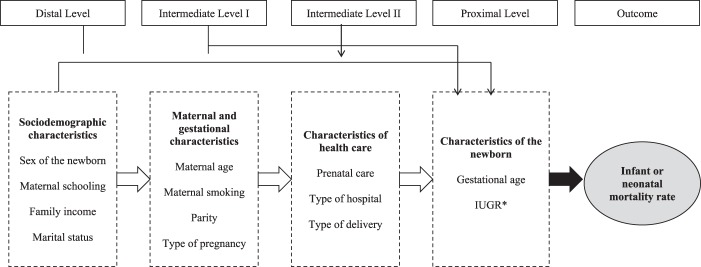
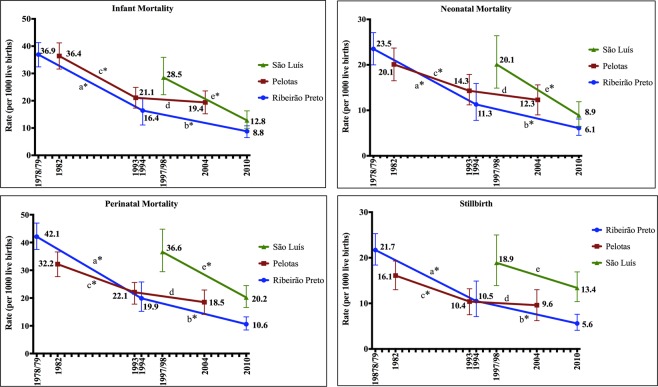
Stillbirth (SBR), perinatal (PMR), neonatal (NMR) and infant mortality rates (IMR) are declining in Brazil and the factors associated with these falls are still being investigated. The objective of the present study was to assess changes in SBR, PMR, NMR and IMR over time and to determine the factors associated with changes in NMR and IMR in eight Brazilian cohorts. All cohorts are population-based (Ribeirão Preto in 1978/79, 1994 and 2010; Pelotas in 1982, 1993 and 2004; and São Luís in 1997/98 and 2010). Were included data on 41440 children. All indicators were decreased, except in the city of Pelotas, from 1993 to 2004, and except SBR in São Luís. Sociodemographic variables seem to be able to explain reductions of NMR and IMR in Ribeirão Preto, from 1978/79 to 1994, and in São Luís. In Ribeirão Preto, from 1994 to 2010 declines in NMR and IMR seem to be explained by reductions in intrauterine growth restriction (IUGR). Newborn's gestational age had diminished in all cohorts, preventing even greater reductions of NMR and IMR. Improved sociodemographic variables and reduction of IUGR, seem to be able to explain part of the decrease observed. NMR and IMR could have been reduced even more, were it not for the worsening in gestational age distribution.
死产率(SBR)、围产期死亡率(PMR)、新生儿死亡率(NMR)和婴儿死亡率(IMR)在巴西呈下降趋势,与这些下降相关的因素仍在研究中。本研究的目的是评估 SBR、PMR、NMR 和 IMR 随时间的变化,并确定与巴西八个队列中 NMR 和 IMR 变化相关的因素。所有队列均为基于人群的研究(1978/79 年、1994 年和 2010 年的里贝朗普雷托;1982 年、1993 年和 2004 年的佩洛塔斯;1997/98 年和 2010 年的圣路易斯)。共纳入了 41440 名儿童的数据。除了佩洛塔斯市在 1993 年至 2004 年期间和圣路易斯的 SBR 外,所有指标均有所下降。社会人口学变量似乎能够解释里贝朗普雷托从 1978/79 年至 1994 年和圣路易斯的 NMR 和 IMR 的减少。在里贝朗普雷托,从 1994 年到 2010 年,NMR 和 IMR 的下降似乎可以用宫内生长受限(IUGR)的减少来解释。所有队列中的新生儿胎龄都有所减少,这甚至阻止了 NMR 和 IMR 的进一步减少。社会人口学变量的改善和 IUGR 的减少,似乎能够解释观察到的部分下降。如果不是胎龄分布恶化,NMR 和 IMR 可能会进一步下降。