Department of Pulmonary Medicine, Erasmus MC, Rotterdam, The Netherlands.
Department of Pathology, Erasmus MC, Rotterdam, The Netherlands.
Br J Cancer. 2020 Mar;122(7):953-956. doi: 10.1038/s41416-020-0762-5. Epub 2020 Feb 25.
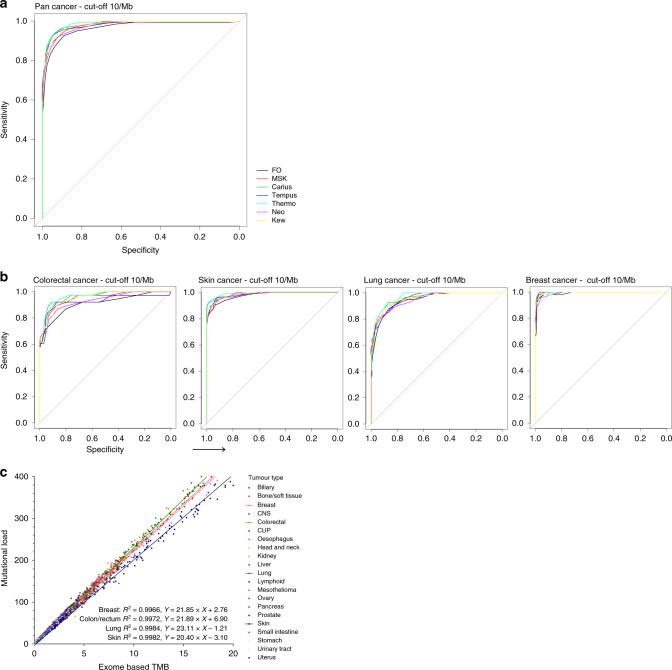
Tumour mutational burden (TMB) has emerged as a promising biomarker to predict immune checkpoint inhibitors (ICIs) response in advanced solid cancers. However, harmonisation of TMB reporting by targeted gene panels is lacking, especially in metastatic tumour samples. To address this issue, we used data of 2841 whole-genome sequenced metastatic cancer biopsies to perform an in silico analysis of TMB determined by seven gene panels (FD1CDx, MSK-IMPACT™, Caris Molecular Intelligence, Tempus xT, Oncomine Tumour Mutation Load, NeoTYPE Discovery Profile and CANCERPLEX) compared to exome-based TMB as a golden standard. Misclassification rates declined from up to 30% to <1% when the cut-point for high TMB was increased. Receiver operating characteristic analysis demonstrated that, for correct classification, the cut-point for each gene panel may vary more than 20%. In conclusion, we here demonstrate that a major limitation for the use of gene panels is inter-assay variation and the need for dynamic thresholds to compare TMB outcomes.
肿瘤突变负荷 (TMB) 已成为预测晚期实体瘤免疫检查点抑制剂 (ICIs) 反应的有前途的生物标志物。然而,靶向基因panel 的 TMB 报告缺乏协调,特别是在转移性肿瘤样本中。为了解决这个问题,我们使用了 2841 个全基因组测序的转移性癌症活检数据集,对七种基因panel(FD1CDx、MSK-IMPACT™、Caris Molecular Intelligence、Tempus xT、Oncomine Tumour Mutation Load、NeoTYPE Discovery Profile 和 CANCERPLEX)确定的 TMB 进行了基于计算的分析,并与外显子组 TMB 作为金标准进行了比较。当高 TMB 的截断值增加时,错误分类率从高达 30%下降到<1%。受试者工作特征分析表明,为了正确分类,每个基因panel 的截断值可能相差 20%以上。总之,我们在这里证明,基因panel 的主要限制是检测内变异性和需要动态阈值来比较 TMB 结果。