Yang Lidong, Zhang Liyou, Lu Lu, Wang Yan
Department of Ocular Fundus Disease, Cangzhou Eye Hospital, Cangzhou Central Hospital, Cangzhou 061001, People's Republic of China.
Onco Targets Ther. 2020 Jan 28;13:803-811. doi: 10.2147/OTT.S235862. eCollection 2020.
MicroRNAs (miRNAs) have been shown to contribute to the initiation and progression of human cancer, including retinoblastoma. However, expression levels and potential roles of miRNAs in retinoblastoma remain largely unknown. In this study, we aimed to identify dysregulated miRNAs and explore their functional roles in the development of retinoblastoma.
First, miRNA expression profiling in retinoblastoma tissues was performed via microarray analysis. To evaluate the involvement of miR-214-3p in multi-drug resistance, gain-of-function experiments were employed in vitro and in vivo. Bioinformatics analysis, luciferase reporter assay, qRT-PCR and Western blot were used to investigate the underlying mechanisms.
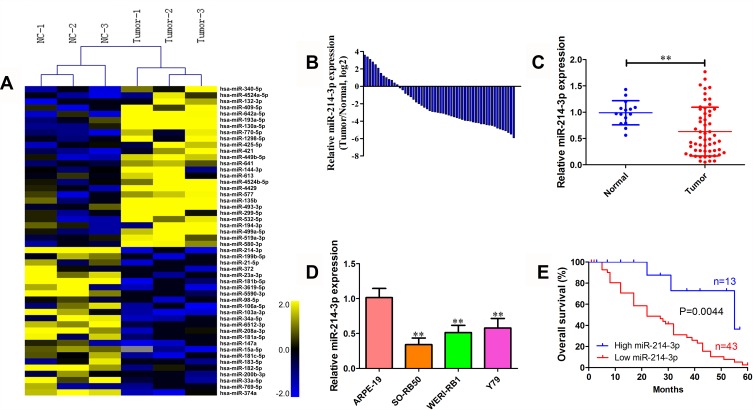
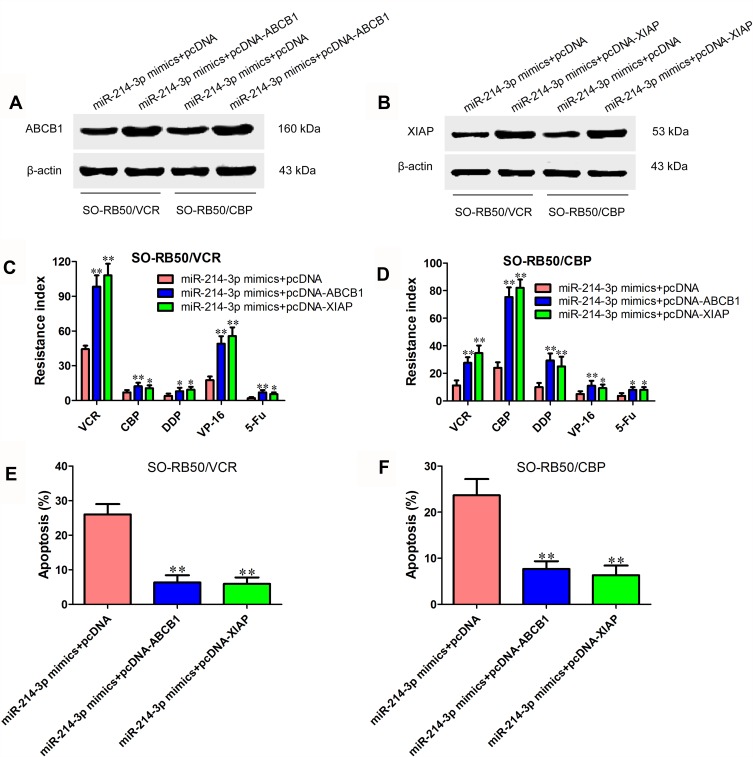
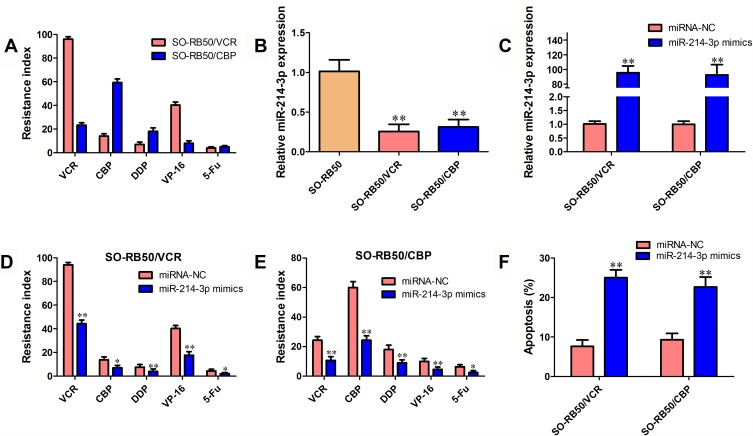
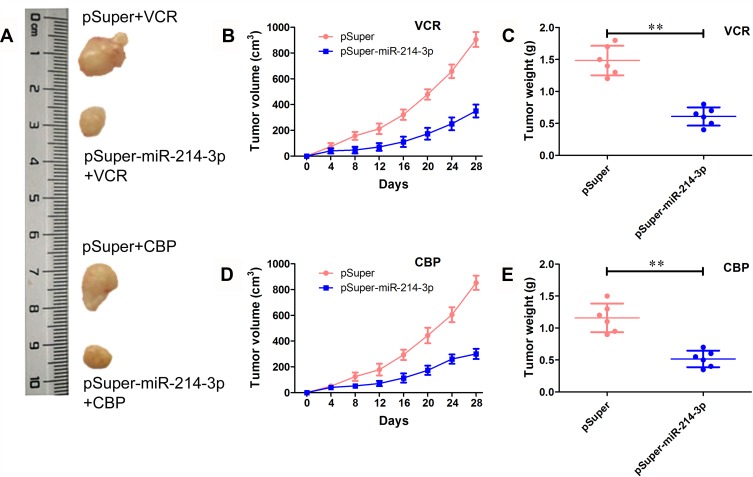
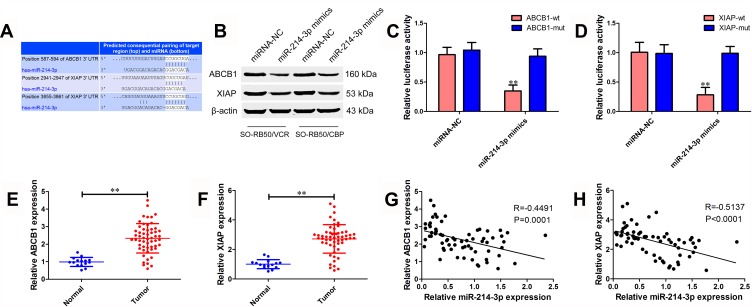
Here, we identified 57 up-regulated and 34 down-regulated miRNAs. Among them, miR-214-3p was the most significantly decreased. We found that miR-214-3p level was positively correlated with clinical outcome and chemotherapy response. Overexpression of miR-214-3p significantly sensitized retinoblastoma cells to multiple chemodrugs and promoted cell apoptosis in vitro and in vivo. Further investigations revealed that miR-214-3p directly regulated ABCB1 and XIAP expression through interacting with the 3' untranslated regions (3'UTRs). Pearson correlation analysis showed that miR-214-3p expression in retinoblastoma tissues was negatively correlated with ABCB1 and XIAP expression. We also observed that overexpression of ABCB1 or XIAP partly reversed the chemoresistance inhibition-induced by miR-214-3p overexpression.
Our data demonstrate that miR-214-3p functions as a tumor suppressor to inhibit the chemoresistance in retinoblastoma, suggesting that miR-214-3p might be potential diagnostic and therapeutic targets for retinoblastoma treatment.
微小RNA(miRNA)已被证明在包括视网膜母细胞瘤在内的人类癌症的发生和发展中起作用。然而,miRNA在视网膜母细胞瘤中的表达水平和潜在作用仍 largely 未知。在本研究中,我们旨在鉴定失调的miRNA并探讨它们在视网膜母细胞瘤发展中的功能作用。
首先,通过微阵列分析对视网膜母细胞瘤组织进行miRNA表达谱分析。为了评估miR-214-3p在多药耐药中的作用,在体外和体内进行了功能获得实验。采用生物信息学分析、荧光素酶报告基因检测、qRT-PCR和蛋白质免疫印迹法研究其潜在机制。
在此,我们鉴定出57个上调的和34个下调的miRNA。其中,miR-214-3p下降最为显著。我们发现miR-214-3p水平与临床结果和化疗反应呈正相关。miR-214-3p的过表达显著使视网膜母细胞瘤细胞对多种化疗药物敏感,并在体外和体内促进细胞凋亡。进一步研究表明,miR-214-3p通过与3'非翻译区(3'UTR)相互作用直接调节ABCB1和XIAP的表达。Pearson相关性分析表明,视网膜母细胞瘤组织中miR-214-3p的表达与ABCB1和XIAP的表达呈负相关。我们还观察到,ABCB1或XIAP的过表达部分逆转了miR-214-3p过表达诱导的化疗耐药抑制。
我们的数据表明,miR-214-3p作为一种肿瘤抑制因子抑制视网膜母细胞瘤的化疗耐药,提示miR-214-3p可能是视网膜母细胞瘤治疗的潜在诊断和治疗靶点。