Soudeyns Camille, Speybroeck Niko, Brisson Marc, Mossong Joël, Latsuzbaia Ardashel
Public Health Faculty, Université Catholique de Louvain, Brussels, Belgium.
Department of Social and Preventive Medicine, Université Laval, Quebec, Canada.
PeerJ. 2020 Feb 10;8:e8516. doi: 10.7717/peerj.8516. eCollection 2020.
Human papillomavirus (HPV) is the most common sexually transmitted infection (STI) worldwide. Despite recommendations for HPV vaccination of young women from health authorities, parental concerns were raised whether vaccination could induce unsafe sexual behaviour in young women. Therefore, the primary aim of this study was to investigate if HPV vaccination in healthcare seeking adult women in Luxembourg was associated with unsafe sexual behaviour.
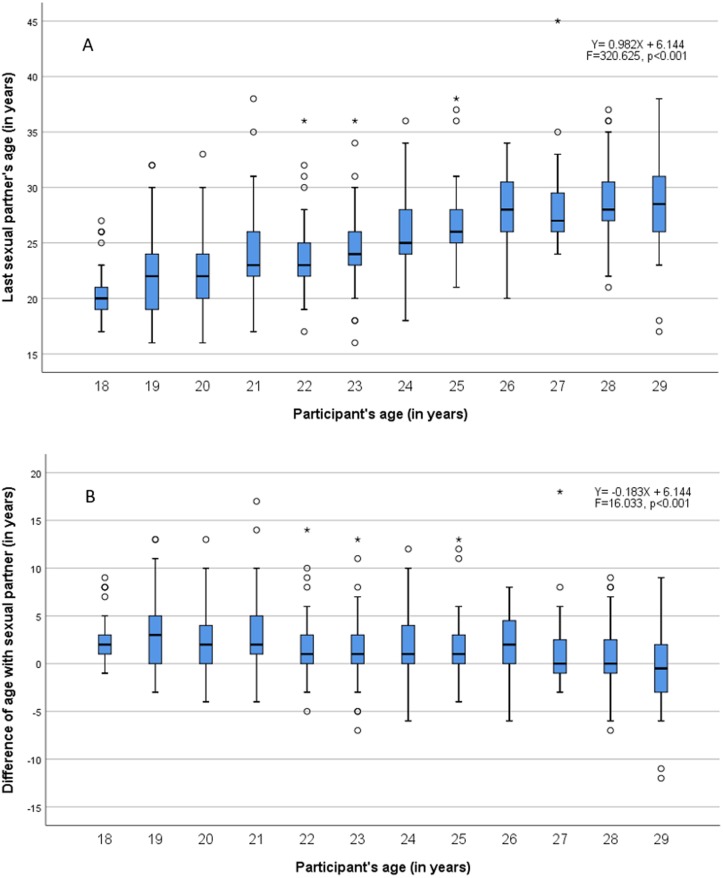
Seven hundred twenty-nine women (mean age = 22.5; range 18-43 years) were recruited either at Luxembourg family planning centres or at private gynaecology practices. All participants completed a questionnaire on vaccination status and sexual behaviour. Poisson and logistic regressions were used to study the association between sexual behaviour and vaccination status ( = 538). Both models were restricted to women younger than 26 years, since the first cohort being vaccinated would be 25 years old at the time of sampling. Assortativity of sexual mixing by age was also assessed for further transmission modelling for women <30 years reporting age of last/current sexual partner ( = 649). Women older than 29 years were excluded from the assortativity analysis due to restricted sample size.
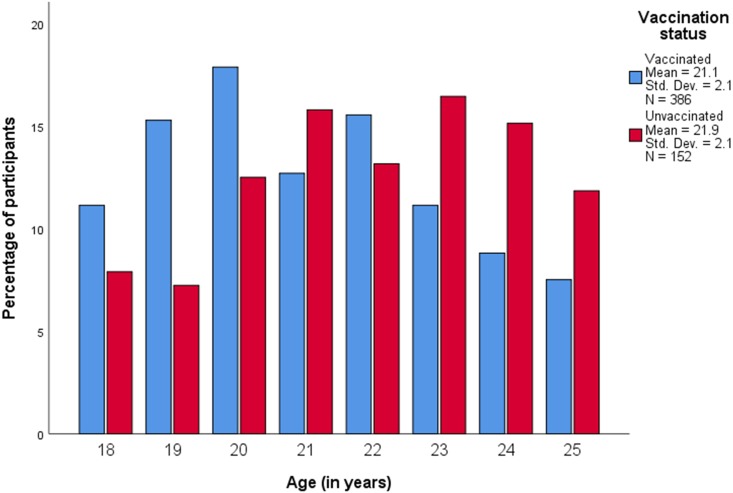
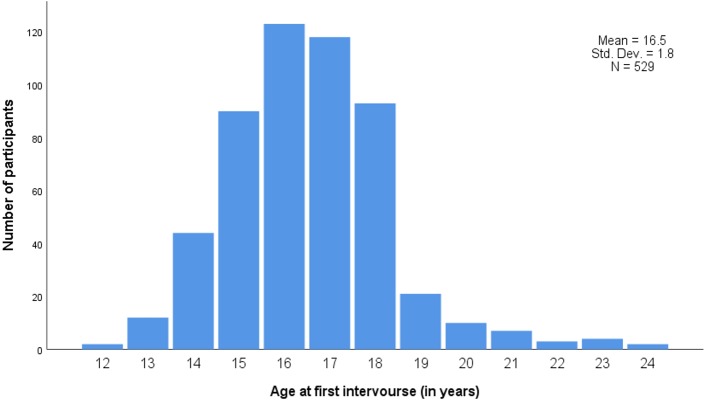
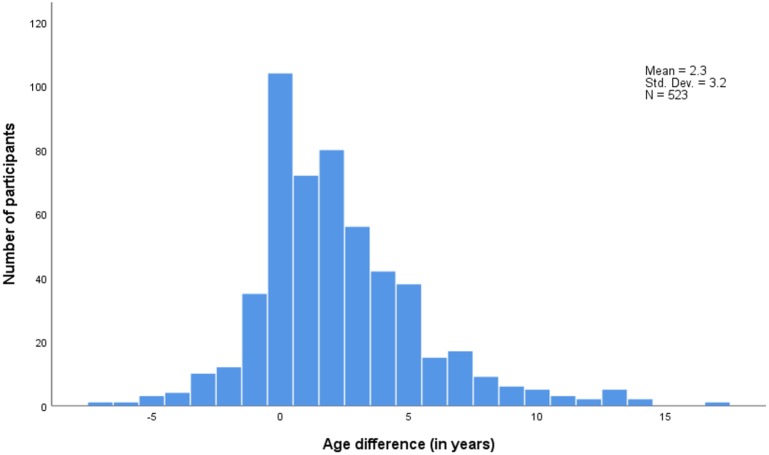
In total, 386/538 (71.8%) of participants reported receiving HPV vaccine. Vaccination uptake significantly varied by nationality and was higher in Portuguese 112/142 (78.9%) and in Luxembourgish 224/313(71.6%) residents, and lower in residents of other nationalities 50/83 (60.2%) ( = 0.011). HPV vaccination was not associated with unsafe sexual behaviour such as shorter relationship duration with current or last sexual partner (odds ratio (OR) = 1.05, 95% CI [0.94-1.16]), younger age of sexual debut (OR = 1.00, 95% CI [0.88-1.14]), increased number of lifetime sexual partners (OR = 0.95, 95% CI [0.87-1.03), higher age difference with sexual partner (OR = 1.01, 95% CI [0.95-1.08]), condom use (OR = 0.97, 95% CI [0.60-1.56]), nor with other factors like smoking (OR = 0.73, 95% CI [0.47-1.15]) and nationality. HPV vaccination was only associated with younger age (OR = 0.84, 95% CI [0.75-0.94]). Relationship duration, age of sexual debut, age difference with sexual partner, smoking, age and non-Portuguese foreign nationality were predictors of number of lifetime sexual partners. Assortativity analysis revealed that young women chose sexual partners who were 2.3 years older on average.
Our study found no association between unsafe sexual behaviour and HPV vaccination.
人乳头瘤病毒(HPV)是全球最常见的性传播感染(STI)。尽管卫生当局建议对年轻女性进行HPV疫苗接种,但家长们担心疫苗接种是否会在年轻女性中引发不安全的性行为。因此,本研究的主要目的是调查卢森堡寻求医疗服务的成年女性接种HPV疫苗是否与不安全的性行为有关。
在卢森堡的计划生育中心或私立妇科诊所招募了729名女性(平均年龄=22.5岁;范围18 - 43岁)。所有参与者都完成了一份关于疫苗接种状况和性行为的问卷。使用泊松回归和逻辑回归来研究性行为与疫苗接种状况之间的关联(n = 538)。两个模型都仅限于26岁以下的女性,因为第一批接种疫苗的队列在抽样时年龄将为25岁。还评估了年龄对性伴侣选择的匹配性,以便对报告了最后/当前性伴侣年龄的30岁以下女性进行进一步的传播模型分析(n = 649)。由于样本量有限,29岁以上的女性被排除在匹配性分析之外。
总共有386/538(71.8%)的参与者报告接种了HPV疫苗。疫苗接种率因国籍而异,葡萄牙居民的接种率较高,为112/142(78.9%),卢森堡居民为224/313(71.6%),其他国籍居民的接种率较低,为50/83(60.2%)(p = 0.011)。HPV疫苗接种与不安全的性行为无关,如与当前或最后一次性伴侣的关系持续时间较短(优势比(OR)= 1.05,95%置信区间[0.94 - 1.16])、首次性行为的年龄较小(OR = 1.00,95%置信区间[0.88 - 1.14])、终身性伴侣数量增加(OR = 0.95,95%置信区间[0.87 - 1.03])、与性伴侣的年龄差较大(OR = 1.01,95%置信区间[0.95 - 1.08])、使用避孕套(OR = 0.97,95%置信区间[0.60 - 1.56]),也与吸烟(OR = 0.73,95%置信区间[0.47 - 1.15])和国籍等其他因素无关。HPV疫苗接种仅与年龄较小有关(OR = 0.84,95%置信区间[0.75 - 0.94])。关系持续时间、首次性行为年龄、与性伴侣的年龄差、吸烟、年龄和非葡萄牙外国国籍是终身性伴侣数量的预测因素。匹配性分析表明,年轻女性选择的性伴侣平均比自己大2.3岁。
我们的研究发现不安全的性行为与HPV疫苗接种之间没有关联。