Dipartimento di Scienze Mediche e Sanità Pubblica, Università degli Studi di Cagliari, SS554 bivio per Sestu, 09042, Monserrato, CA, Italy.
UNIL | Université de Lausanne, CHUV | Centre hospitalier universitaire vaudois, Lausanne, Switzerland.
BMC Palliat Care. 2020 Feb 25;19(1):23. doi: 10.1186/s12904-020-0531-5.
Hospice workers are required to regularly use emotional regulation strategies in an attempt to encourage and sustain terminally ill patients and families. Daily emotional regulation in reaction to constantly watching suffering patients may be intensified among those hospice professionals who have high levels of compassion fatigue. The main object of this study was to examine the relationship between daily exposition to seeing patient suffering and daily emotional work, and to assess whether compassion fatigue (secondary traumatic stress and burnout) buffers this relationship.
We used a diary research design for collecting daily fluctuations in seeing patients suffering and emotional work display. Participants filled in a general survey and daily survey over a period of eight consecutive workdays. A total of 39 hospice professionals from two Italian hospices participated in the study.
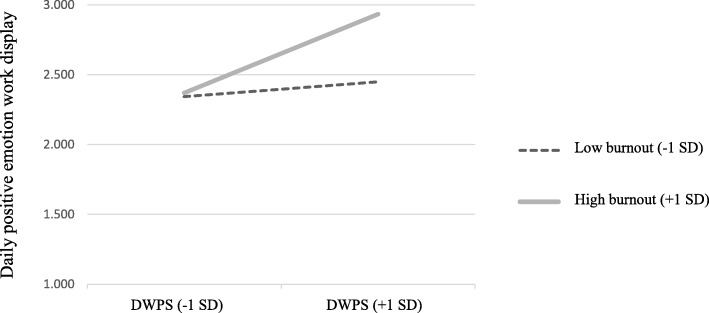
Multilevel analyses demonstrated that daily fluctuations in seeing patients suffering was positively related to daily emotional work display after controlling for daily death of patients. Moreover, considering previous levels of compassion fatigue, a buffering effect of high burnout on seeing patients suffering - daily emotional work display relationship was found.
A central finding of our study is that fluctuations in daily witness of patients suffering are positively related to daily use of positive emotional regulations. Further, our results show that burnout buffers this relationship such that hospice professionals with high burnout use more emotional display in days where they recurrently witness patients suffering.
临终关怀工作者需要定期使用情绪调节策略,以鼓励和维持绝症患者及其家属。对于那些同情心疲劳程度较高的临终关怀专业人员来说,他们每天可能会因为不断目睹患者的痛苦而加剧情绪调节。本研究的主要目的是检验每天观察患者痛苦与日常情绪劳动之间的关系,并评估同情心疲劳(二次创伤压力和倦怠)是否会缓冲这种关系。
我们使用日记研究设计来收集每天观察患者痛苦和情绪劳动表现的波动。参与者在连续八天的时间里填写了一份一般调查和每日调查。来自意大利两家临终关怀机构的 39 名专业人员参加了这项研究。
多水平分析表明,在控制患者每日死亡后,每天观察患者痛苦的波动与日常情绪劳动表现呈正相关。此外,考虑到之前的同情心疲劳水平,高倦怠对观察患者痛苦-日常情绪劳动表现关系有缓冲作用。
我们研究的一个主要发现是,每天观察患者痛苦的波动与日常使用积极的情绪调节呈正相关。此外,我们的结果表明,倦怠缓冲了这种关系,即高倦怠的临终关怀专业人员在反复目睹患者痛苦的日子里会更多地表现出情绪。