Kirillova Anastasia, Lysenkov Sergey, Farmakovskaya Maria, Kiseleva Yulia, Martazanova Bella, Mishieva Nona, Abubakirov Aydar, Sukhikh Gennady
1Federal State Budget Institution "National Medical Research Center for Obstetrics, Gynecology and Perinatology named after Academician V.I. Kulakov of the Ministry of Healthcare of Russian Federation", st. Academician Oparin 4, 4117513 Moscow, Russia.
2Department of Evolutionary Biology, Biological Faculty, Moscow State University, Leninskie Gory 1/12, 119991 Moscow, Russia.
Fertil Res Pract. 2020 Feb 19;6:2. doi: 10.1186/s40738-020-00072-5. eCollection 2020.
To evaluate if it is safe and effective to transfer poor quality embryos.
It was a retrospective analysis using individual patient data with positive controls. All patients undergoing embryo transfers of poor quality embryos on day 3 or on day 5 as part of fresh In Vitro Fertilization (IVF) cycles performed between 2012 and 2016. This study assessed a total of 738 poor quality embryos from 488 IVF programs. 261 embryo transfers were performed on day 3 (402 embryos were transferred) and 227 on day 5 (336 embryos were transferred). Control group consisted of 9893 fair and good quality embryos from 5994 IVF programs. Outcome rates were compared with two-tailed Fisher exact test using fisher.test function in R software. 95% confidence intervals for proportions were calculated using the Clopper-Pearson method with binom.test function in R. The groups of patients with poor vs. good and fair quality embryos were compared by age, body mass index(BMI), number of oocytes, female and male main diagnosis, cycle type, controlled ovarian stimulation (COS) protocol, the starting day of gonadotropin administration, the starting dose of gonadotropins, the total dose of gonadotropins, the total number of days of gonadotropins administration, the starting day of gonadotropin-releasing hormone (GnRH) agonist administration, the total number of ampoules of GnRH-agonist used, day of the trigger of ovulation administration and the type of the trigger of ovulation using the Student's t-test for interval variables and with the chi-square test for nominal variables.
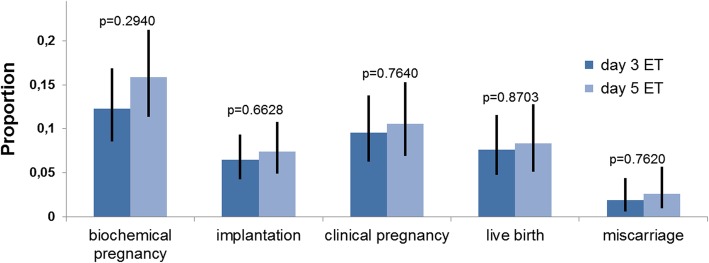
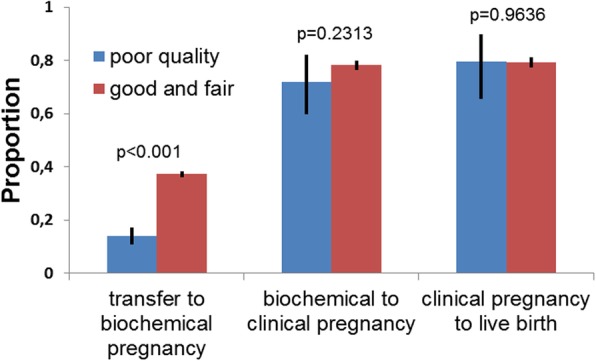
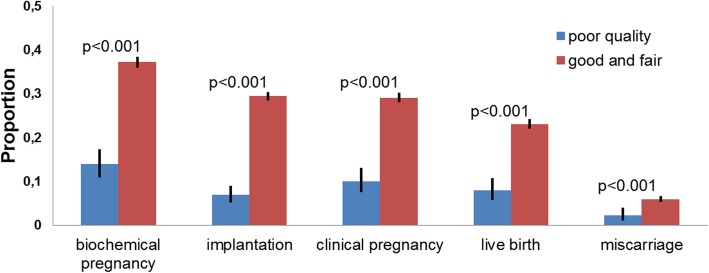
No significant differences in the implantation rate, clinical pregnancy rate, miscarriage rate, live births, and the number of children born were found between the groups of poor quality embryos transferred on day 3 and day 5. Though the implantation rate was lower for the group of poor quality embryos, than for the control (13.9% vs 37.2%), statistically significant differences between the proportion of implanted embryos which resulted in clinical pregnancies and live births in both groups were not observed (72% vs 78.2 and 55.8% vs 62.0% respectively).
Transfer of poor quality embryos at either day 3 or day 5 have a low potential for implantation, though those embryos which successfully implanted have the same potential for live birth as the embryos of fair and good quality. This study supports that it is safe to transfer poor quality embryos when they are the only option for fresh embryo transfer (ET).
评估移植质量差的胚胎是否安全有效。
这是一项使用个体患者数据并设阳性对照的回顾性分析。所有在2012年至2016年期间进行的新鲜体外受精(IVF)周期中,于第3天或第5天移植质量差的胚胎的患者。本研究评估了来自488个IVF程序的总共738个质量差的胚胎。在第3天进行了261次胚胎移植(移植了402个胚胎),在第5天进行了227次(移植了336个胚胎)。对照组由来自5994个IVF程序的9893个质量中等和良好的胚胎组成。使用R软件中的fisher.test函数通过双尾Fisher精确检验比较结局率。使用R中的binom.test函数通过Clopper-Pearson方法计算比例的95%置信区间。通过年龄、体重指数(BMI)、卵母细胞数量、女性和男性主要诊断、周期类型、控制性卵巢刺激(COS)方案、促性腺激素给药开始日、促性腺激素起始剂量、促性腺激素总剂量、促性腺激素给药总天数、促性腺激素释放激素(GnRH)激动剂给药开始日、使用的GnRH激动剂安瓿总数、排卵触发日和排卵触发类型,对质量差与质量中等和良好的胚胎患者组进行比较,区间变量使用Student t检验,名义变量使用卡方检验。
在第3天和第5天移植的质量差的胚胎组之间,在着床率、临床妊娠率、流产率、活产率和出生子女数量方面未发现显著差异。尽管质量差的胚胎组的着床率低于对照组(13.9%对37.2%),但两组中着床胚胎导致临床妊娠和活产的比例之间未观察到统计学显著差异(分别为72%对78.2%和55.8%对62.0%)。
在第3天或第5天移植质量差的胚胎着床潜力较低,尽管那些成功着床的胚胎与质量中等和良好的胚胎有相同的活产潜力。本研究支持当质量差的胚胎是新鲜胚胎移植(ET)的唯一选择时,移植它们是安全的。