Department of Environmental Science, Institute for Water and Wetland Research, Faculty of Science, Radboud University Nijmegen, 6525 AJ Nijmegen, Netherlands.
Environmental Modeling, Sensing and Analysis, TNO, Princetonlaan 6, 3584 CB Utrecht, Netherlands.
Environ Sci Technol. 2020 Mar 17;54(6):3499-3509. doi: 10.1021/acs.est.9b06252. Epub 2020 Feb 26.
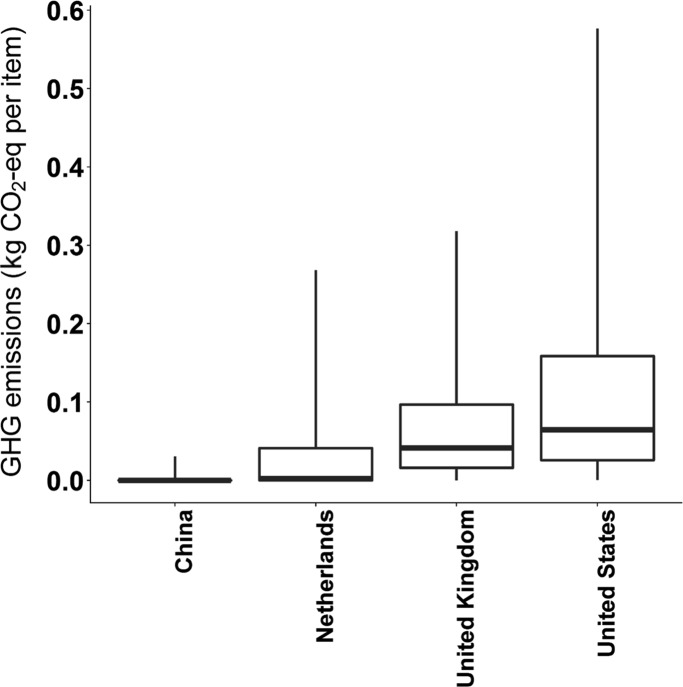
Variability in consumer practices and choices is typically not addressed in comparisons of environmental impacts of traditional shopping and e-commerce. Here, we developed a stochastic model to quantify the variability in the greenhouse gas (GHG) footprints of product distribution and purchase of fast-moving consumer goods (FMCGs) via three prevalent retail channels in the United Kingdom (U.K.). We found that shopping via bricks and clicks (click and fulfillment via physical store delivery) most likely decreases the GHG footprints when substituting traditional shopping, while FMCGs purchased through pure players with parcel delivery often have higher GHG footprints compared to those purchased via traditional retail. The number of items purchased and the last-mile travel distance are the dominant contributors to the variability in the GHG footprints of all three retail channels. We further showed that substituting delivery vans with electric cargo bikes can lead to a GHG emission reduction of 26% via parcel delivery. Finally, we showed the differences in the "last mile" GHG footprint of traditional shopping in the U.K. compared to three other countries (China, Netherlands, and the United States), which are primarily caused by the different shares of modes of transport (walking and by car, bus, and bike).
在传统购物和电子商务对环境影响的比较中,通常不会考虑消费者行为和选择的可变性。在这里,我们开发了一个随机模型,以量化通过英国(英国)三种流行的零售渠道(实体店配送和在线购买)分销和购买快速消费品(FMCG)的温室气体(GHG)足迹的可变性。我们发现,通过砖块和点击(通过实体店交付进行点击和履行)进行购物最有可能在替代传统购物时减少 GHG 足迹,而通过具有包裹配送的纯在线零售商购买的 FMCG 通常比通过传统零售商购买的 FMCG 具有更高的 GHG 足迹。购买的商品数量和最后一英里的旅行距离是所有三种零售渠道 GHG 足迹变化的主要因素。我们进一步表明,通过包裹配送,用电动货运自行车代替厢式送货车可减少 26%的 GHG 排放。最后,我们展示了英国传统购物的“最后一英里”GHG 足迹与其他三个国家(中国、荷兰和美国)之间的差异,这主要是由于运输方式(步行和汽车、公共汽车和自行车)的不同份额造成的。