Fondazione Edmund Mach, Research and Innovation Centre, Trento, Italy.
Friederich-Loeffler-Institute, Federal Research Institute for Animal Health, Institute of Novel and Emerging Infectious Diseases, Greifswald-Insel Riems, Germany.
Emerg Microbes Infect. 2020 Feb 26;9(1):474-484. doi: 10.1080/22221751.2020.1730246. eCollection 2020.
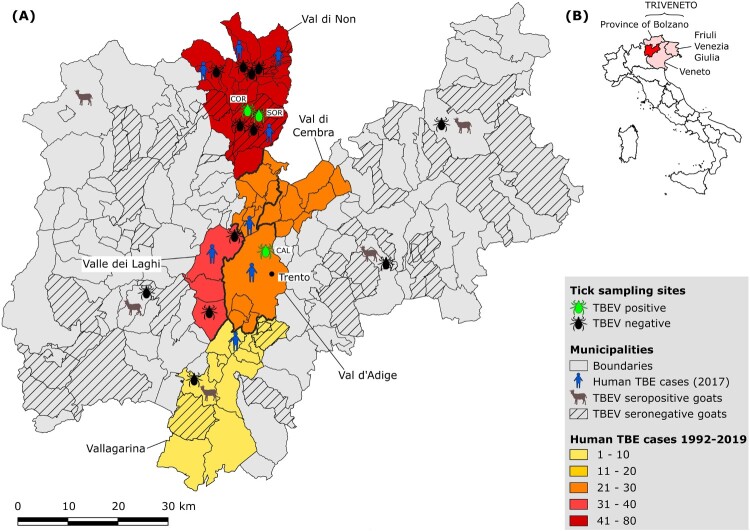
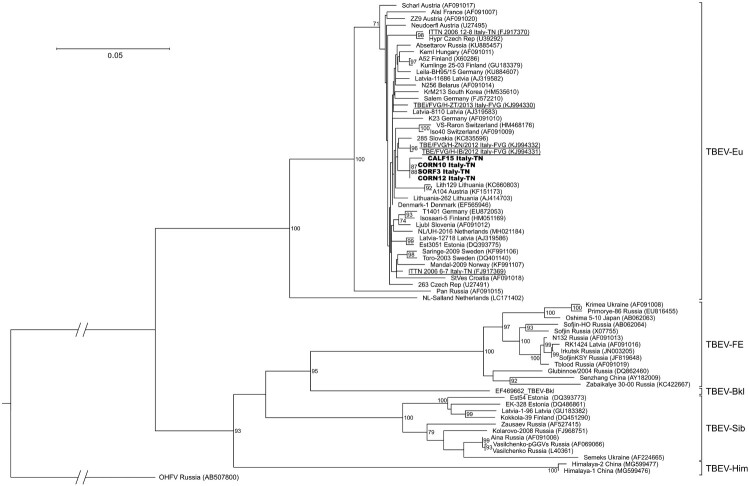
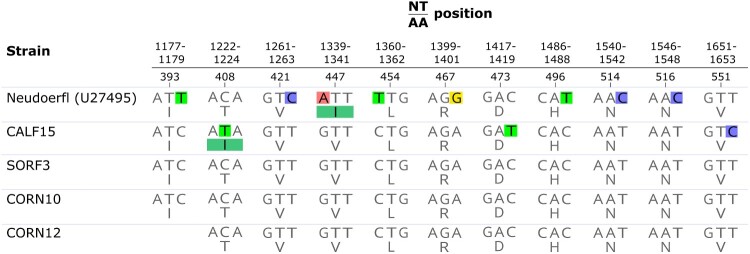
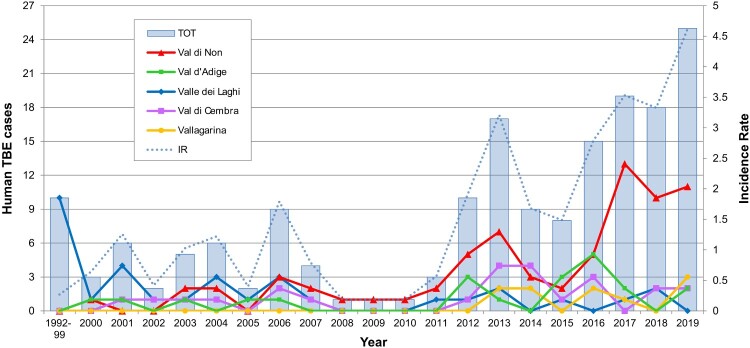
Tick-borne encephalitis (TBE) is a severe zoonotic neurological disease endemic in northeast Italy since 1992. In the Province of Trento, a sharp increase in TBE incidence has been recorded since 2012, despite the vaccination efforts. To assess current TBE infection hazard in this area, we applied an integrated approach combining the distribution of human cases, the seroprevalence of tick-borne encephalitis virus (TBEV) in sentinel hosts and the screening of questing ticks for TBEV. A total of 706 goat sera from 69 farms were screened for TBEV-specific antibodies resulting in 5 positive farms, while the location of human cases was provided by the local Public Health Agency. Tick sampling was concentrated in areas where TBEV circulation was suggested by either seroprevalence in goats or human cases, resulting in 2,410 collected and analyzed by real-time RT-PCR. Four tick samples from 2 areas with record of human cases were positive to TBEV corresponding to a 0.17% prevalence in the region, while risk areas suggested by serology on goats were not confirmed by tick screening. Our results revealed an increase in TBEV prevalence in ticks and the emergence of new active TBE foci, compared to previous surveys, and demonstrated the importance of an integrated approach for TBE risk assessment. A phylogenetic analysis of the partial E gene confirmed that the European TBEV subtype is circulating in northeast Italy and suggested that the different Italian TBEV strains originated independently as a result of different introductions from neighbouring countries, presumably through migratory birds.
蜱传脑炎(TBE)自 1992 年以来一直是意大利东北部的一种严重的动物源性神经系统疾病。在特伦蒂诺省,尽管进行了疫苗接种,但自 2012 年以来,TBE 的发病率急剧上升。为了评估该地区当前 TBE 感染的危险,我们采用了一种综合方法,结合了人类病例的分布、蜱传脑炎病毒(TBEV)在哨兵宿主中的血清阳性率以及对 TBEV 进行的游离蜱筛查。共筛查了来自 69 个农场的 706 份山羊血清,结果发现 5 个农场的 TBEV 特异性抗体呈阳性,而人类病例的位置则由当地公共卫生机构提供。蜱的采样集中在通过山羊血清阳性率或人类病例提示 TBEV 循环的地区,共采集并分析了 2410 个蜱样本。在有人类病例记录的 2 个地区,有 4 个蜱样本对 TBEV 呈阳性,该地区的流行率为 0.17%,而通过对山羊进行血清学检测提示的风险地区并未通过蜱筛查得到证实。与以前的调查相比,我们的研究结果显示,与以前的调查相比,TBEV 在蜱中的流行率有所增加,出现了新的活跃 TBE 焦点,并证明了综合方法在 TBE 风险评估中的重要性。对部分 E 基因的系统进化分析证实,欧洲 TBEV 亚型正在意大利东北部流行,并表明不同的意大利 TBEV 株是由于从邻国不同的传入途径,可能是通过候鸟而独立起源的。