Department of Biochemistry, Duke University Medical Center, Durham, NC 27710, USA.
Department of Molecular Genetics and Microbiology, Center for Virology, Duke University Medical Center, Durham, NC 27710, USA.
Cell Rep. 2020 Feb 25;30(8):2472-2480.e4. doi: 10.1016/j.celrep.2020.02.004.
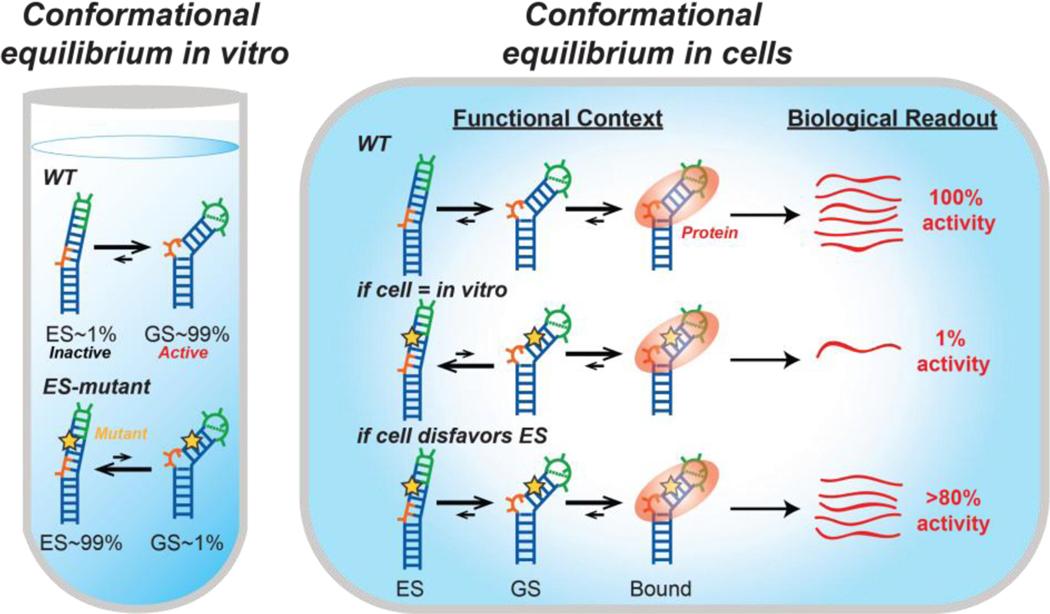
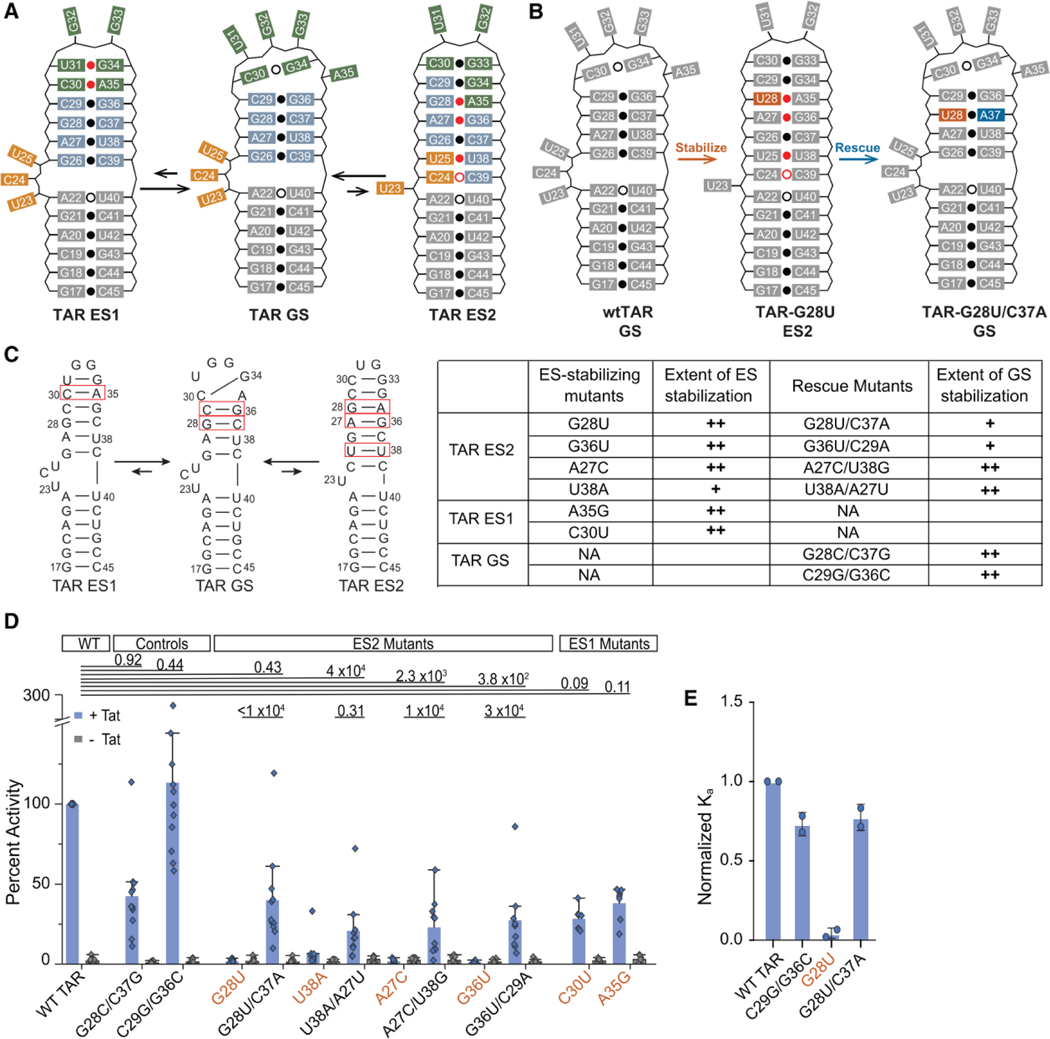
Low-abundance short-lived non-native conformations referred to as excited states (ESs) are increasingly observed in vitro and implicated in the folding and biological activities of regulatory RNAs. We developed an approach for assessing the relative abundance of RNA ESs within the functional cellular context. Nuclear magnetic resonance (NMR) spectroscopy was used to estimate the degree to which substitution mutations bias conformational equilibria toward the inactive ES in vitro. The cellular activity of the ES-stabilizing mutants was used as an indirect measure of the conformational equilibria within the functional cellular context. Compensatory mutations that restore the ground-state conformation were used to control for changes in sequence. Using this approach, we show that the ESs of two regulatory RNAs from HIV-1, the transactivation response element (TAR) and the Rev response element (RRE), likely form in cells with abundances comparable to those measured in vitro, and their targeted stabilization may provide an avenue for developing anti-HIV therapeutics.
低丰度的短寿命非天然构象被称为激发态(ES),越来越多地在体外观察到,并与调节 RNA 的折叠和生物活性有关。我们开发了一种在功能细胞环境中评估 RNA ES 相对丰度的方法。核磁共振(NMR)光谱用于估计取代突变使构象平衡向体外无活性 ES 倾斜的程度。ES 稳定突变体的细胞活性被用作功能细胞环境中构象平衡的间接测量。恢复基态构象的补偿突变被用来控制序列的变化。使用这种方法,我们表明来自 HIV-1 的两种调节 RNA(TAR 和 RRE)的 ES 在细胞中形成,其丰度与体外测量的丰度相当,并且它们的靶向稳定可能为开发抗 HIV 治疗提供途径。