Institute of Health Policy and Management, Seoul National University Medical Research Center, Seoul, South Korea.
Department of Public Health, Keimyung University, Daegu, Korea, Seoul, South Korea.
Health Qual Life Outcomes. 2020 Feb 27;18(1):45. doi: 10.1186/s12955-020-01302-6.
The aim of this study was to measure differences in quality-adjusted life expectancy (QALE) by income in Korea at the national and district levels.
Mortality rates and EuroQol-5D (EQ-5D) scores were obtained from the National Health Information Database of the National Health Insurance Service and the Korea Community Health Survey, respectively. QALE and differences in QALE among income quintiles were calculated using combined 2008-2014 data for 245 districts in Korea. Correlation analyses were conducted to investigate the associations of neighborhood characteristics with QALE and income gaps therein.
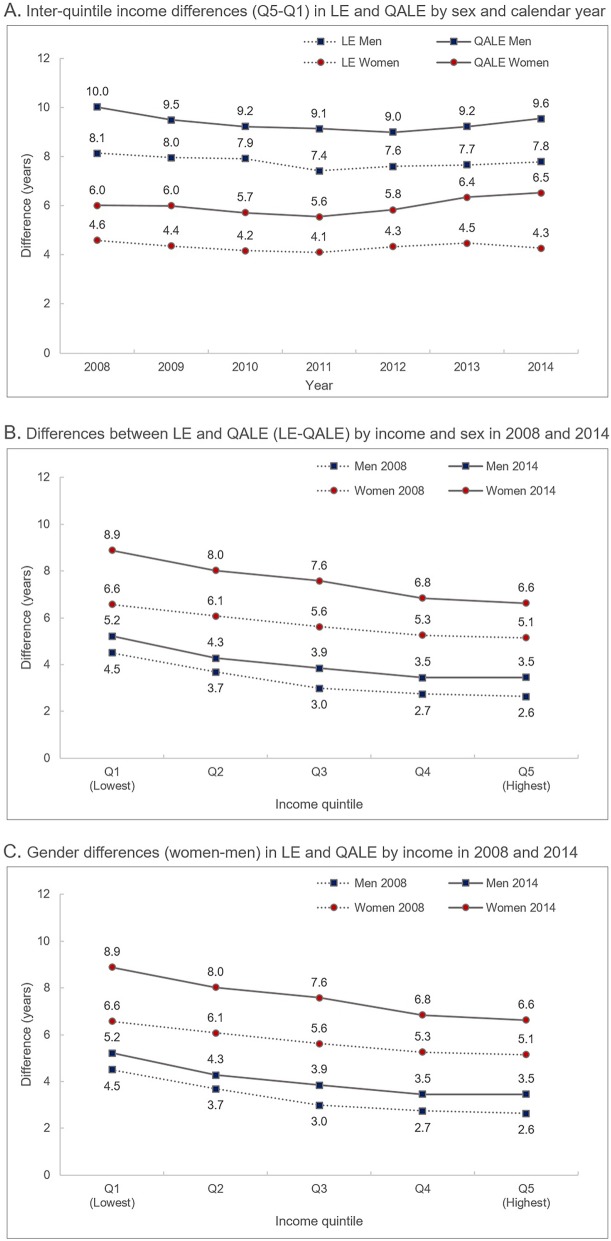
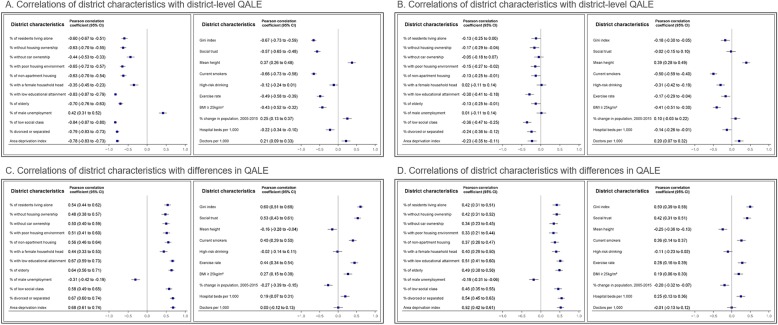
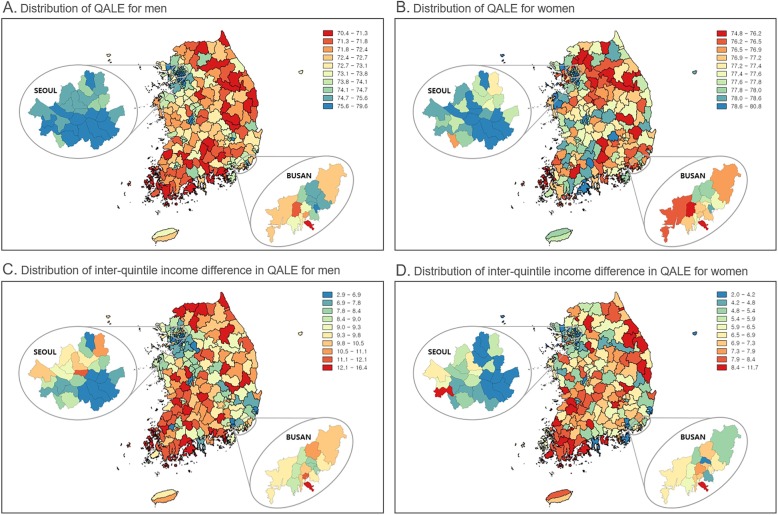
QALE showed a graded pattern of inequality according to income, and increased over time for all levels of income and in both sexes, except for low-income quintiles among women, resulting in a widened inequality in QALE among women. In all 245 districts, pro-rich inequalities in QALE were found in both men and women. Districts with higher QALE and smaller income gaps in QALE were concentrated in metropolitan areas, while districts with lower QALE and larger income gaps in QALE were found in rural areas. QALE and differences in QALE by income showed relatively close correlations with socioeconomic characteristics, but relatively weak correlations with health behaviors, except for smoking and indicators related to medical resources.
This study provides evidence of income-based inequalities in health measured by QALE in all subnational areas in Korea. Furthermore, QALE and differences in QALE by income were closely associated with neighborhood-level socioeconomic characteristics.
本研究旨在衡量韩国国家和地区层面收入差异对质量调整生命预期(QALE)的影响。
死亡率和 EuroQol-5D(EQ-5D)评分分别来自国家健康保险服务的国家健康信息数据库和韩国社区健康调查。使用韩国 245 个地区 2008-2014 年的数据,计算了 QALE 以及收入五分位数之间的 QALE 差异。相关性分析用于研究邻里特征与 QALE 及其收入差距之间的关系。
QALE 呈现出随收入梯度不平等的模式,所有收入水平和性别在时间上都有所增加,除了女性的低收入五分位数,导致女性的 QALE 不平等程度扩大。在所有 245 个地区,男性和女性的 QALE 都存在贫富不均的情况。QALE 较高且 QALE 收入差距较小的地区集中在大都市地区,而 QALE 较低且 QALE 收入差距较大的地区则在农村地区。QALE 和收入差异的 QALE 与社会经济特征具有相对密切的相关性,但与健康行为的相关性相对较弱,除了吸烟和与医疗资源相关的指标。
本研究为韩国所有次国家地区用 QALE 衡量的健康方面的收入不平等提供了证据。此外,QALE 和收入差异的 QALE 与邻里层面的社会经济特征密切相关。