Centre des Sciences du Goût et de l'Alimentation, AgroSup Dijon, CNRS, INRAE, Université Bourgogne Franche -Comté, Dijon F-21000, France.
Institut d'Ecologie et des Sciences de l'Environnement de Paris, Versailles F-78000, France.
Genes (Basel). 2020 Feb 25;11(3):237. doi: 10.3390/genes11030237.
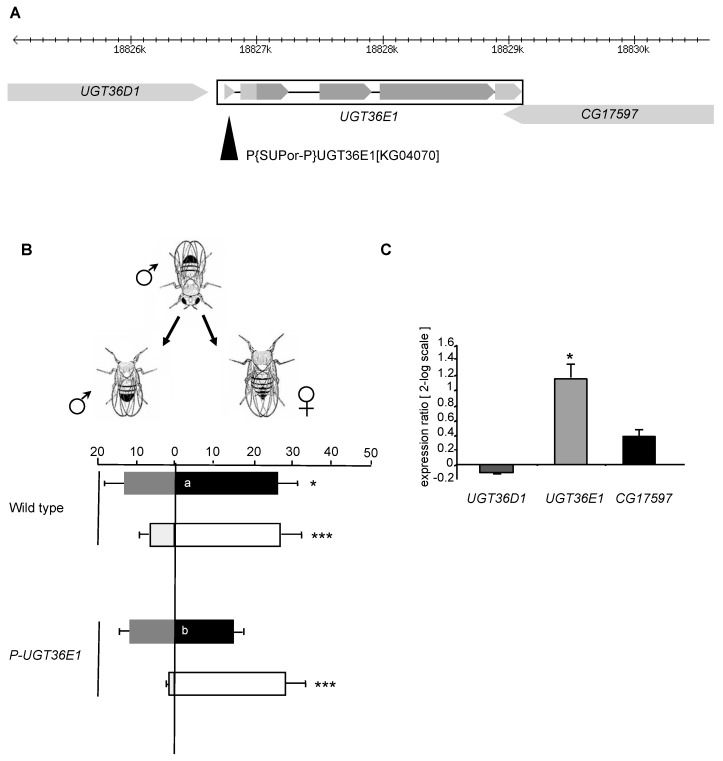
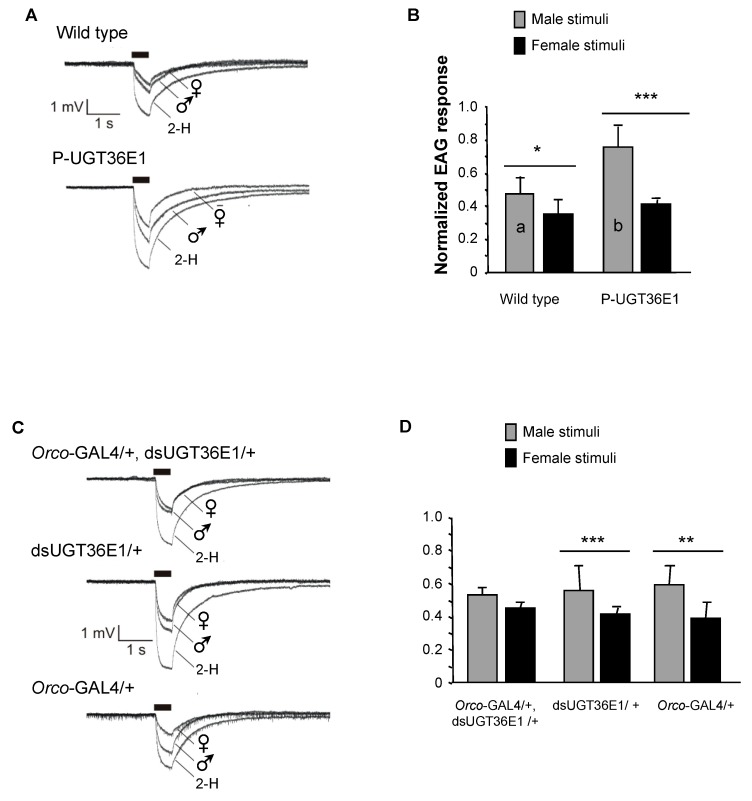
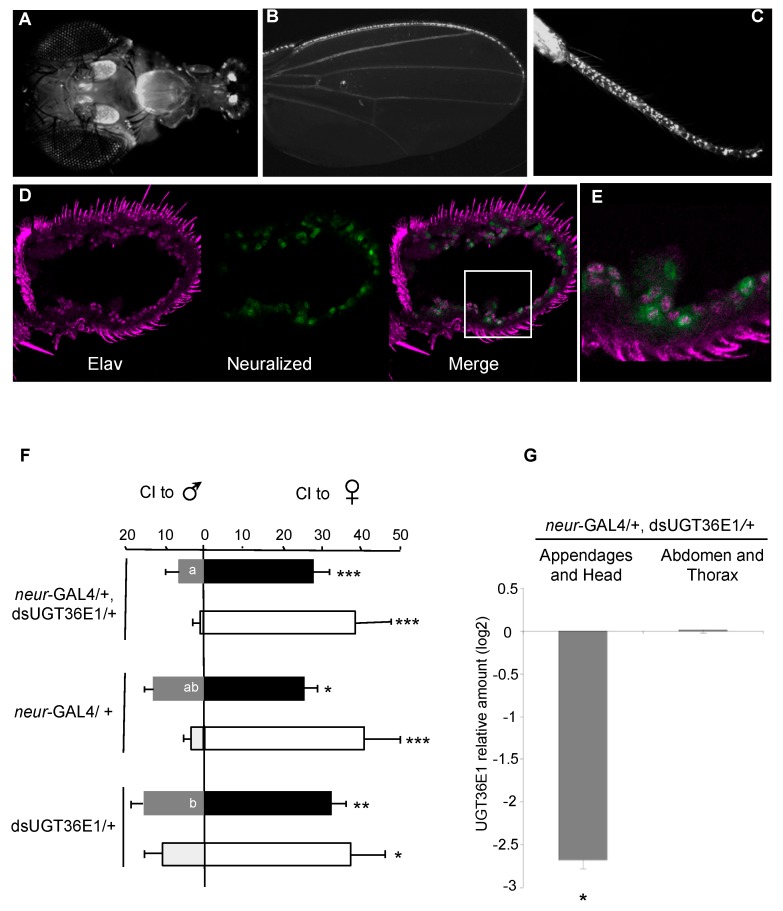
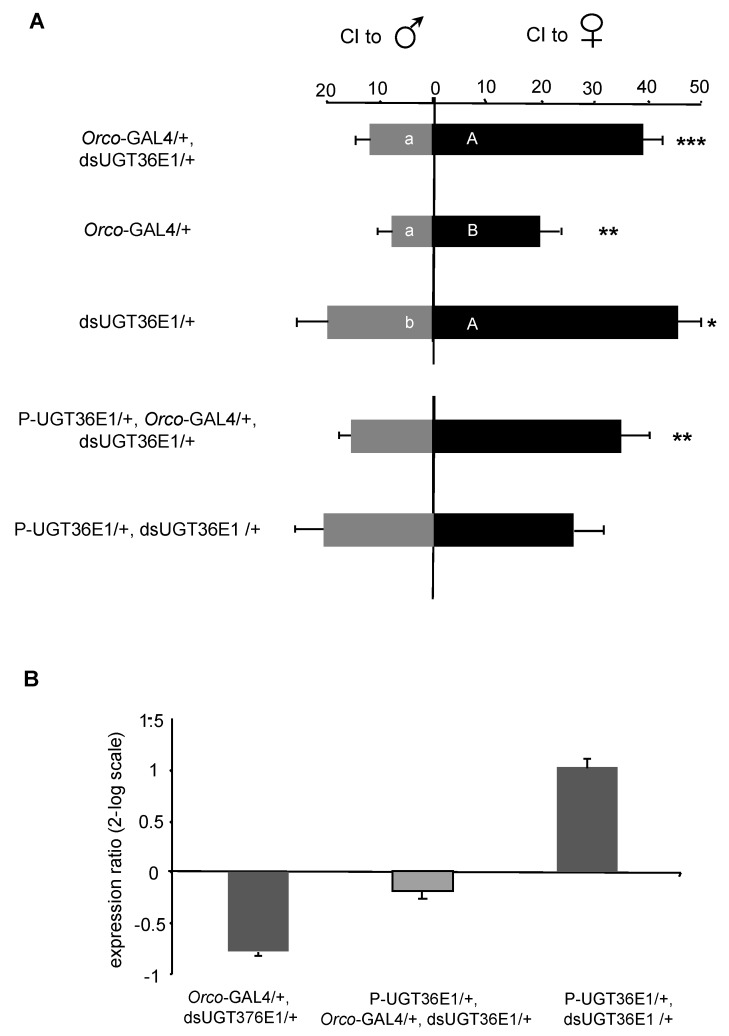
The detection and processing of chemical stimuli involve coordinated neuronal networks that process sensory information. This allows animals, such as the model species , to detect food sources and to choose a potential mate. In peripheral olfactory tissues, several classes of proteins are acting to modulate the detection of chemosensory signals. This includes odorant-binding proteins together with odorant-degrading enzymes (ODEs). These enzymes, which primarily act to eliminate toxic compounds from the whole organism also modulate chemodetection. ODEs are thought to neutralize the stimulus molecule concurrently to its detection, avoiding receptor saturation thus allowing chemosensory neurons to respond to the next stimulus. Here, we show that one UDP-glycosyltransferase (UGT36E1) expressed in antennal olfactory sensory neurons (OSNs) is involved in sex pheromone discrimination. UGT36E1 overexpression caused by an insertion mutation affected male behavioral ability to discriminate sex pheromones while it increased OSN electrophysiological activity to male pheromones. Reciprocally, the decreased expression of UGT36E1, controlled by an RNAi transgene, improved male ability to discriminate sex pheromones whereas it decreased electrophysiological activity in the relevant OSNs. When we combined the two genotypes (mutation and RNAi), we restored wild-type-like levels both for the behavioral discrimination and UGT36E1 expression. Taken together, our results strongly suggest that this UGT plays a pivotal role in Drosophila pheromonal detection.
化学刺激的检测和处理涉及协调的神经元网络,这些网络处理感官信息。这使得动物(如模型物种)能够检测到食物来源并选择潜在的配偶。在外周嗅觉组织中,几类蛋白质参与调节对化学感觉信号的检测。这包括气味结合蛋白以及气味降解酶(ODE)。这些酶主要作用是从整个生物体中消除有毒化合物,同时也调节化学检测。ODE 被认为可以在检测到刺激分子的同时使其失活,从而避免受体饱和,使化学感觉神经元能够对下一个刺激做出反应。在这里,我们表明,在触角嗅觉感觉神经元(OSN)中表达的一种 UDP-糖基转移酶(UGT36E1)参与性信息素的辨别。由插入突变引起的 UGT36E1 过表达会影响雄性区分性信息素的行为能力,同时增加 OSN 对雄性信息素的电生理活性。相反,由 RNAi 转基因控制的 UGT36E1 表达减少,提高了雄性区分性信息素的能力,而相关 OSN 的电生理活性降低。当我们将两种基因型(突变和 RNAi)结合起来时,我们恢复了行为辨别和 UGT36E1 表达的野生型水平。总之,我们的结果强烈表明,这种 UGT 在果蝇信息素检测中起着关键作用。