Réserve Naturelle Nationale du Pinail, GEREPI, Moulin de Chitré, 86210, Vouneuil-sur-Vienne, France.
Laboratoire Ecologie et Biologie des Interactions - UMR CNRS 7267 Equipe Ecologie Evolution Symbiose, Bâtiment B8-B35, 6, rue Michel Brunet, TSA 51106, 86073, Poitiers, Cedex, France.
Sci Rep. 2020 Feb 27;10(1):3570. doi: 10.1038/s41598-020-60479-4.
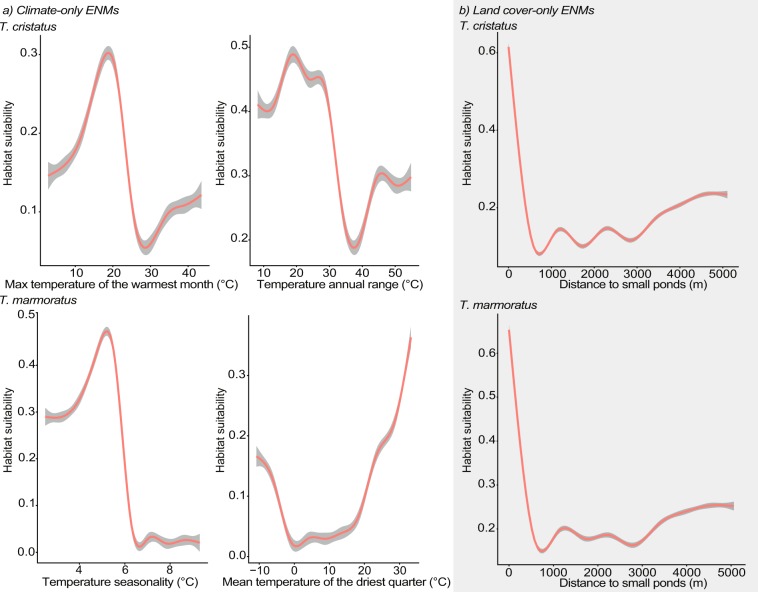
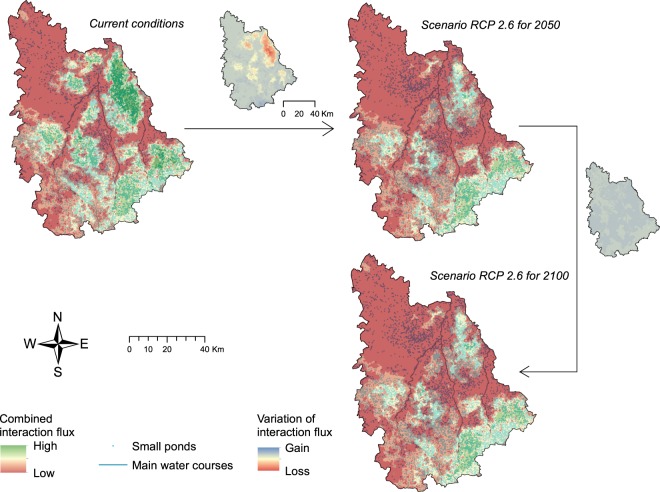
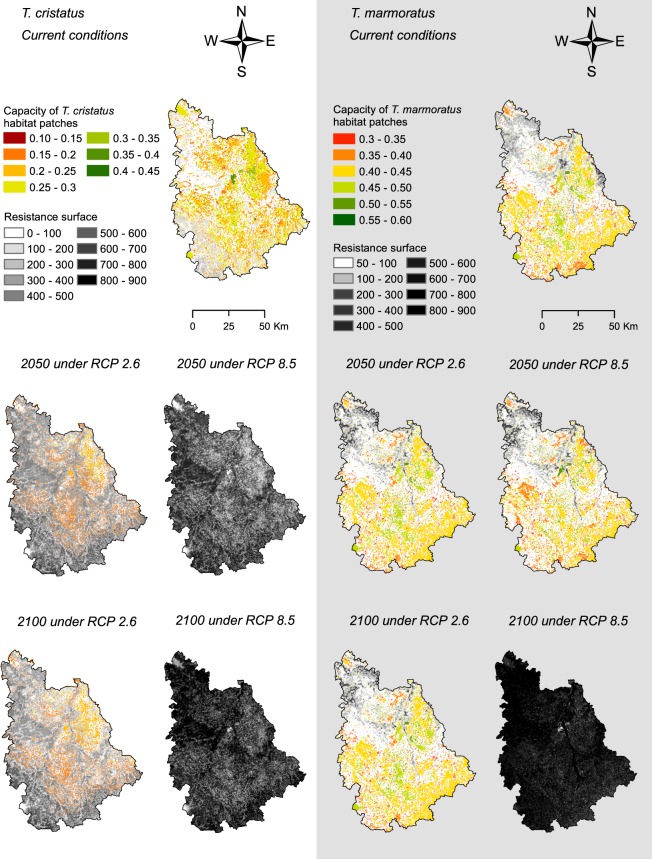
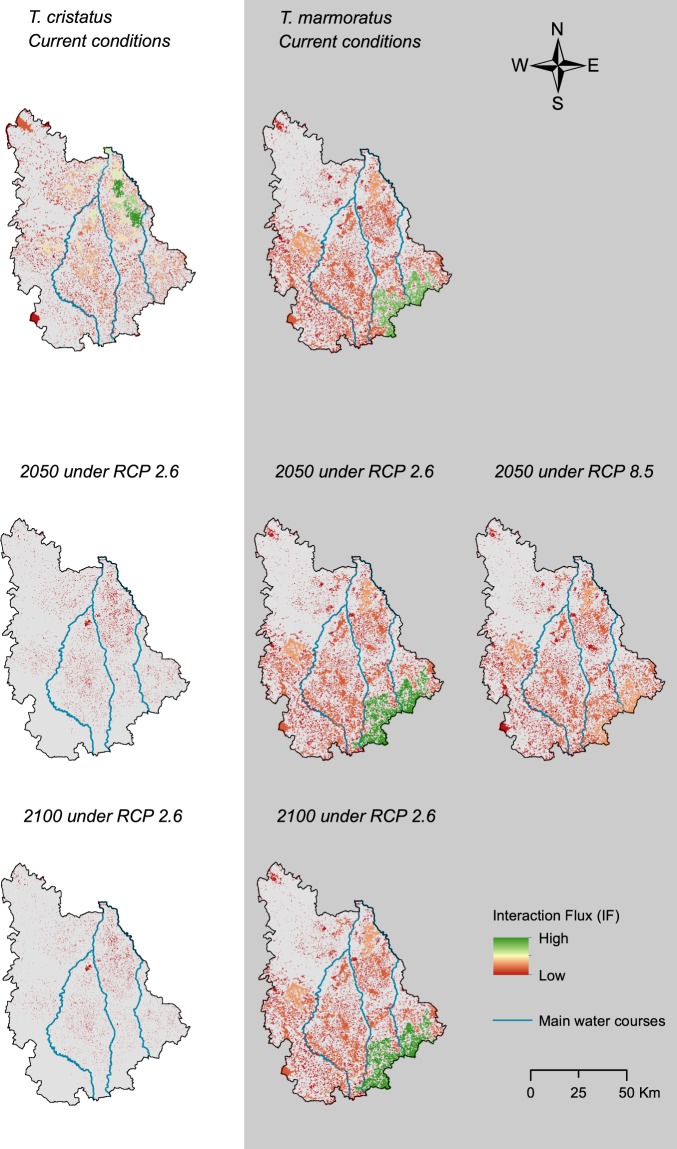
Triturus cristatus and Triturus marmoratus are two protected and declining newts occurring in the administrative department of Vienne, in France. They have limited dispersal abilities and rely on the connectivity between habitats and their suitability. In a warming climate, the locations of suitable habitats are expected to change, as is the connectivity. Here, we wondered how climate change might affect shifts in habitat suitability and connectivity of habitat patches, as connectivity is a key element enabling species to realize a potential range shift. We used ecological niche modelling (ENM), combining large-scale climate suitability with local scale, high-resolution habitat features, to identify suitable areas for the two species, under low and high warming scenarios (RCP 2.6 and RCP 8.5). We associated it with connectivity assessment through graph theory. The variable 'small ponds' contributed most to land cover-only ENMs for both species. Projections with climate change scenarios revealed a potential impact of warming on suitable habitat patches for newts, especially for T. cristatus. We observed a decrease in connectivity following a decrease in patch suitability. Our results highlight the important areas for newt habitat connectivity within the study area, and define those potentially threatened by climate warming. We provide information for prioritizing sites for acquisition, protection or restoration, and to advise landscape policies. Our framework is a useful and easily reproducible way to combine global climate requirements of the species with detailed information on species habitats and occurrence when available.
红瘰疣螈和中国瘰螈是分布于法国维埃纳省的两种受保护且数量减少的蝾螈。它们的扩散能力有限,依赖于栖息地之间的连通性及其适宜性。在气候变暖的情况下,适宜栖息地的位置预计会发生变化,连通性也是如此。在这里,我们想知道气候变化可能如何影响栖息地适宜性和栖息地斑块连通性的变化,因为连通性是使物种能够实现潜在分布范围转移的关键因素。我们使用生态位模型(ENM),将大尺度气候适宜性与小尺度、高分辨率的栖息地特征相结合,确定了在低和高变暖情景(RCP 2.6 和 RCP 8.5)下两种物种的适宜区域。我们通过图论将其与连通性评估相关联。变量“小池塘”对两种物种的仅基于土地覆盖的 ENM 贡献最大。气候变化情景的预测显示,变暖对蝾螈适宜栖息地斑块有潜在影响,尤其是对 T. cristatus。我们观察到随着斑块适宜性的降低,连通性也随之降低。我们的研究结果突出了研究区域内蝾螈栖息地连通性的重要区域,并确定了那些可能受到气候变暖威胁的区域。我们提供了有关在优先考虑收购、保护或恢复地点的信息,并为景观政策提供建议。我们的框架是一种有用且易于复制的方法,可将物种的全球气候要求与物种栖息地和出现的详细信息相结合,当有详细信息时可以使用。