Department of Thoracic Surgery, The Sixth Medical Center of Chinese PLA General Hospital, Beijing, China.
Thorac Cancer. 2020 Apr;11(4):1061-1067. doi: 10.1111/1759-7714.13366. Epub 2020 Feb 28.
Tumor recurrence or residual tumor after targeted therapy is common in patients with advanced non-small cell lung cancer (NSCLC). There is a lack of high-level evidence on which type of treatment should be employed for these patients and the role of salvage surgery has not been well reported in the literature.
A retrospective analysis of patients who underwent salvage surgery in our center between January 2016 and June 2019 for advanced NSCLC after targeted therapy was performed.
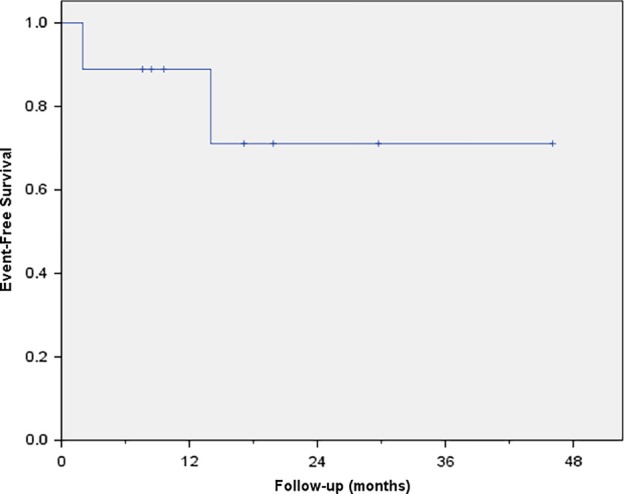
A total number of nine patients were identified, including five males and four females, with a median age of 56 years (range, 40-65 years), all diagnosed with lung adenocarcinoma stage IIIa-IVb. All patients had received targeted therapy according to individual positive mutation of driver gene(s). Salvage surgery was performed for tumor recurrence or residual tumor after a duration of 2-46 months of targeted therapy. A negative surgical margin was achieved in all cases. Postoperative complication rate was 11.1% (1/9). All patients were alive at the time of this analysis and two patients had disease progression. After a median follow-up of 17 months (range: 5-44 months), the median event-free survival and postoperative survival was 14 months (range: 2-44 months) and 17 months (range: 5-44 months) respectively.
Salvage surgery may be a feasible and promising therapeutic option for tumor recurrence or residual tumor in advanced NSCLC in selective patients after targeted therapy.
Salvage surgery is feasible in selected patients with advanced NSCLC and provides promising survival outcomes after targeted therapy failure. Salvage surgery provides precise molecular and pathological information which is most important for subsequent therapy.
晚期非小细胞肺癌(NSCLC)患者在接受靶向治疗后常出现肿瘤复发或残留肿瘤。对于这些患者,哪种治疗方法应该采用,缺乏高级别的证据,而且挽救性手术的作用在文献中也没有得到很好的报道。
对 2016 年 1 月至 2019 年 6 月期间在我中心因靶向治疗后晚期 NSCLC 而接受挽救性手术的患者进行回顾性分析。
共确定了 9 例患者,其中男性 5 例,女性 4 例,中位年龄 56 岁(范围,40-65 岁),均诊断为肺腺癌 IIIa-IVb 期。所有患者均根据驱动基因突变的个体阳性突变接受了靶向治疗。在靶向治疗 2-46 个月后,因肿瘤复发或残留肿瘤而进行了挽救性手术。所有病例均获得阴性手术切缘。术后并发症发生率为 11.1%(1/9)。在本分析时,所有患者均存活,有 2 例患者疾病进展。中位随访 17 个月(范围:5-44 个月)后,中位无事件生存和术后生存分别为 14 个月(范围:2-44 个月)和 17 个月(范围:5-44 个月)。
对于接受靶向治疗后选择性晚期 NSCLC 患者,肿瘤复发或残留肿瘤时,挽救性手术可能是一种可行且有前途的治疗选择。
挽救性手术在接受靶向治疗失败的晚期 NSCLC 患者中是可行的,可为患者提供有希望的生存结果。挽救性手术可提供精确的分子和病理信息,这对后续治疗非常重要。